

Every SMS you send travels through a chain of carriers before it lands on a phone screen. Somewhere in that chain, a routing engine makes a decision about which path your message takes. That decision is least cost routing, and it quietly decides whether your SMS wholesale margins survive the month or get eaten alive.
If you run traffic through an SMS wholesale platform, you already know the math is brutal. Wholesale SMS rates can sit at fractions of a cent per message, and at scale those fractions decide whether a deal is profitable. Get your routing wrong and you can lose money on the volume you were celebrating last quarter.
This guide breaks down how least cost routing actually works, where it helps, where it quietly damages delivery rates, and how operators, aggregators, and enterprises can use it without wrecking quality. You will also see where AI driven routing tools fit into a strategy that used to run on spreadsheets and gut instinct.
What Is Least Cost Routing in Telecom and SMS Wholesale?
Least cost routing, often shortened to LCR, is the process of automatically selecting the cheapest available path to deliver a message or call based on destination, carrier agreements, and current rate cards. In SMS wholesale, this usually means choosing between several SMPP gateway connections or direct operator links to reach the same mobile network.
I have watched aggregators set up routing tables with dozens of vendors for a single country, all competing to terminate traffic on the same three or four mobile networks. The routing engine inside the SMS wholesale platform checks the rate card for each vendor, picks the lowest cost option that still meets the minimum quality rule, and sends the message down that path.
A good example comes from the Nigeria to MTN corridor. Aggregators often have access to five or six different termination routes into MTN Nigeria, each priced differently depending on the underlying interconnect agreement. A pure cost based engine will rotate traffic toward whichever vendor drops their rate that week, sometimes shifting volume daily. This pattern shows up across most least cost routing for SMS aggregators in Africa, where corridor pricing moves fast and margins are thin.
Key takeaway: least cost routing is not a single tool, it is a continuous decision process running every time a message hits the gateway.
How Does Least Cost Routing Work in SMS Termination?
The mechanics are simpler than people expect. A routing engine pulls from a rate table that maps MCC and MNC codes to vendor pricing, applies any quality or volume rules you have set, then forwards the message to the cheapest qualifying route.
The Role of Route Tables and Rate Cards
Every SMS wholesale platform keeps a route table that lists available vendors per destination network, their current price per SMS, and often a quality score based on recent delivery performance. Wholesale SMS rates change constantly because interconnect deals get renegotiated all the time, sometimes several times in a single week during price wars between aggregators.
Real Time Route Switching
Modern systems do not just pick a route once and forget it. They re-evaluate constantly. If a vendor’s price drops, or their delivery rate falls below an agreed threshold, the engine reroutes new traffic without anyone touching a dashboard. This is the part that trips people up, because switching too aggressively on price alone can send traffic into a route that looks cheap but fails silently.
Key takeaway: route tables are only as good as how often they are updated and how strictly quality rules are enforced alongside price.
What Factors Determine the Cheapest Route in SMS Wholesale?
The cheapest route on paper depends on more than the listed rate. Several factors combine to decide what actually counts as least cost:
- Interconnect agreements and volume commitments between carriers
- Currency fluctuation, especially on corridors priced in USD but settled locally
- Whether the route is a licensed direct connect or a grey route riding on a local SIM
- Bulk discounts tied to monthly volume thresholds
- Regulatory fees, such as registration costs under frameworks like TRAI DLT in India or 10DLC in the US
In the UK and across Europe, interconnect agreements get scrutinized just as closely, since regulators expect operators to show clean traffic origin and proper SMS interconnect documentation. A route that looks like the cheapest option in a rate card can become the most expensive one once you account for failed deliveries, retries, and customer complaints. I have seen operators chase a 0.0003 dollar saving per message and lose far more in support tickets and resend costs within a week.
Key takeaway: the listed price per SMS is only the starting point, not the full cost of a route.
Does Least Cost Routing Lower SMS Delivery Success Rates?
Yes, it can, if cost is the only variable driving the decision. Routes that win purely on price are sometimes grey routes or SIM box setups that mobile network operators actively detect and block, which tanks delivery rates without warning.
A European mobile operator I worked alongside saw delivery rates for a high volume enterprise client drop by close to 18 percent over three weeks after switching to a cheaper vendor. The new route was running through what turned out to be a SIM box farm. The mobile network flagged the traffic pattern and started silently dropping messages instead of bouncing them back, which made the problem hard to spot until complaint volume spiked.
This is the central tension in least cost routing strategy for telecom operators. Price and quality pull in opposite directions more often than people want to admit, and ignoring that tension is how AIT fraud and SIM box fraud creep into otherwise legitimate traffic.
Key takeaway: a route is never truly least cost if it triggers carrier blocking, fraud filters, or repeated message failures.
Least Cost Routing vs Quality Routing Comparison
The route quality vs price tradeoff sits at the center of every SMS wholesale strategy, and most arguments in this industry come back to where you draw that line.
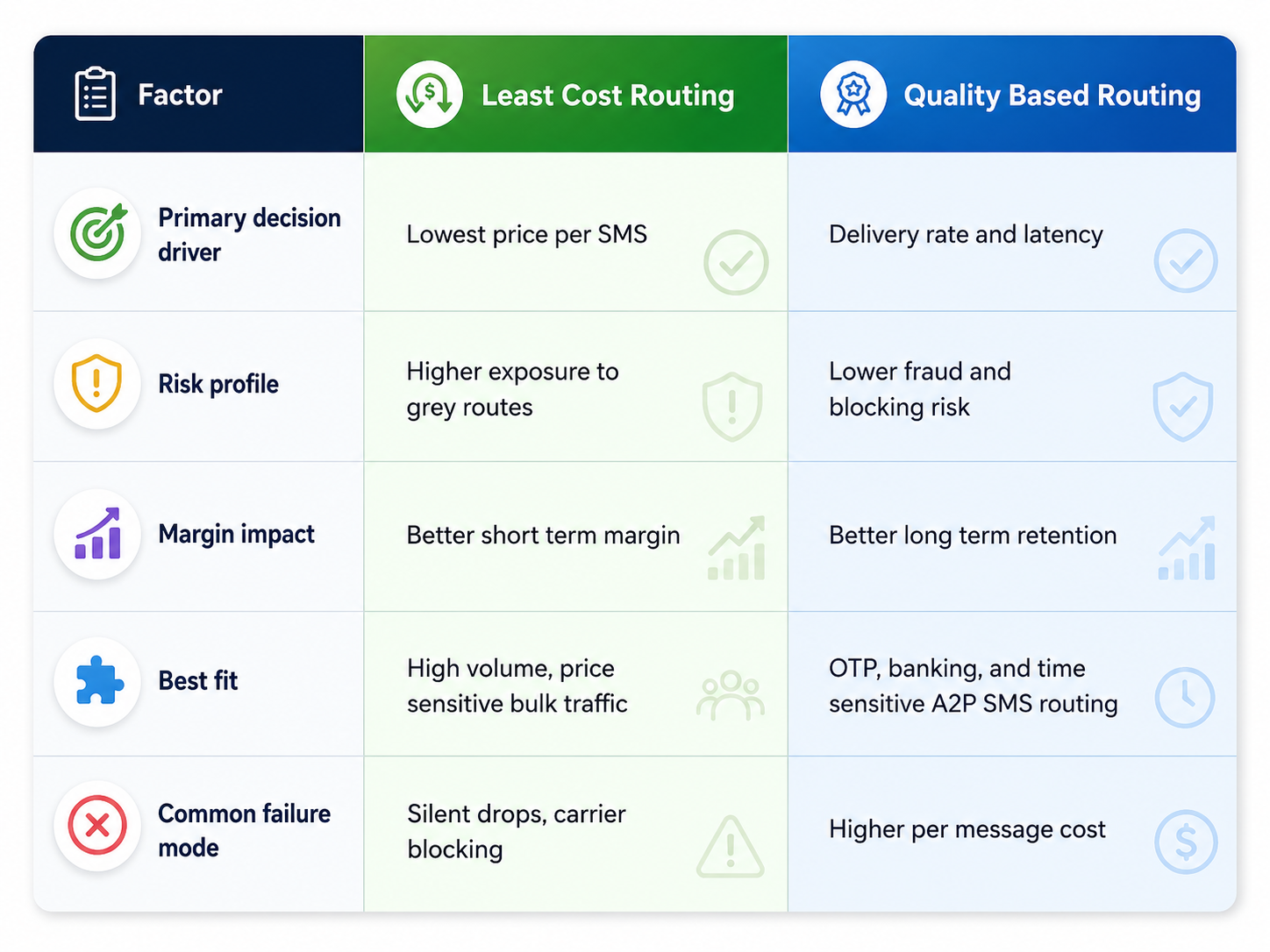
Most serious SMS wholesale platforms now blend both models rather than picking one extreme. A flat price only engine is rare among operators who have been burned at least once.
How Do Telecom Operators Balance Cost and Quality in Routing?
The practical answer is weighted routing. Instead of ranking routes purely by price, the engine scores each route using a formula that combines cost with recent delivery rate, latency, and DLR accuracy. A route only wins if it clears a minimum quality bar, regardless of how cheap it is.
Setting Quality Thresholds
Operators typically set a floor, for example a route must maintain a 95 percent delivery rate over a rolling 24 hour window to stay eligible. Drop below that and the route gets automatically deprioritized even if it is still the cheapest option on the table.
Using Test Numbers and Monitoring
Sending regular test messages to monitor numbers across major networks gives you an early warning system. If a route’s test message delivery starts slipping, you catch it before a client does. This is standard practice across most established SMS wholesale operations and it costs very little compared to the support fallout from undetected route failure.
Key takeaway: balance comes from rules, not guesswork. Decide your quality floor before price ever enters the decision.
What Tools Are Used to Manage Least Cost Routing Automatically?
Most of this runs through the routing engine built into your SMS wholesale platform or SMPP gateway. A solid least cost routing setup for global SMS interconnect typically includes automated rate card ingestion, DLR feedback loops that adjust route scores in near real time, and fraud detection layers that flag suspicious traffic patterns, like a sudden spike from a single MNO, before they damage your delivery rates.
Platforms aimed at serious carrier routing optimization also support manual override rules, so a network operations team can lock certain traffic, like OTP or banking alerts, to premium direct routes regardless of price, while letting promotional bulk SMS ride the cheapest qualifying path.
Key takeaway: automation handles the repetitive decisions, but the rules behind that automation still need a human who understands the corridor.
Is Least Cost Routing Still Relevant With AI Driven Routing Tools?
Yes, the core logic of least cost routing has not disappeared, it has been absorbed into more predictive systems. AI driven routing tools still rely on the same rate tables and quality thresholds, but they add forecasting, predicting which routes are likely to degrade before the failure actually shows up in your DLR reports.
This matters even as messaging shifts toward RCS, OTT bypass alternatives, and broader conversational messaging infrastructure, since cost and quality tradeoffs do not disappear just because the channel changes. Think of AI as a smarter front end. The fundamentals of least cost routing for SMS wholesale platforms, rate comparison, quality scoring, and automated switching, remain the backbone. AI mainly improves how early you catch a problem and how precisely you can predict route behavior across high volume corridors.
Key takeaway: AI improves prediction and speed, it does not remove the need for sound least cost routing fundamentals.
Common Least Cost Routing Mistakes to Avoid
Chasing price without a quality floor.
Switching routes purely because a vendor dropped their rate by a fraction of a cent, without checking recent delivery performance first.
Ignoring grey routes until a network blocks them.
Some routes work fine for weeks before an MNO detects the pattern and shuts it down overnight, leaving zero warning if you were not monitoring quality continuously.
Treating all traffic the same.
Routing OTP, banking alerts, and promotional bulk SMS through the same logic ignores the fact that time sensitive A2P SMS routing needs a different cost to quality balance than mass marketing blasts.
Updating rate cards manually or infrequently.
Stale rate tables mean your engine is making decisions on outdated pricing, which either costs you margin or routes traffic toward a vendor who quietly raised prices days ago.
Skipping test number monitoring.
Without regular test traffic to monitor numbers, you find out about route degradation from angry clients instead of your own dashboard.
Best Practices for Choosing a Least Cost Routing Provider
These apply whether you are a telecom operator managing your own gateway or an enterprise leaning on an aggregator for delivery:
- Set a non negotiable delivery rate floor before price ever factors into route selection
- Separate routing logic for transactional A2P SMS routing versus promotional bulk traffic
- Refresh rate cards and quality scores automatically rather than on a fixed manual schedule
- Run continuous test number monitoring across your top destination networks
- Use weighted scoring that blends cost, delivery rate, and latency instead of pure price ranking
- Review interconnect agreements regularly since carrier pricing in this industry shifts often
- Keep a fraud detection layer active to catch AIT and SIM box patterns before they scale
The Margin Is in the Routing Decision
Least cost routing is not optional if you operate at any real volume in SMS wholesale, the economics simply do not work without it. The mistake is treating it as a single switch you flip once. It is a continuous decision process that needs a quality floor, monitoring, and rules that protect your most sensitive traffic from chasing pennies.
Getting the balance right and least cost routing becomes one of the strongest margin protection tools you have. Get it wrong and you will spend more time on support tickets and client churn than you ever saved on rate cards.
If you are evaluating an SMS wholesale platform or rebuilding your routing logic from scratch, talk to the TeleOSS team about how our SMS gateway software handles weighted routing, fraud detection, and real time rate card management without forcing you to choose between margin and delivery rates.
FAQs
What is least cost routing?
Least cost routing is an automated process that selects the cheapest available carrier path to deliver an SMS or call, based on real time rate cards and destination network rules, while ideally still meeting minimum delivery quality standards.
Does least cost routing hurt delivery rates?
It can, particularly when price is the only factor considered. Routes that win purely on cost are more likely to be grey routes vulnerable to carrier blocking, which silently lowers delivery success without immediate warning.
What’s the difference between least cost and quality routing?
Least cost routing optimizes for price first, while quality based routing optimizes for delivery rate and latency first. Most mature SMS wholesale platforms blend both into a weighted scoring model.
Are AI routing tools replacing least cost routing?
No, AI tools build on top of least cost routing fundamentals, adding predictive scoring and earlier failure detection rather than replacing the underlying cost and quality logic.
What is least cost routing in telecom and SMS wholesale?
Least cost routing is an automated method for choosing the cheapest available carrier path to terminate an SMS or call, based on current rate cards and destination network rules. In SMS wholesale, it usually means picking between multiple SMPP gateway connections to the same mobile network and routing traffic through whichever option costs the least while still meeting basic delivery requirements.
How does least cost routing affect SMS delivery quality?
It can lower delivery quality when price is prioritized without a quality check. Cheaper routes are sometimes grey routes that mobile networks eventually detect and block, causing silent message failures. Combined with delivery rate monitoring and a quality floor, least cost routing can run without sacrificing reliability.
What’s the difference between least cost routing and quality based routing?
Least cost routing ranks options primarily by price, while quality based routing ranks them by delivery success rate and latency first. Most established SMS wholesale platforms use a hybrid model that weighs both factors together rather than relying on either approach alone.
Why do SMS aggregators use least cost routing?
Aggregators operate on thin per message margins, often fractions of a cent, so routing decisions directly affect profitability at scale. Least cost routing lets them automatically capture the cheapest qualifying rate across dozens of vendor connections instead of manually comparing rate cards for every destination network.
What are the risks of relying only on least cost routing?
Relying only on price exposes you to grey routes, SIM box fraud, and sudden carrier blocking, all of which damage delivery rates and client trust. It also increases exposure to AIT fraud, since some artificially inflated traffic schemes specifically target low cost, loosely monitored routes.