

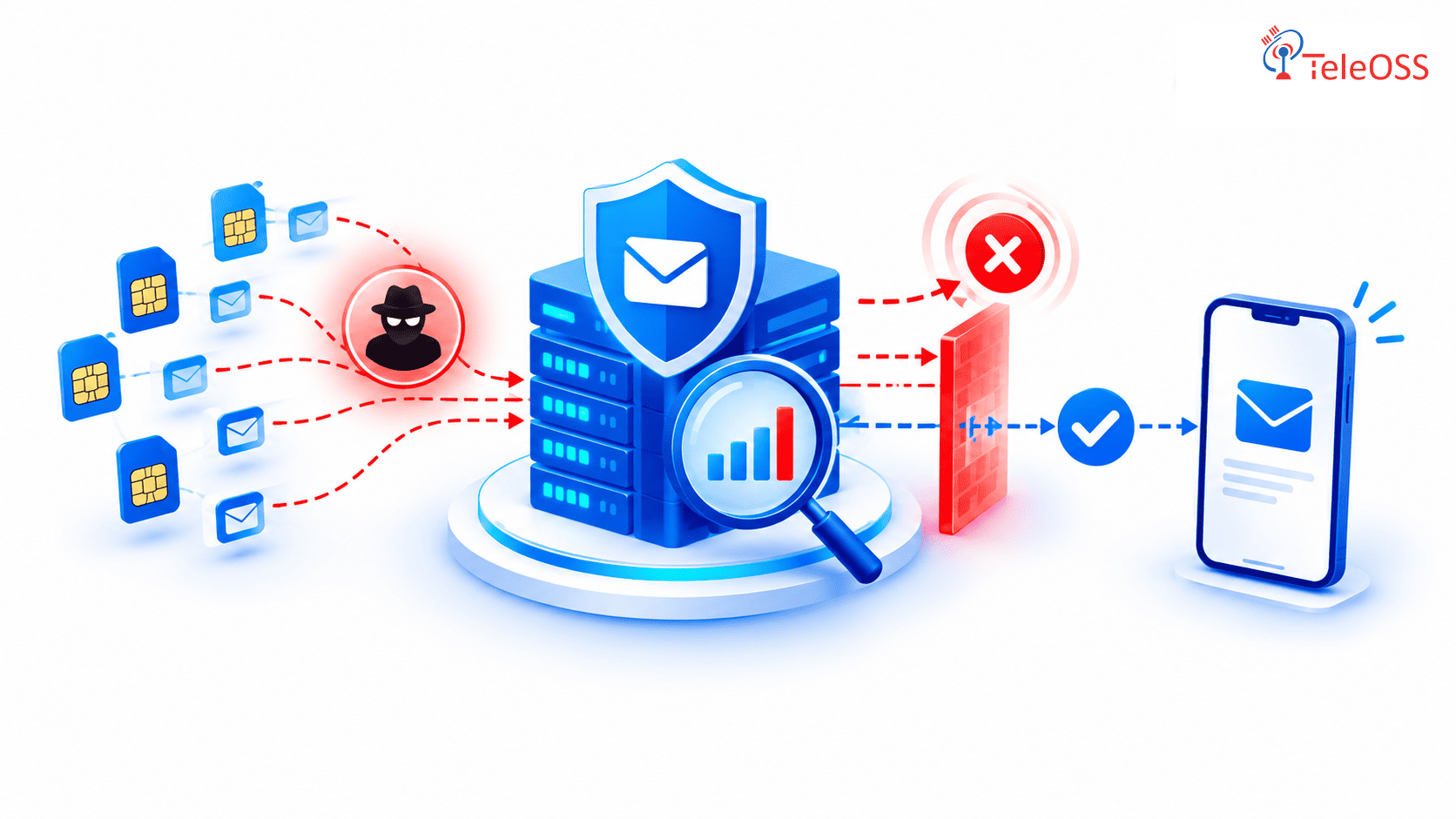
SMS pumping is the practice of generating fake text message traffic, usually through one time password (OTP) forms, so that someone in the delivery chain collects a share of the termination fee. The enterprise pays for messages no real customer asked for. The attack is quiet, fast, and often spotted only when the invoice arrives.
If you run an SMS network, an aggregator, or a messaging platform, you sit closer to the evidence than anyone else. This guide explains how the fraud works, which signals operators use to catch it, and which controls actually stop it.
Quick Answer
SMS pumping fraud happens when bots trigger large volumes of A2P SMS, typically OTPs, to numbers tied to a party that earns revenue from delivery. Operators detect it by watching destination spikes, low OTP conversion, and unusual number ranges. They block it with prefix and range rules, per destination caps, throttling, route changes, and settlement holds.
Key Takeaways
- SMS pumping is also called Artificially Inflated Traffic (AIT) or SMS toll fraud. The GSMA treats it as a revenue motivated abuse of the SMS chain.
- The strongest single signal is a gap between sent and verified messages for one destination. Delivery reports alone will not expose it.
- Detection needs baselines per customer, per MCC/MNC, and per sender ID. A global threshold misses most attacks.
- Blocking works in layers: pre-send checks, caps, throttles, route control, and commercial action against the termination partner.
- Every control has a false positive cost. Plan an unblock path before you switch anything on.
What Is SMS Pumping?
SMS pumping is a fraud in which attackers push artificial A2P SMS traffic through a victim’s messaging endpoint to earn money from the termination fees that traffic generates. It works because a message delivered to a number controlled by the fraudster, or by a complicit party downstream, pays someone along the route.
You will see several names for the same family of abuse: SMS pumping fraud, SMS toll fraud, AIT, and sometimes International Revenue Share Fraud (IRSF). The GSMA defines AIT as SMS traffic generated to earn revenue from its delivery, and notes that it is out of proportion to what legitimate use would produce. Industry bodies including the GSMA, i3forum, and MEF have struggled to agree on one universal definition, so expect vendors to use the terms loosely.
Here is the plain version. A bot types fake numbers into a signup form. The form sends an OTP to each one. The enterprise pays its normal per message rate. Someone downstream keeps part of the termination fee. Nobody ever reads the code.
How Does SMS Pumping Work?
An SMS pumping attack follows a repeatable cycle: find a form that sends an SMS, flood it with numbers the attacker can monetize, collect a revenue share on delivery, and move on before the victim reacts. The cycle repeats until someone blocks it.
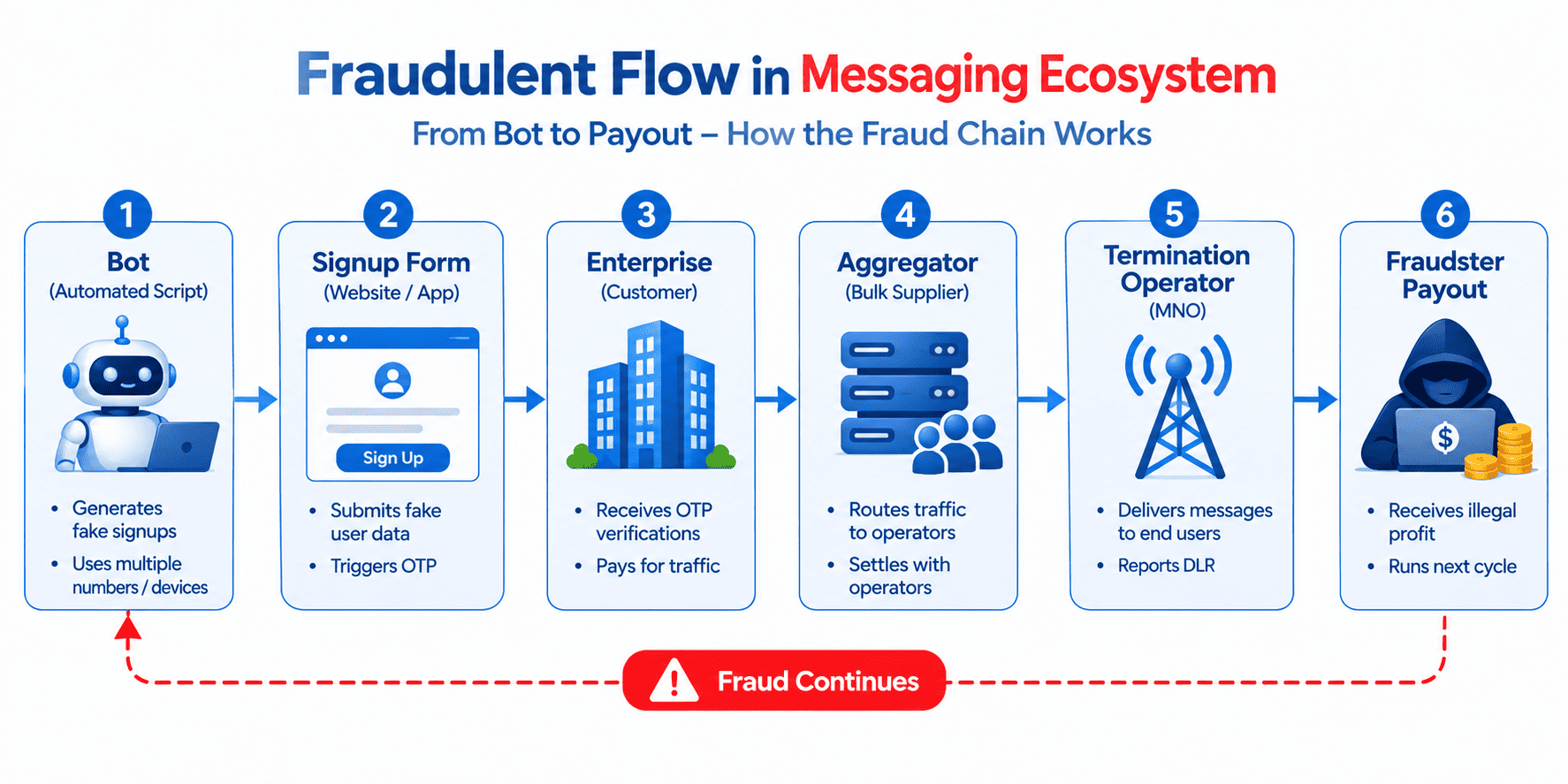
- Find the trigger: Attackers look for any public action that sends a text: sign up, password reset, app download link, two factor login.
- Get the numbers: They use number ranges from destinations where a revenue share is possible, often premium or low cost ranges with a partner who pays kickbacks.
- Automate the requests: Bots submit hundreds or thousands of requests, usually rotating IPs and devices to look like many users.
- Deliver and collect: The enterprise’s messaging provider routes each SMS onward. The party controlling the destination or the last leg earns termination revenue.
- Repeat and rotate: When one range is blocked, the attacker switches to another.
Who Profits in the Chain?
Profit depends on who controls the final delivery leg. It can be a rogue or complicit operator, a reseller that kicks back part of the termination fee, or an aggregator injecting traffic in transit. Enea describes several AIT types, including counterfeit fabrication, where traffic is injected by an aggregator rather than created on the brand’s website.
That last point matters if you run a sms wholesale platform. Not every pumping attack starts at the enterprise’s login form. Some start inside the chain.
Why Does SMS Pumping Matter to Operators?
Operators and aggregators lose revenue quality, partner trust, and sometimes money. When enterprises find fake traffic in their invoices, they dispute charges, demand credits, or move OTPs to other channels.
Some numbers help size the problem, with caveats. Mobilesquared estimated AIT would cost brands about US$2.4 billion between 2022 and 2024, and projected a loss of US$14.4 billion in A2P SMS revenue by 2027. Enea cites around 5% of international A2P traffic as believed by AIT. Both are industry estimates, not audited figures, so treat them as direction rather than precision.
Elon Musk said in 2022 that Twitter was losing roughly US$60 million a year to SMS pumping through its two factor flow. That figure is his statement, not an audited number, but it shows how large a single enterprise exposure can become.
For carriers, the second order cost is reputation. Brands that feel burned stop trusting SMS as a verification channel, which shrinks the A2P pool everyone shares.
How Do Operators Detect SMS Pumping?
Operators detect SMS pumping by comparing live traffic to a baseline and looking for destinations, ranges, or customers that behave unlike real users. The most reliable evidence is behavioral, not content based, because pumped OTP messages look identical to genuine ones.
The Six Signals Worth Monitoring
- Destination spikes: Sudden volume to a country or MCC/MNC where the customer has little or no user base. Compare against that customer’s own history, not a platform average.
- Conversion gap: OTPs sent versus OTPs verified. A healthy flow converts well. A pumped destination shows heavy sends and near zero completions. This is the signal that delivery reports cannot fake for the fraudster, because the bot never enters a code.
- Narrow or sequential ranges: Many requests landing in a tight block of numbers inside one operator’s allocation.
- Unusual delivery report behavior: Very high delivered rates on routes that normally show mixed results, or oddly uniform latency across thousands of messages.
- Account behavior shifts: A customer who normally sends a few hundred OTPs an hour suddenly sends tens of thousands, or a new account ramps traffic on day one.
- Partner level anomalies: One termination partner receiving a disproportionate share of a customer’s traffic, with weak conversion compared to other partners on the same prefix.
Number Intelligence Helps, but Does Not Settle It
A Home Location Register (HLR) lookup checks whether a number is live, its network, and sometimes its status. It can flag disposable or inactive numbers before a send. It cannot prove intent. A fraudster can activate real SIMs, so use lookups as one input in a score, not as a verdict.
A Hypothetical Example
Consider an illustrative scenario, not a real customer case. A food delivery app sends about 400 OTPs an hour, almost all to its home market, with roughly 70% verified. Overnight, a new destination appears and sends 6,000 OTPs in two hours. Delivery reports show 95% delivered. Verification from that destination is under 1%. The destination was never in the customer’s history, the numbers fall in two adjacent blocks, and one termination partner carries nearly all of it.
Any one of those facts could have an innocent explanation. All four together justify an immediate hold.
How Do Operators Block SMS Pumping?
Operators block SMS pumping by stacking controls at different points: before a message is accepted, while it is queued, and at the route and commercial level. No single control is enough, because attackers adapt to whichever one is visible.
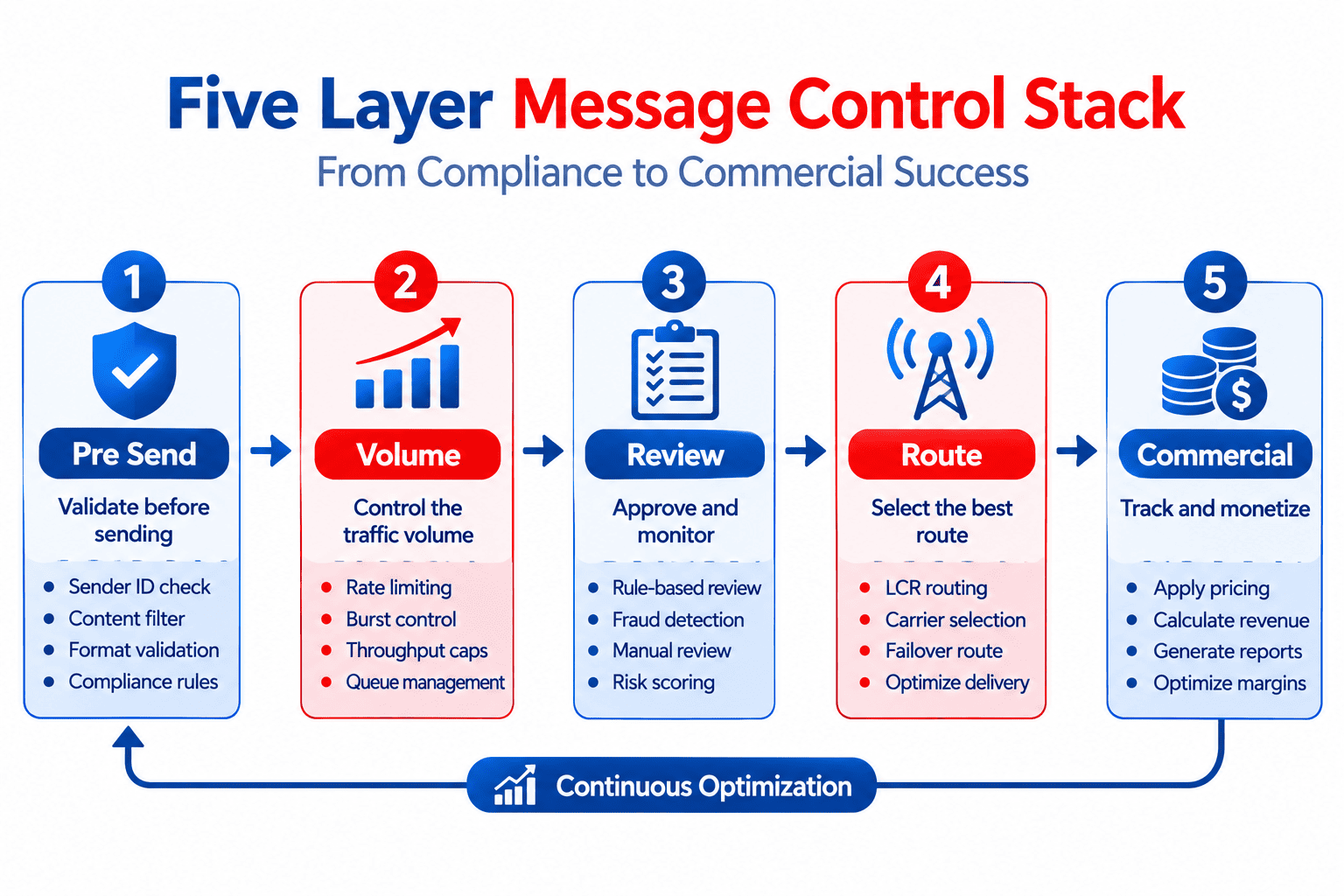
Layer 1: Pre Send Controls
Apply rules before the message reaches the network.
- Block or hold destinations a customer has never used, until reviewed.
- Maintain prefix and range lists tied to confirmed abuse, and update them from your own incident data.
- Validate numbers with lookups to catch invalid or disposable ones.
Layer 2: Volume Controls
- Set per customer, per destination caps on messages per hour and per day.
- Apply throttling so a spike slows to a trickle instead of draining a budget in minutes.
- Use messages per second limits on each SMPP bind so one account cannot flood a route.
Layer 3: Review and Hold
- Send flagged traffic to a hold queue where an analyst can release or reject it.
- Alert the customer with specifics: destination, volume, conversion rate, time window. Specifics get faster responses than a generic warning.
Layer 4: Route Control
- Remove suspect termination partners from the route for the affected prefixes.
- Shift traffic to routes with verified conversion history.
- Keep route level logs so you can show which leg produced the abnormal results.
Layer 5: Commercial Action
- Withhold or dispute settlement with a termination partner whose traffic fails conversion analysis.
- Put clauses in interconnect and reseller agreements that allow traffic holds and chargebacks for confirmed AIT.
- Share confirmed patterns with industry groups such as the GSMA Fraud and Security Group where your agreements allow it.
An aggregator’s response time matters. Fast action limits loss and keeps the enterprise relationship intact.
Where an SMS Router Fits
An SMS router is the traffic control point between your customer connections and your upstream routes. Because it sees every message, destination, and delivery report, it is where destination rules, caps, throttles, and route switches can be applied per customer and per prefix.
Operators that need that kind of route level control may evaluate SMS Router software for features such as rule based routing, traffic limits, and delivery reporting. A router does not replace a fraud analyst or an enterprise side defense like bot detection, but it gives them a place to enforce decisions.
Limits and Trade Offs
Every defense has a cost, and pretending otherwise leads to bad deployments.
- False positives: A product launch in a new country looks identical to pumping for the first hour. Strict destination blocks can stop real revenue. Build a fast unblock path and an owner for it.
- Mixed traffic: Ericsson notes that AIT is harder for operators to pinpoint when fraud is blended with legitimate traffic. Blocking a whole prefix may hurt genuine users on it.
- Attacker rotation: Range blocks age quickly. Expect fraudsters to move to adjacent blocks.
- Visibility limits: Operators see the SMS side. They usually cannot see the bot behavior on the enterprise’s website. Real prevention needs enterprise controls such as rate limits, CAPTCHA, and retry delays on the form.
- Commercial friction: Withholding settlement protects margin but can strain partner relationships. Document your evidence before you act.
Common Mistakes to Avoid
- Watching delivery rate only: Pumped traffic often delivers perfectly. Track conversion.
- Using one global threshold: A number that is a spike for one customer is normal for another. Baseline per customer and destination.
- Blocking without notifying: Customers retry, escalate, or churn when messages vanish. Explain what you blocked and why.
- Ignoring your own chain: Review inbound traffic and downstream partners, not just the enterprise form.
- Reviewing monthly: An attack can drain a budget in hours. Alerts should fire in minutes.
- No post incident learning: Feed every confirmed attack back into your range lists and scoring rules.
Conclusion
SMS pumping works because every fake OTP looks like a real one until you compare it with what a real user does. Operators and aggregators that baseline traffic per customer and destination, watch conversion instead of delivery alone, and act at the route and commercial level can shut attacks down in hours instead of billing cycles.
Start with three steps: add destination caps for each customer, alert on conversion gaps, and write a hold and unblock procedure your team can run at 2 a.m. Then tighten route control from there.
If you want to see how route level rules, caps, and traffic visibility work in a real routing layer, explore the TeleOSS SMS Router or talk to the team about how it could fit your network. You will get a clear view of where fraud controls sit in your messaging path and what your current setup is missing.
FAQs
What is SMS pumping fraud in simple terms?
SMS pumping fraud is when bots trigger a business’s SMS messages to numbers a fraudster profits from. The business pays the per message cost, the fraudster or a complicit party earns part of the termination fee, and no genuine customer receives or uses the message.
What is the difference between SMS pumping and SMS toll fraud?
They describe the same fraud. SMS toll fraud emphasizes the termination fee being exploited, while SMS pumping emphasizes artificially pushing traffic through the system. AIT is the broader industry term used by the GSMA and others.
How can I tell if I am being pumped?
Look for sudden volume to unfamiliar countries, many OTPs sent with almost none verified, requests landing in narrow number ranges, and a bill that jumps without matching user growth. Low conversion on a specific destination is the clearest sign.
Can an operator stop SMS pumping on its own?
Partly. Operators can cap, throttle, and reroute traffic, and act against bad termination partners. They cannot see bot behavior on a customer’s website, so enterprises still need form level defenses such as rate limits and bot detection.
Do HLR lookups prevent SMS pumping?
They help but do not prevent it alone. A lookup can flag invalid or inactive numbers before a send. Attackers can use live SIMs, so lookups work best as one signal alongside conversion, volume, and range analysis.
Does blocking a country stop pumping?
It stops pumping to that country and can hurt legitimate users there. A better first step is a per customer allow list of destinations with a review process for new ones, so real expansion is not blocked for long.