
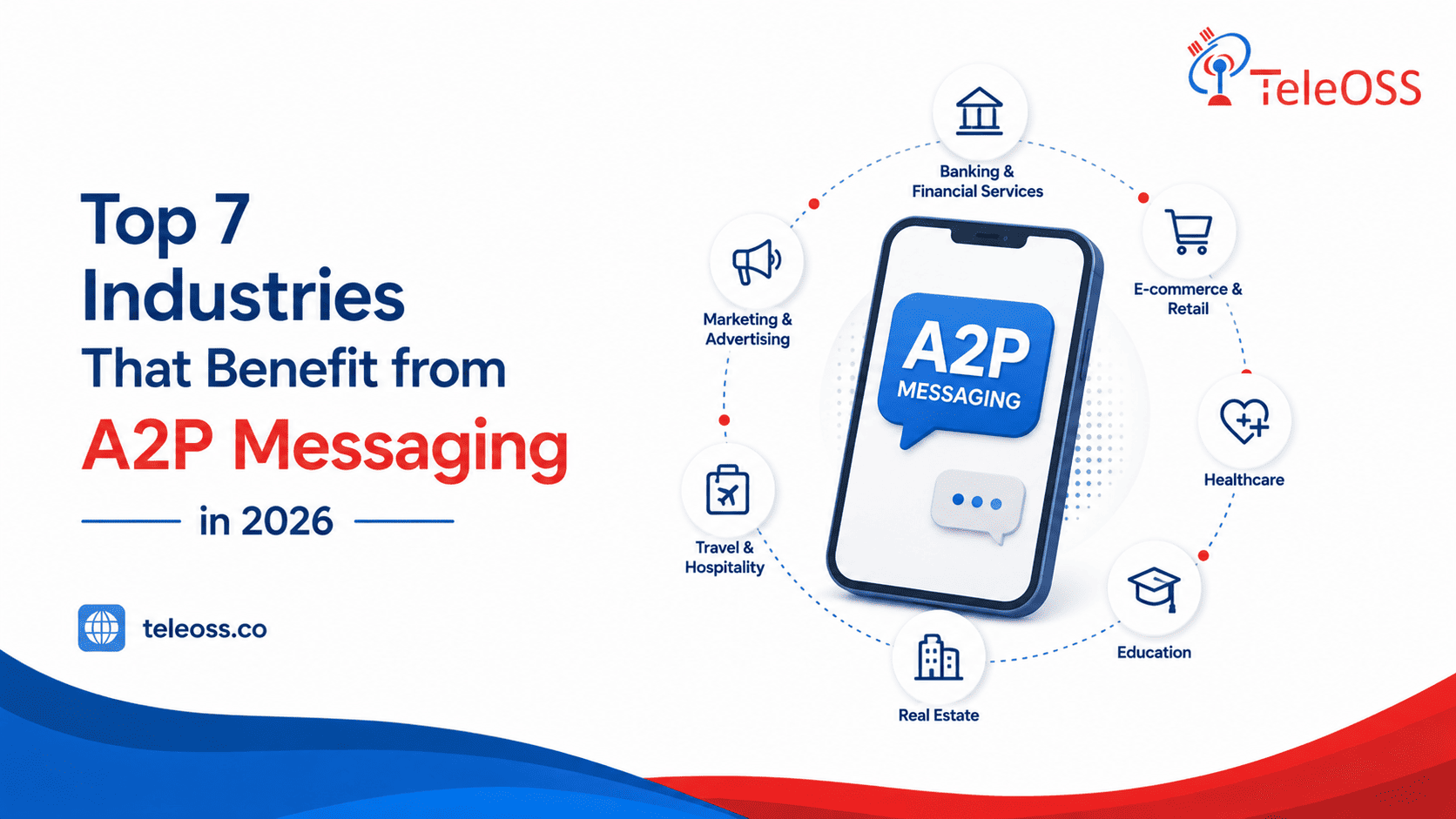
If you have ever gotten a bank OTP within two seconds of requesting it, or a text saying your food delivery driver is three minutes away, you have already experienced A2P messaging. A2P stands for application to person, and it is the technology that lets a business system, not a human, send an SMS or app message directly to a customer’s phone.
By 2026, A2P messaging is no longer a nice extra for customer communication. It is the core infrastructure. Banks use it to stop fraud in real time. Hospitals use it to cut missed appointments. Logistics companies use it to keep drivers, warehouses, and customers on the same page. And with SMS open rates still sitting well above email, this channel keeps earning its place in the budget.
This article breaks down the seven industries where A2P messaging delivers the most measurable value in 2026, with real examples of how each sector puts it to work. Whether you run a telecom network, manage an SMS aggregator business, or handle enterprise communications, you will walk away with a clear picture of where the demand is coming from and what buyers actually care about right now.
What Is A2P Messaging and Why Does It Matter in 2026?
A2P messaging is any message sent from an application or business system to an individual’s mobile device, as opposed to person to person (P2P) messaging between two people. It runs through SMS gateway software, messaging platforms, and increasingly RCS and WhatsApp Business APIs, but SMS remains the backbone because it works on every phone without an app or internet connection.
The reason it matters more in 2026 than it did five years ago comes down to three shifts. First, regulators in the US, UK, and EU have tightened sender ID and registration rules, which pushed low quality senders out and raised trust in the channel. Second, mobile money and digital banking adoption across Africa has made SMS the default rail for financial alerts. Third, AI driven personalization now lets businesses trigger messages based on real customer behavior instead of blasting the same text to everyone.
Key takeaway: A2P messaging works because it reaches people where they already are, without asking them to open another app or check another inbox.
1. Banking and Financial Services
Financial institutions were early adopters of A2P messaging and remain some of the heaviest users. Banks, digital lenders, and fintech apps rely on SMS for:
- Transaction and balance alerts
- One time passwords for login and payment authentication
- Fraud detection notifications
- Loan and EMI due date reminders
- Mobile money confirmations, especially across African markets
A regional bank in Kenya that shifted its OTP delivery to a dedicated financial grade SMS route saw failed authentication attempts drop noticeably during peak mobile money hours, simply because messages stopped competing with promotional traffic on the same channel. This is a pattern telecom operators see repeatedly: when banks separate transactional SMS from marketing SMS on different routes, delivery speed and reliability both improve.
With fraud attempts rising every year, secure and fast A2P delivery is not optional anymore. Regulatory frameworks like PSD2 in Europe and RBI guidelines in India already require strong customer authentication, and SMS OTP remains one of the simplest ways to meet that bar without forcing users into a new app.
Practical example: A digital lender running loan repayment reminders through A2P SMS typically sees repayment rates improve because the reminder arrives on the exact day it is needed, not buried in an email inbox.
2. E-Commerce and Retail
Online retailers depend on A2P messaging to close the gap between browsing and buying. Common use cases include:
- Order and shipping confirmations
- Abandoned cart recovery messages
- Personalized discount codes
- Delivery status updates
- Post-purchase satisfaction surveys
A mid-size fashion retailer testing SMS cart recovery against email-only recovery found that the SMS variant recovered a meaningfully higher share of abandoned carts, largely because the message landed within minutes instead of hours. This lines up with what industry data consistently shows: SMS open rates average around 98%, compared to much lower averages for marketing email.
Retailers targeting the US and UK also need to watch consent and opt-out compliance closely, since both markets enforce strict rules under TCPA and PECR respectively. Getting this wrong does not just risk fines, it damages the sender reputation that carriers use to filter A2P traffic.
Key takeaway: Timing beats volume. A well-timed cart reminder outperforms a generic promotional blast every time.
3. Healthcare
In healthcare, a missed message can mean a missed appointment or a missed dose. Hospitals, clinics, and diagnostic labs use A2P messaging for:
- Appointment confirmations and reminders
- Lab result notifications
- Medication schedule alerts
- Health campaign and vaccination reminders
A diagnostic chain in the UK that introduced automated SMS appointment reminders reported a measurable drop in no-show rates within the first quarter, freeing up slots that would otherwise sit empty. This mirrors what the NHS and similar public health systems have published about SMS reminders reducing missed appointments across outpatient services.
As telehealth consultations become routine rather than exceptional, A2P messaging now also handles pre-consult instructions and post-visit follow-ups, which keeps patients engaged between visits without adding staff workload.
Practical example: A clinic sending a reminder 24 hours and again 2 hours before an appointment, rather than a single reminder, consistently sees better attendance than a single-touch approach.
4. Travel and Hospitality
Travel is inherently unpredictable, which is exactly why A2P messaging fits so well here. Airlines, railways, and hotel chains use it for:
- Flight or train status updates
- Booking and check-in confirmations
- Gate changes and delay alerts
- Real-time itinerary changes
- Targeted travel deals based on past bookings
During a major winter storm that grounded flights across several European hubs, airlines that pushed proactive SMS rebooking options saw far fewer calls to their support centers than those relying only on app notifications, since not every stranded traveler has data access or the airline app installed at that moment.
For hospitality brands, the value goes beyond logistics. A hotel that texts a room upgrade offer or a late checkout option based on loyalty status creates a moment of good service that a generic email rarely matches.
Key takeaway: In travel, SMS works as a fallback channel that reaches people even when apps and Wi-Fi fail them.
5. Education
Schools, universities, and online learning platforms increasingly treat A2P messaging as a core part of their operations, not an afterthought. Typical use cases include:
- Enrollment and admission updates
- Exam schedules and result announcements
- Class or session reminders
- Emergency and campus safety alerts
A university in South Africa that moved exam schedule changes from email-only to combined SMS and email communication reported far fewer students showing up to the wrong exam slot, since students check text messages faster than institutional email during busy weeks.
As blended and hybrid learning models continue into 2026, real-time messaging keeps students, parents, and administrative staff aligned, particularly for emergency notifications where speed matters more than formatting.
Practical example: A K-12 district using SMS for weather-related closure alerts reaches parents faster than a phone tree or a website update, which matters when decisions need to happen before the morning school run.
6. Logistics and Supply Chain
Logistics runs on precise timing, and A2P messaging keeps every link in the chain informed. Common applications include:
- Pickup and delivery confirmations
- Real-time shipment tracking updates
- Driver and warehouse staff alerts
- Proactive delay notifications
A last-mile delivery company operating across several US metro areas found that customers who received a live SMS tracking link filed far fewer support tickets asking “where is my order” compared to customers who only got an email confirmation at checkout. That single change reduced call center volume enough to reassign staff to other tasks.
Transparency built through consistent, accurate updates strengthens customer trust in an industry where delays are common but silence is what actually frustrates people.
Key takeaway: Customers tolerate delays better when they are informed proactively rather than left to guess.
7. Government and Public Services
Government agencies use A2P messaging as one of the most trusted mass communication channels available, because it does not depend on app downloads or social media accounts. Applications include:
- Public health and vaccination campaign alerts
- Utility bill and payment reminders
- E-governance service updates
- Emergency and disaster alerts
During flood warnings in parts of the UK, local councils that used SMS alerts alongside traditional broadcast warnings reached elderly residents and those without smartphones far more reliably than digital-only channels. This is consistent with why agencies like FEMA in the US and similar bodies across Europe maintain SMS-based emergency alert systems as a baseline, not a backup.
Africa presents an especially strong case for this model, where SMS penetration far exceeds smartphone and broadband penetration in many regions, making it the most inclusive channel governments have for reaching citizens.
Practical example: A city utility board that switched from paper bill reminders to SMS payment reminders saw on-time payments improve, since the reminder arrives at the moment a resident is most likely to act on it.
A2P Messaging Use Cases by Industry: Quick Comparison
| Industry | Primary Use Case | Why It Works |
| Banking & Finance | OTPs, fraud alerts | Speed and security |
| E-Commerce & Retail | Cart recovery, order updates | High open rates, timing |
| Healthcare | Appointment reminders | Reduces no-shows |
| Travel & Hospitality | Delay and rebooking alerts | Works without apps or Wi-Fi |
| Education | Emergency and schedule alerts | Fast reach to parents and students |
| Logistics | Delivery tracking | Cuts support ticket volume |
| Government | Emergency and utility alerts | Reaches non-smartphone users |
Quick Answer Summary
What is A2P messaging?
A2P messaging, short for application to person messaging, is any text sent from a business system or software application directly to a customer’s mobile device. It covers OTPs, alerts, reminders, and marketing messages sent through SMS gateways or messaging APIs, rather than between two individuals.
Which industries use A2P messaging the most in 2026?
Banking, e-commerce, healthcare, travel, education, logistics, and government services are the heaviest users of A2P messaging in 2026. Each relies on it for time-sensitive alerts, from OTPs and appointment reminders to delivery tracking and emergency notifications, because SMS reaches users instantly without requiring app access.
Why is A2P messaging still relevant with app notifications available?
A2P messaging works on any mobile phone without needing an app, data connection, or account login, which makes it more reliable for urgent alerts. App notifications require the app installed, permissions granted, and an internet connection, three points of failure that SMS avoids entirely.
Common Mistakes Businesses Make with A2P Messaging
- Mixing transactional and promotional traffic on the same route: This slows down urgent messages like OTPs and increases the chance of delivery delays during high traffic periods. Keep transactional and marketing SMS on separate routes or sender IDs.
- Ignoring local regulations: Sending unregistered A2P traffic in the US without proper 10DLC registration, or ignoring GDPR consent rules in the EU, leads to blocked messages and potential fines. Compliance requirements differ by country and must be checked before launch.
- Sending messages without clear opt-out instructions: Regulators in the US, UK, and EU require a simple way to stop receiving messages. Missing this increases complaints and can get a sender ID blacklisted by carriers.
- Overloading customers with frequency: Too many messages, even useful ones, leads to opt-outs and spam complaints. Set frequency caps based on message type and monitor unsubscribe rates closely.
- Choosing a low-cost route without checking delivery quality: Some providers route messages through grey channels to cut costs, which causes inconsistent delivery, especially on international corridors. Always verify route quality with a reputable SMS gateway partner.
Best Practices for A2P Messaging Success
- Register sender IDs and comply with local telecom regulations before launching any campaign
- Separate transactional messages from promotional messages using different routes
- Personalize messages using real customer data, not generic templates
- Test message timing based on when your audience is most likely to act
- Monitor delivery rates and carrier feedback continuously, not just at launch
- Use a reliable SMS gateway with strong uptime and clear reporting
- Keep messages short, clear, and free of unnecessary jargon
- Always include a working opt-out option in marketing messages
Conclusion
A2P messaging has moved from a marketing add-on to essential infrastructure for banking, retail, healthcare, travel, education, logistics, and government services in 2026. The industries covered here share one thing in common: they all depend on messages arriving fast, reliably, and at the right moment, whether that message is an OTP, a delivery update, or an emergency alert.
For telecom operators and SMS aggregators, this growing demand across sectors represents a real opportunity, provided the underlying infrastructure can handle volume, compliance, and route quality without compromise. If you are evaluating your current SMS gateway setup or looking to scale wholesale messaging capacity for 2026 and beyond, TeleOSS builds the infrastructure that telecom operators and aggregators rely on to deliver A2P messaging at scale. Get in touch with the TeleOSS team to see how your platform can handle what’s coming next.
Need More Help?
Explore the TeleOSS Support Center for product documentation, setup guides, troubleshooting articles, FAQs, and expert support.
FAQs
Is A2P messaging the same as bulk SMS?
Not exactly. Bulk SMS refers to sending the same message to many recipients at once, usually for marketing. A2P messaging is broader and includes bulk SMS along with individually triggered messages like OTPs, alerts, and reminders sent based on specific customer actions or system events. A2P is the category, bulk SMS is one type of campaign within it.
How does A2P messaging differ from P2P messaging?
P2P, or person to person messaging, happens between two individuals using their own phones, like a text between friends. A2P messaging originates from a business application or system and is sent to a person’s device. A2P traffic runs through dedicated gateways and carrier agreements, while P2P uses standard consumer mobile plans, which is why the two are priced and regulated differently.
Why do businesses in the US need A2P 10DLC registration?
US carriers require businesses sending applications to person traffic over standard 10-digit long codes to register through The Campaign Registry. This registration confirms the sender’s identity and use case, which reduces spam and improves delivery rates. Unregistered traffic is often throttled or blocked entirely, making registration a practical requirement rather than an optional step.
What industries send the most A2P messages globally?
Banking and financial services typically generate the highest volume of A2P traffic worldwide, driven largely by OTPs and fraud alerts. E-commerce and logistics follow closely, especially during peak shopping seasons. Government and healthcare messaging volumes have grown steadily as more public services digitize citizen communication.
Can A2P messaging work alongside WhatsApp or RCS?
Yes, most enterprises now run SMS alongside WhatsApp Business API and RCS as part of an omnichannel strategy. SMS remains the fallback channel because it does not require the recipient to have a specific app installed, while WhatsApp and RCS offer richer media for customers who do have those apps available. A good SMS gateway platform lets businesses manage all three channels from one system.
How do businesses choose a reliable A2P messaging provider?
Look for providers with direct carrier connections rather than only relying on grey routes, transparent delivery reporting, and support for regulatory requirements in your target markets. Uptime, latency, and route quality matter more than the lowest advertised price, since a cheap route that fails during peak hours costs more in lost transactions than it saves.