
If you run enterprise messaging, operate as an SMS aggregator, or manage A2P traffic for clients, SMS gateway software is the infrastructure holding everything together. Without it, you are essentially routing millions of messages through a system that has no intelligence, no failover, and no visibility.
This blog breaks down what SMS gateway software actually is, what it does at a technical and operational level, and what separates basic setups from carrier-grade platforms built for real scale.
What Is SMS Gateway Software?
SMS gateway software is a platform that sits between message senders (enterprises, applications, aggregators) and mobile networks. It translates, routes, monitors, and delivers SMS traffic across multiple operator connections in real time.
Think of it as the engine behind every OTP you receive from your bank, every transactional alert from an e-commerce app, and every bulk notification from a service provider. The software manages the entire message journey: from intake to delivery confirmation.
At its core, SMS gateway software handles protocol translation (typically SMPP and HTTP), routing logic, delivery report processing, and connection management. A carrier like Vodafone or a regional operator does not speak the same language as your web application. The gateway bridges that gap.
Example: HDFC Bank sends millions of OTP and transactional SMS every day. Behind that scale sits a carrier-grade gateway managing routing priorities, failover paths, and delivery confirmations without manual intervention.
How SMS Gateway Software Works
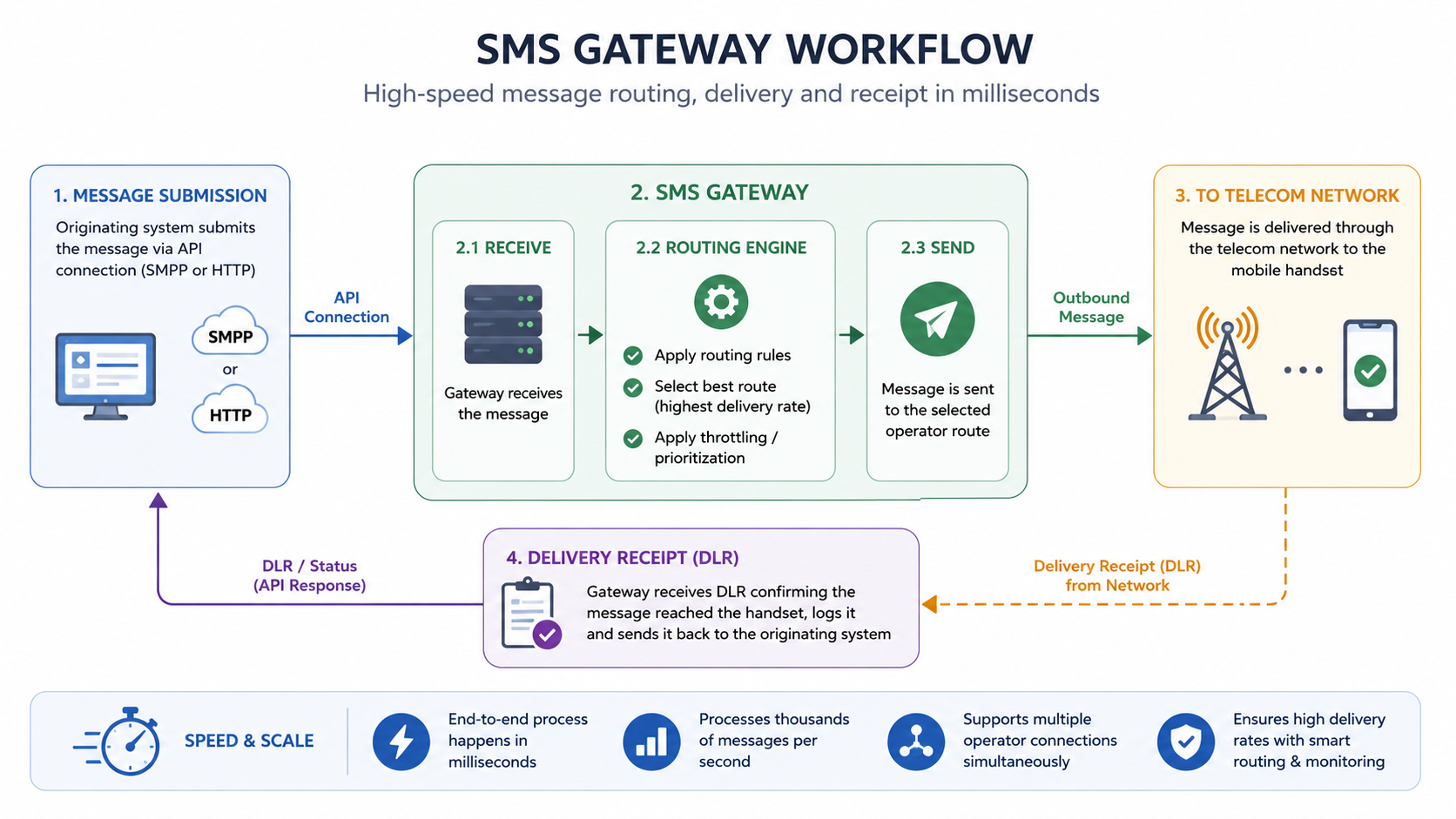
Understanding the workflow helps you see why the software layer matters so much.
When a message is submitted, the gateway receives it through an API connection, typically over SMPP or HTTP. It then applies routing rules: which operator connection to use, which route has the best delivery rate, and whether to apply throttling or prioritization.
Once routed, the message goes out to the telecom network. The gateway then waits for a Delivery Receipt (DLR) confirming the message reached the handset. That DLR gets logged and sent back to the originating system.
This entire process happens in milliseconds. At high volume, the gateway is processing thousands of messages per second across multiple simultaneous connections.
Read more: SMPP vs HTTP API: Which Protocol Actually Fits Your SMS Gateway?
Core Features That Define Enterprise-Grade SMS Gateway Software
Not all SMS gateway software is built the same. The difference between a basic relay and an enterprise platform comes down to the feature set under the hood.
Multi-Protocol Support: SMPP and HTTP
Carrier integrations use SMPP. Business applications use HTTP APIs. A proper enterprise SMS gateway supports both natively, without requiring you to build separate pipelines.
TeleOSS SMS Gateway Software, for example, handles both SMPP and HTTP connections in a single platform, letting aggregators manage operator-level connections while serving enterprise clients through REST APIs at the same time.
Rule-Based Intelligent Routing
This is where the real operational value sits. Intelligent routing lets you define rules around cost, delivery rate, geography, operator priority, and failover paths.
If your primary route to a carrier goes down, the system should automatically reroute traffic to a backup path without any manual action. Load balancing across connections ensures no single route gets saturated. For aggregators managing dozens of operator connections, this is not optional.
Example: VOX Solutions, one of Europe’s established messaging hubs, has publicly discussed how intelligent routing directly impacts delivery rates and cost per message across regional operator networks.
Real-Time Monitoring and DLR Transparency
You need to see what is happening to your traffic right now, not in a report generated tomorrow morning.
A proper SMS gateway enterprise software gives you live dashboards showing active connections, message throughput, error rates, and DLR status. When a delivery failure spikes on a specific route, you should know within seconds.
Detailed error mapping helps your operations team diagnose problems fast. Is the failure at the network level? A handset issue? A content filter triggering? Good monitoring tells you.
Security and Access Control
Enterprise messaging environments handle sensitive data: OTPs, financial alerts, authentication codes. Security cannot be an afterthought.
Role-based access control means your finance team cannot accidentally touch routing configurations. Audit logs record every action taken on the platform. Encrypted connections protect data in transit across operator links.
Read more: A2P Messaging Explained: What It Is, How It Works
Who Actually Uses SMS Gateway Software?
The platform serves three main operator types, and each has different needs.
SMS Aggregators and Wholesalers
Aggregators sit between brands and telecom operators. They buy SMS capacity wholesale and sell it to businesses. Their gateway needs to manage hundreds of operator connections, enforce client-level routing rules, and handle billing per account.
Software SMS gateway platforms built for aggregators, like TeleOSS, include multi-account management, per-client pricing configuration, and white-label support so resellers can offer the platform under their own brand.
Enterprises Running A2P Messaging at Scale
A large enterprise sending OTPs, appointment reminders, or transactional alerts needs guaranteed delivery speeds and full visibility. Downtime or latency in OTP delivery means failed logins and frustrated users.
The campaign registry (TCR) in the US and DLT registration in India have raised compliance requirements for enterprise A2P senders. A proper SMS gateway enterprise software helps enterprises stay compliant while maintaining delivery performance.
Example: Post India’s Telecom Regulatory Authority (TRAI) DLT mandate, enterprises that had invested in compliant gateway platforms experienced significantly fewer message blocks compared to those relying on basic API integrations.
CPaaS Providers and Telecom Operators
CPaaS providers need a multi-channel messaging backbone that can handle SMS alongside OTT channels like WhatsApp and Viber. Telecom operators need gateway software that integrates with their core network signaling infrastructure.
TeleOSS addresses this by supporting OTT messaging channels within the same platform, centralizing A2P SMS, RCS, WhatsApp, and USSD traffic under a single routing and monitoring layer.
On-Premise vs Cloud Deployment
The deployment model affects control, cost, and compliance posture. Both options have legitimate use cases depending on your regulatory environment and operational preferences.
On-premise deployment gives you full control over infrastructure, which matters in markets where data residency regulations apply. You manage the hardware, but you also own the security perimeter.
Cloud deployment reduces infrastructure overhead and allows faster scaling. TeleOSS supports both deployment options, letting operators choose based on their specific requirements rather than being forced into a single model.
What Separates Carrier-Grade Platforms from Basic Solutions
The phrase “carrier-grade” gets used loosely. In practice it means a few specific things: 99.9% or higher uptime, the ability to handle tens of thousands of messages per second without performance degradation, and architecture designed for continuous operation without maintenance windows disrupting live traffic.
Basic software SMS gateway solutions handle modest traffic but start showing limitations at scale. Connections drop under load. Routing logic is static. Monitoring is delayed or incomplete.
TeleOSS SMS Gateway Software is built specifically for high-throughput environments. The platform manages high-volume A2P traffic with stable low-latency performance, real-time delivery tracking, and architecture designed around the reliability standards that carrier-level operations demand.
The Billing and Operational Side
One aspect often underestimated: the operational management layer.
Aggregators and resellers need to manage pricing per route, per client, and per message type. They need to generate billing reports, track usage, and manage account-level configurations without digging into raw database tables.
Built-in billing and pricing management tools reduce the administrative overhead of running a messaging business. When your operations team can handle account setup, pricing adjustments, and reporting through a clean interface, you move faster and make fewer errors.
SMS Gateway Software and Multi-Channel Messaging
The messaging landscape is not SMS-only anymore. Enterprises want to reach users on WhatsApp, Viber, and RCS alongside traditional SMS. Operators and aggregators need to handle this traffic through a single platform.
This is why modern SMS gateway enterprise software has expanded beyond pure SMS. TeleOSS integrates A2P SMS with OTT channels in the same routing and monitoring environment, giving operators a unified view of all messaging traffic regardless of channel.
Ready to See It in Action?
If you are evaluating SMS gateway software for your enterprise, aggregator business, or CPaaS platform, the right move is to see how the platform handles your specific traffic patterns, routing requirements, and integration needs.
TeleOSS offers a free demo session where you can walk through the platform with an expert, ask specific technical questions, and see the routing, monitoring, and management tools working on real scenarios.
Request your demo at teleoss.co and get a clear picture of what carrier-grade messaging infrastructure looks like in practice.
FAQs
Q1: What is SMS gateway software used for?
SMS gateway software routes, manages, and monitors SMS traffic between applications or enterprises and mobile networks. It handles OTP delivery, transactional alerts, bulk messaging, and A2P traffic through SMPP and HTTP connections.
Q2: How is SMS gateway enterprise software different from a basic SMS API?
A basic SMS API gives you a connection to send messages. Enterprise SMS gateway software adds intelligent routing, real-time monitoring, multi-account management, billing controls, DLR tracking, failover logic, and security features needed for high-volume operations.
Q3: Can SMS gateway software support both SMPP and HTTP protocols?
Yes. Platforms like TeleOSS support both SMPP for carrier-level integrations and HTTP APIs for enterprise applications, allowing operators to manage all connection types through a single platform.
Q4: Is SMS gateway software suitable for OTP and time-sensitive messaging?
Yes. Carrier-grade SMS gateway software is optimized for low-latency delivery, which is exactly what OTP and authentication messaging requires. Intelligent routing and failover ensure messages reach handsets within seconds even if one operator path is degraded.
Q5: What deployment options are available for SMS gateway software?
Most enterprise-grade platforms support both on-premise and cloud deployment. On-premise suits operators with data residency requirements; cloud deployment suits those prioritizing flexibility and reduced infrastructure overhead.