

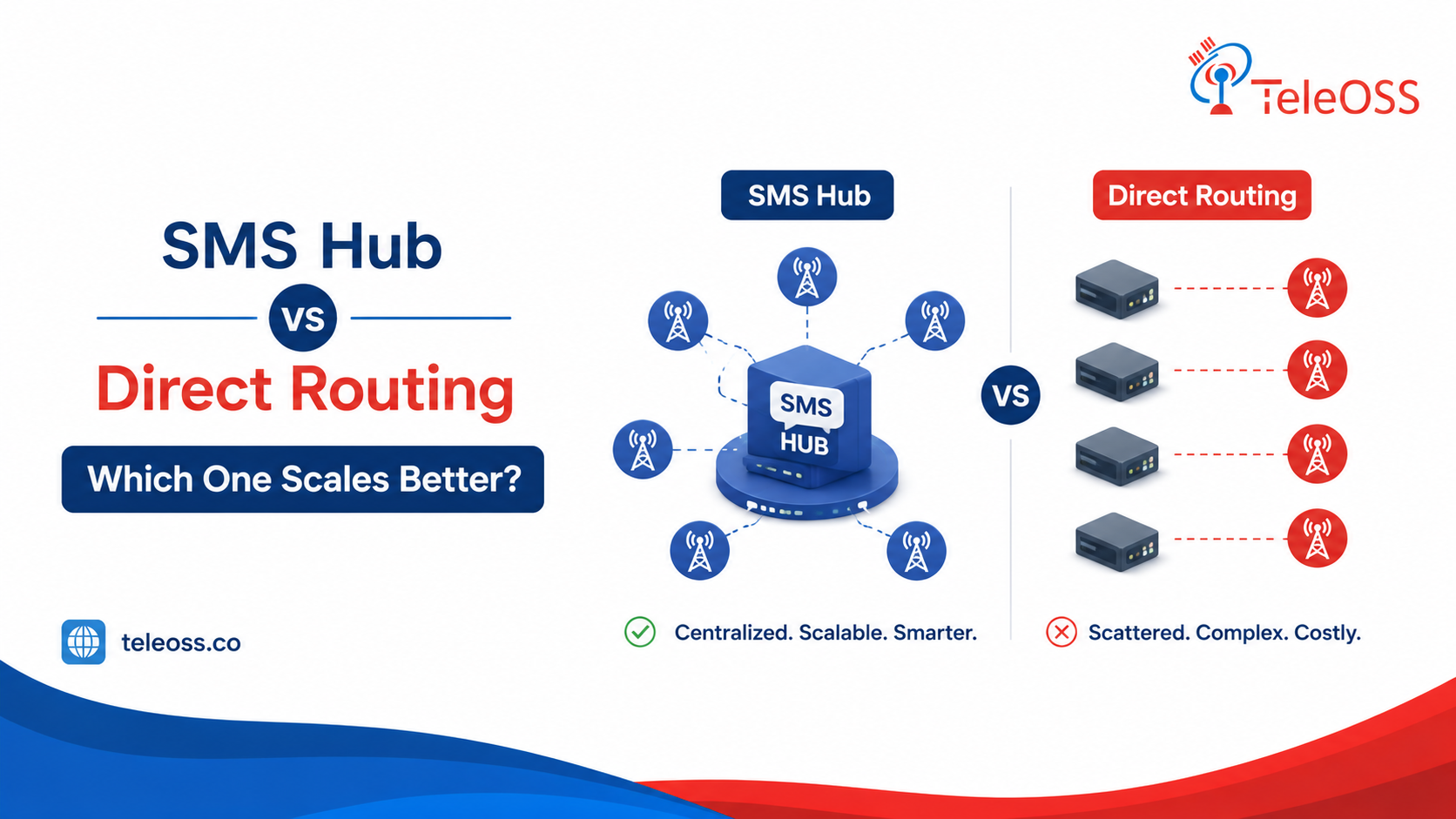
If you have ever tried to negotiate a bilateral SMS interconnect agreement with a dozen different operators, you already know the pain. Every new route means new commercial terms, new technical testing, and a new set of firewall rules to maintain. An SMS hub exists to solve exactly this problem.
An SMS hub is a centralized routing layer that sits between operators, aggregators, and enterprises, handling A2P and P2P message exchange through a single connection instead of dozens of one to one links. Instead of building and maintaining separate SMPP connections with every partner, you connect once to the hub and reach the rest of the ecosystem through it.
This matters right now because message volumes keep climbing while margins keep shrinking. GSMA Intelligence has repeatedly flagged grey routes and interconnect fraud as persistent revenue drains for operators, and every extra bilateral link is one more point of exposure. The question most telecom decision makers are asking today is not whether to centralize routing, but whether an SMS hub or direct routing gives them better long term scalability.
In this article, you will learn how SMS hubbing actually works, how it compares to direct bilateral routing, what the real cost and performance tradeoffs look like, and how to decide which model fits your traffic profile. We will also cover the technical mechanics behind SMPP based hub architecture and the compliance considerations operators in the US, UK, Europe, and Africa need to account for.
What Is an SMS Hub and How Does It Work in Telecom Networks?
An SMS hub is a routing platform that consolidates multiple interconnect relationships into one central node, so a single connection can reach many destination networks. Rather than each operator or aggregator negotiating and maintaining a direct link with every other party they need to exchange traffic with, they connect to the hub once, and the hub handles routing, format translation, and delivery to the correct destination.
Technically, most SMS hubs operate on SMPP (Short Message Peer to Peer Protocol), the same protocol used in bilateral connections, but the hub adds a routing and policy layer on top. When a message enters the hub, the platform checks the destination number, applies routing rules based on cost, quality, or contractual priority, converts the message format if needed, and forwards it through the appropriate outbound connection.
Think of it like an airport hub model in aviation. A regional airline does not fly direct routes to every city in the world. It flies into a major hub, and from there passengers connect onward. The airline maintains one relationship with the hub airport instead of managing gate agreements at fifty different airports.
Practical example: A mid sized aggregator in the UK wanting to reach mobile subscribers in Nigeria, Kenya, and South Africa would traditionally need three separate bilateral agreements, three sets of SMPP binds, and three ongoing technical relationships. Through an SMS hub, that aggregator connects once and the hub manages onward delivery to all three markets, including local number formatting and DLT style compliance checks where applicable.
Key takeaway: An SMS hub reduces the number of technical and commercial relationships a business must maintain, which directly lowers operational overhead as traffic volume and destination count grow.
SMS Hub vs SMS Aggregator: What Is the Difference?
An SMS hub routes traffic between multiple parties as neutral infrastructure, while an SMS aggregator resells messaging capacity and manages client relationships on top of that infrastructure. The two terms get used interchangeably in casual conversation, but they serve different roles in the value chain.
A hub is closer to the plumbing. It is the routing and interconnect layer that operators and aggregators plug into. An aggregator, on the other hand, is a commercial entity that buys messaging capacity, often through hubs or direct operator connections, and resells it to enterprises with added services like campaign management, delivery reporting, or opt-in compliance tools.
In practice, many aggregators use SMS hubs as part of their own infrastructure stack. A single aggregator might connect to two or three hubs to get broader route coverage and better redundancy, then layer their own customer-facing platform on top.
Practical example: A US based enterprise SMS platform serving retail clients might not touch operator connections directly at all. They work with an aggregator, who in turn routes a portion of traffic through an SMS hub to reach international destinations they do not have direct agreements with. Each layer adds a specific function: the enterprise platform handles campaign logic, the aggregator handles client billing and support, and the hub handles the actual cross network routing.
Key takeaway: If your business needs raw routing infrastructure to reach many networks efficiently, you are looking for a hub. If you need a managed messaging service with support and reseller tools, you are looking for an aggregator, and the two are often layered together.
SMS Hub vs Direct Routing: Core Differences
This is the central comparison most telecom operators and aggregators need to work through before choosing an architecture. Direct routing means establishing a bilateral SMPP connection straight to the destination operator, with no intermediary. An SMS hub means routing through a centralized platform that manages multiple destinations on your behalf.
Neither approach is universally better. The right choice depends on your traffic volume, the number of destinations you serve, your tolerance for operational complexity, and how much control you need over routing decisions.
| Factor | SMS Hub | Direct Routing |
| Setup time per new destination | Fast, often same day since the hub already has the connection | Slow, can take weeks of testing and commercial negotiation |
| Technical maintenance | Centralized, hub manages SMPP binds and updates | You maintain every bilateral connection separately |
| Cost per message on high volume corridors | Slightly higher due to hub margin | Usually lower once volume justifies direct agreements |
| Control over routing decisions | Shared with the hub operator | Full control |
| Scalability across many countries | High, minimal added complexity per new market | Low, complexity grows linearly with each new operator |
| Fraud and grey route exposure | Lower, hub applies centralized monitoring | Higher, depends on your own monitoring discipline |
| Best suited for | Aggregators and enterprises expanding into new markets quickly | High volume operators with strong traffic on specific corridors |
How Does SMS Hubbing Reduce Interconnect Costs for Operators?
SMS hubbing reduces interconnect costs by consolidating technical infrastructure, cutting the administrative overhead of managing dozens of bilateral contracts, and giving operators access to competitive routing without individually negotiating every corridor. Instead of paying for separate SMPP infrastructure, testing cycles, and account management per partner, operators absorb one integration cost and gain access to a broader network.
There is a real tradeoff here worth being honest about. Per-message pricing through a hub is sometimes marginally higher than a well negotiated direct bilateral rate on a high volume corridor, because the hub takes a margin for the routing service. But once you account for engineering time, support staff, fraud monitoring tools, and the opportunity cost of slow market entry, the total cost of ownership frequently favors the hub model, especially for operators serving ten or more destination markets.
Practical example: An African mobile network operator expanding P2P and A2P interconnect to five neighboring countries found that direct bilateral negotiation with each national operator took an average of six to eight weeks per corridor, including regulatory sign off. Routing through an established SMS hub cut that to under two weeks per new corridor because the hub already held active agreements in those markets.
Key takeaway: Direct routing can win on per message cost for your top two or three highest volume corridors. For everything beyond that, an SMS hub usually wins on total cost once you factor in time, staffing, and risk.
Can an SMS Messaging Hub Handle International A2P Traffic?
Yes, SMS hubs are built specifically to handle international A2P traffic, including cross border formatting differences, local regulatory checks, and delivery through operator specific gateways. This is actually one of the strongest use cases for a hub, since bilateral A2P agreements at international scale are notoriously slow to establish.
A2P traffic brings extra complexity beyond simple P2P delivery. Sender ID registration rules differ by country, message content filtering varies, and compliance frameworks like TRAI DLT in India, TCR and 10DLC in the US, and CTIA guidelines all impose different obligations on how application generated messages get delivered. A well built SMS hub incorporates these compliance layers into the routing logic itself, checking sender ID validity or content flags before a message ever leaves the platform.
This is where a platform like TeleOSS becomes relevant for operators and aggregators building or upgrading their hubbing infrastructure. TeleOSS’s SMS gateway software is designed to handle multi-country A2P routing with built-in support for regional compliance checks, so operators are not manually coding separate rule sets for every jurisdiction they touch.
Practical example: An enterprise running OTP delivery for a fintech app across the US and UK needs different registration processes for each market, 10DLC campaign registration in the US and sender ID rules in the UK. A properly configured SMS hub applies the correct compliance path automatically based on the destination country, instead of the enterprise having to manage two entirely separate integration paths.
Key takeaway: International A2P delivery is exactly where the complexity of direct bilateral routing becomes hardest to justify, and where hub based routing earns its cost.
What Is SMS Hubbing in the Context of Mobile Network Operators?
For mobile network operators, SMS hubbing refers to the practice of routing inbound and outbound SMS traffic through a shared interconnect platform rather than negotiating individual bilateral agreements with every roaming or interconnect partner. Historically, MNOs relied almost entirely on bilateral SS7 based interconnects for P2P SMS. As A2P traffic grew and international messaging volumes exploded, that bilateral model became operationally unsustainable for many mid-sized operators.
Hubbing gives operators a way to reach global coverage without a proportional increase in technical staff or infrastructure spend. It also gives smaller operators access to routes and volume discounts that would otherwise only be available to the largest carriers with dedicated interconnect teams.
There is a governance dimension too. Operators using hubs still need firm policies on route quality monitoring, since not every hub applies the same rigor to grey route filtering. GSMA has published guidance encouraging operators to audit their hub partners’ anti-fraud practices rather than assuming all routing intermediaries apply equal scrutiny.
Practical example: A European operator with strong domestic P2P volume but limited international roaming agreements used hubbing specifically to extend SMS reach into markets where building direct SS7 or SMPP interconnects was not commercially justified by traffic volume alone.
Key takeaway: Hubbing is not just a cost tool, it is a market access tool that lets operators punch above their direct interconnect footprint.
Which Telecom Companies Use SMS Hub Models for Routing?
A wide range of telecom companies use SMS hub models, from mobile network operators extending international reach, to SMS aggregators building wholesale routing networks, to enterprise messaging platforms that need broad destination coverage without managing dozens of direct connections. The common thread is not company size, it is destination diversity. Any business messaging across more than a handful of countries tends to find hub routing more practical than a fully bilateral approach.
Large global carriers often run hybrid models. They maintain direct bilateral connections for their top volume corridors, typically the countries where they have roaming partnerships or historical traffic, and use hub routing to fill in coverage for lower volume or emerging markets. This hybrid approach captures the cost advantage of direct routing where volume justifies it, while keeping the flexibility of hub routing everywhere else.
Wholesale sms solutions built for aggregators, including TeleOSS’s SMS Wholesale Platform, are typically architected around this hybrid logic by default, giving operators the ability to set routing preferences per corridor rather than forcing an all or nothing decision.
Practical example: A wholesale SMS provider serving enterprise clients across Europe and Africa maintains direct routes into its five highest volume countries, while every other destination flows through a hub connection, giving the provider full coverage without fifty separate bilateral contracts.
Key takeaway: Most mature telecom messaging operations do not choose hub or direct exclusively. They blend both based on corridor economics.
What Are the Main Benefits of Using an SMS Hub for Aggregators and Enterprises?
The main benefits of an SMS hub for aggregators and enterprises are faster market entry, reduced technical overhead, centralized fraud monitoring, and simplified compliance management across multiple regulatory regions. These benefits compound as the number of destination markets grows, which is why hub adoption tends to correlate strongly with geographic expansion plans.
Faster Time to Market
Instead of a multi week or multi month bilateral negotiation and testing cycle for each new country, hub connections are often already live, meaning new market entry can happen in days rather than months.
Lower Technical Burden
One SMPP integration to maintain instead of dozens means smaller engineering teams can support a much larger route footprint.
Centralized Monitoring
A single point of visibility into delivery rates, latency, and suspicious traffic patterns makes fraud detection and quality assurance more consistent than trying to monitor dozens of separate bilateral links independently.
Simplified Compliance
Hubs that build in regional regulatory logic, such as DLT registration checks for India or 10DLC campaign verification for the US, remove a significant administrative burden from the enterprise or aggregator using the platform.
Practical example: An enterprise sending appointment reminders across four continents reported that consolidating routing through a single hub cut their integration engineering time by more than half compared to maintaining separate bilateral connections, freeing that engineering capacity for product development instead of interconnect maintenance.
Key takeaway: The benefit of an SMS hub is not really about per message price. It is about the operational leverage you get from one integration doing the work of many.
How Do I Choose the Right SMS Hub Platform for My Telecom Business?
Choosing the right SMS hub platform comes down to evaluating route coverage, delivery quality reporting, compliance automation, pricing transparency, and how well the platform integrates with your existing SMPP infrastructure. Do not choose based on price alone, since the cheapest per message rate often correlates with weaker fraud filtering or thinner route coverage.
Route Coverage and Redundancy
Ask for a full list of covered destination countries and confirm whether routes are direct operator connections or sub hubbed through additional intermediaries, since each additional hop adds latency and reduces delivery transparency.
Delivery Quality Reporting
Look for real time delivery receipts, not just submission confirmations. The difference between a message being accepted by the hub and actually delivered to a handset matters enormously for A2P use cases like OTP delivery.
Compliance Automation
Confirm whether the platform automatically applies regional rules like TRAI DLT in India, TCR and 10DLC in the US, or CTIA guidelines, or whether that burden falls back on you.
Pricing Transparency
Understand whether pricing is a flat rate per corridor or a tiered model based on volume, and ask directly about any hidden costs tied to least cost routing changes that might affect delivery quality.
SMPP Compatibility and TPS Support
Confirm the platform’s transactions per second capacity matches your peak traffic needs, particularly for time sensitive A2P traffic like OTPs, where latency directly affects user experience. TeleOSS’s SMS gateway software, for instance, has been built with TPS scalability in mind specifically to support high volume A2P bursts without bottlenecking.
Practical example: A wholesale aggregator evaluating three hub platforms found that the lowest priced option had the weakest delivery reporting, forcing the aggregator’s support team to manually investigate delivery disputes that a better reporting system would have resolved automatically, which ended up costing more in staff time than the price difference saved.
Key takeaway: Evaluate an SMS hub the way you would evaluate any infrastructure vendor, on reliability and transparency first, price second.
Quick Answer Summary
What is an SMS hub?
An SMS hub is a centralized routing platform that connects operators, aggregators, and enterprises through a single interconnect, handling A2P and P2P message delivery to multiple destination networks without requiring separate bilateral agreements for each one.
SMS hub vs direct routing, which scales better?
SMS hubs scale better for businesses reaching many destination countries, since technical overhead stays flat as coverage grows. Direct routing scales better economically only on your highest volume individual corridors.
What is SMS hubbing?
SMS hubbing is the practice of routing SMS traffic through a shared intermediary platform instead of maintaining individual bilateral SMPP connections with every destination network, reducing setup time and ongoing maintenance.
Do SMS hubs handle A2P compliance?
Many modern SMS hubs, including platforms like TeleOSS, build regional compliance logic directly into routing, automatically applying rules like 10DLC in the US or TRAI DLT in India based on message destination.
Common Mistakes to Avoid
Choosing a hub based only on lowest per message price:
Cheap routing often means weaker fraud filtering and lower quality delivery paths, which costs more in the long run through failed deliveries and support overhead.
Ignoring sub hopping in route paths:
Some hubs route your traffic through additional intermediary hubs without disclosing it, adding latency and reducing delivery transparency. Always ask for the actual route path, not just the destination list.
Treating hub and direct routing as mutually exclusive:
Most mature operators run a hybrid model. Locking into one approach for all traffic usually leaves cost or scalability on the table.
Skipping compliance verification per market:
Assuming a hub automatically handles every country’s regulatory requirements without confirming it directly can lead to blocked traffic or compliance penalties, particularly in regulated markets like the US and India.
Underestimating TPS requirements:
Choosing a hub or gateway platform without confirming it can handle your peak transaction volume leads to bottlenecks during high traffic events like OTP surges or marketing campaign sends.
Best Practices for SMS Hub and Routing Strategy
Start by mapping your traffic by corridor volume before deciding which destinations should run through direct routing versus a hub, since this data driven approach avoids guesswork.
Negotiate direct bilateral agreements only for your top three to five highest volume corridors, and route everything else through a well vetted hub to keep engineering overhead manageable.
Request delivery quality benchmarks from any hub provider before committing, including average delivery rate, average latency, and grey route incident history over the past twelve months.
Build monitoring dashboards that track delivery performance per corridor regardless of routing method, so you can catch quality degradation early and adjust routing decisions based on real data rather than assumptions.
Review compliance obligations per target country annually, since frameworks like TRAI DLT and TCR continue to evolve, and a hub configuration that was compliant last year may need updates.
Work with a platform partner, such as TeleOSS’s wholesale SMS solution, that offers both hub style aggregated routing and the flexibility to configure direct routes per corridor, so your architecture can evolve as your traffic patterns change.
Conclusion
Choosing between an SMS hub and direct routing is not really a binary decision. The businesses that scale most efficiently tend to treat it as a portfolio question, running direct bilateral connections on their highest volume corridors while relying on an SMS hub to cover everything else without a matching increase in engineering headcount. An SMS hub earns its keep specifically in the messy middle ground of moderate volume, multi-country traffic, where the administrative cost of bilateral agreements outweighs the routing margin a hub charges.
If you are evaluating your own routing architecture, start with the data. Map your traffic by corridor, identify where volume justifies a direct connection, and let a well vetted SMS hub handle the rest. Platforms like TeleOSS are built to support exactly this kind of hybrid strategy, combining SMS gateway infrastructure with wholesale routing flexibility so you are not locked into an all or nothing approach.
If you want to see how an SMS hub could fit into your specific traffic profile, reach out to the TeleOSS team for a walkthrough of the platform and a look at current route coverage.
FAQs
What is an SMS hub and how does it work in telecom networks?
An SMS hub is a centralized routing platform that connects multiple operators, aggregators, and enterprises through a single interconnect point instead of separate bilateral agreements. It works by receiving messages over SMPP, checking the destination and applying routing rules based on cost, quality, or contractual priority, then forwarding the message through the correct outbound connection to reach the destination network. This significantly reduces the number of individual technical relationships a business needs to maintain while still reaching a broad range of destinations.
What is SMS hubbing and why do operators use it instead of bilateral agreements?
SMS hubbing is the practice of routing SMS traffic through a shared intermediary rather than negotiating and maintaining direct bilateral SMPP or SS7 connections with every destination operator. Operators use it because bilateral agreements are slow to set up, expensive to maintain at scale, and become operationally complex once traffic spans more than a handful of countries. Hubbing lets an operator reach dozens of markets through one connection, trading a small routing margin for significant time and staffing savings.
How does an SMS messaging hub handle A2P and P2P message routing?
An SMS messaging hub handles both A2P and P2P traffic by applying different routing logic based on message type, since A2P traffic often requires additional compliance checks like sender ID validation or campaign registration verification that P2P traffic does not. The hub inspects incoming traffic, classifies it, applies the relevant regulatory and quality rules, then routes it through the appropriate outbound path to the destination network, keeping both traffic types moving efficiently without manual intervention.
What are the main benefits of using an SMS hub for aggregators and enterprises?
The main benefits include faster entry into new markets since hub connections are typically already established, reduced technical maintenance because one integration replaces many bilateral connections, centralized fraud and quality monitoring across all routed traffic, and built-in compliance handling for regulations like TRAI DLT or TCR 10DLC. Together these benefits let aggregators and enterprises scale message delivery across many countries without a proportional increase in engineering or compliance staff.
How do I choose the right SMS hub platform for my telecom business?
Choose an SMS hub platform by evaluating route coverage and whether routes are direct or sub hubbed, the quality and speed of delivery reporting, how much compliance automation the platform handles for regions like the US and India, pricing transparency including hidden fees, and whether the platform’s transactions per second capacity matches your peak traffic needs. Prioritize reliability and transparency over the lowest advertised price, since cheaper routing frequently comes with weaker fraud filtering and delivery quality.