

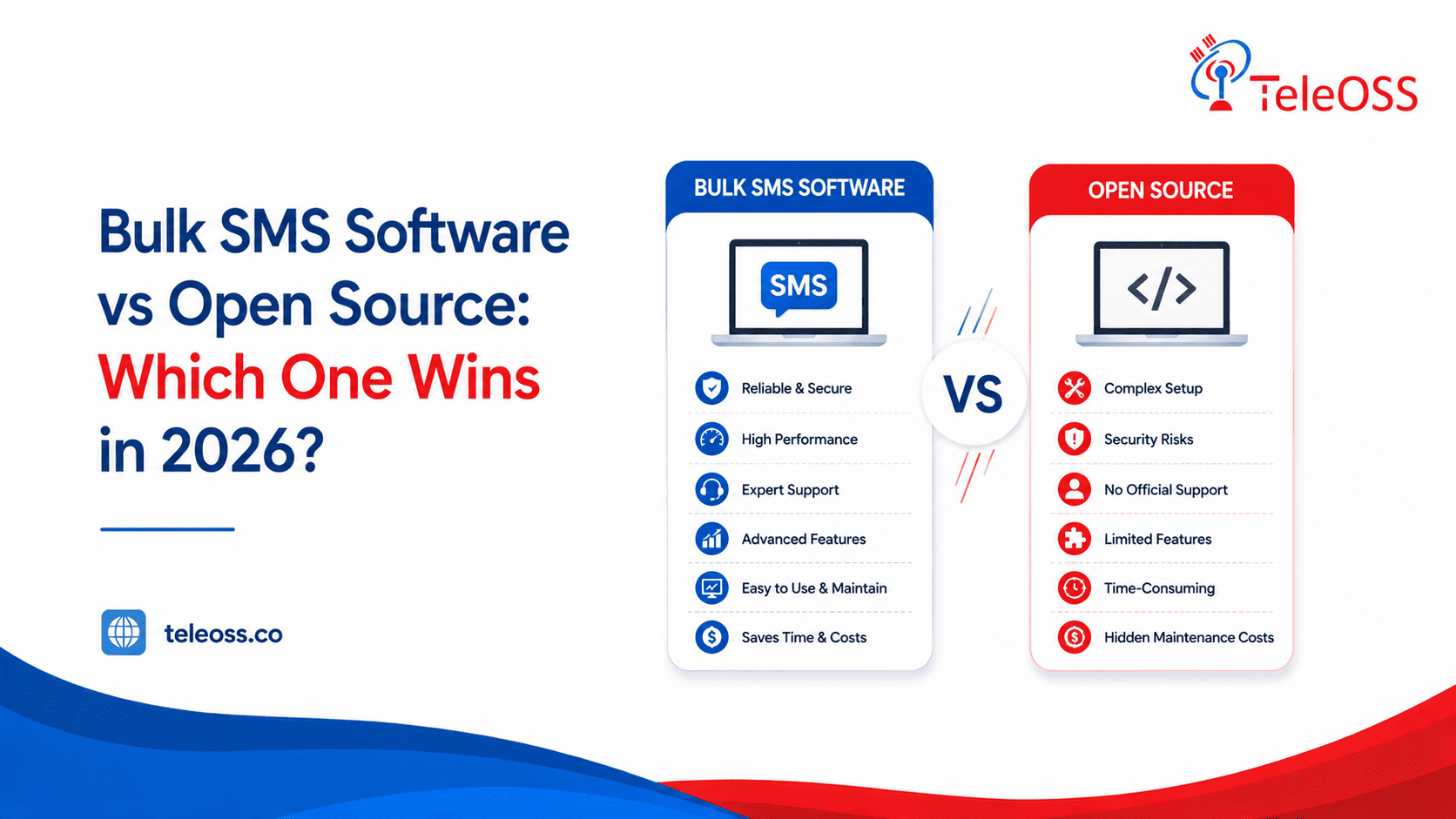
If you run an SMS wholesale operation, you have probably faced this decision at least once: build on an open source SMS engine and save money upfront, or invest in commercial bulk SMS software and pay for stability. It looks like a simple cost question on the surface. It rarely stays that way once traffic volumes climb into the millions.
I have watched aggregators start on open source stacks, hit a wall around the 5 to 10 million messages per day mark, and then spend six figures migrating to a commercial platform under pressure, with customers already complaining about delivery delays. That migration is expensive and stressful. It is also avoidable if the software decision is made with the full picture in mind, not just the license fee.
This article breaks down where open source SMS platforms genuinely hold up, where they fall short for wholesale grade traffic, and what separates them from purpose built bulk SMS software. You will see real scenarios from telecom operations, a comparison table, common mistakes buyers make, and answers to the questions telecom operators and SMS aggregators ask most often before signing a contract.
What Bulk SMS Software Actually Does
Bulk SMS software is the engine that routes, rates, and delivers A2P (application to person) messages at volume across mobile networks worldwide. It handles routing decisions, connects to SMPP binds, manages billing and rating in real time, applies least cost routing logic, and reports delivery status back to the sender.
For a wholesaler or aggregator, this software is not a side tool. It is the core operational system. Every dollar of revenue and every customer relationship runs through it. That is why the build versus buy decision carries more weight here than it would for, say, an internal ticketing tool.
Key takeaway: Treat this as an infrastructure decision, not a feature comparison. The software choice affects uptime, margins, and how fast you can onboard new routes or customers.
Open Source vs Commercial Bulk SMS Software: What Is the Real Difference?
Open source SMS platforms give you free source code and community support but leave scaling, security hardening, and ongoing development to your own team. Commercial bulk SMS software gives you a tested, supported product built specifically for wholesale grade traffic, with vendor accountability when something breaks.
How Open Source SMS Platforms Work
Tools like Kannel and Jasmin SMS Gateway are the two names most people mean when they say open source SMS software. They are genuinely capable pieces of engineering, built by talented developers, and they work well for smaller operations or for teams that have the in-house expertise to maintain them.
The catch is maintenance. There is no vendor SLA. If a protocol update breaks your SMPP binds at 2 a.m. on a Friday, you are relying on a GitHub issue thread or your own engineers, not a support contract. I have seen a regional aggregator in East Africa run Jasmin for two years successfully, then lose three days of MMS revenue on a corridor because a routing bug surfaced right after a carrier changed its SMPP parameters, and no patch existed yet.
How Commercial Bulk SMS Software Platforms Work
Commercial platforms are built around the assumption that downtime costs money and reputation. They come with dedicated engineering teams, tested upgrade paths, built in fraud and spam filtering, and support contracts with response time guarantees. The license fee is the price of transferring operational risk away from your internal team and onto the vendor.
Key takeaway: Open source is a starting point for small volume or experimental projects. Commercial software is built for operations where downtime has a direct dollar cost.
Is Open Source Bulk SMS Software Actually Free?
No, not in any way that matters for a wholesale operation. The license is free, but the total cost of ownership includes developer salaries for customization, infrastructure hardening, security patching, and the revenue lost during outages, which almost always exceeds what a commercial license would have cost.
This is the myth that trips up most new SMS wholesalers. A founder downloads an open source gateway, gets it running in a weekend, and assumes the hard part is done. Then comes the real work: writing custom least cost routing logic, building a billing engine that reconciles correctly with carrier CDRs, and hardening the system against SMPP flooding attacks.
One SMS reseller I worked with in the UK calculated this the hard way. They estimated open source would save them around 40,000 pounds a year in licensing. After hiring two developers to maintain and extend the platform, plus one incident where a misconfigured route caused an overbilling dispute with a carrier, their actual annual cost came out higher than a mid tier commercial license would have been, and they still lacked features like automated grey route detection.
Key takeaway: Calculate total cost of ownership, not just license cost. Include engineering time, patching, and the cost of downtime before comparing numbers.
Which Offers Better Security for High Volume Messaging?
Commercial bulk SMS software generally offers stronger security out of the box, because vendors build in SMPP flood protection, encryption, fraud detection, and SIM box or grey route detection as standard features tested across many deployments, rather than something each operator has to build and maintain independently.
Grey route abuse is one of the biggest risks in this industry. It happens when traffic gets rerouted through unauthorized SIM farms to dodge termination fees, and it costs carriers billions in lost revenue every year according to industry estimates from bodies like the GSMA. A commercial platform typically ships with pattern detection that flags abnormal sending behavior, like a single sender ID suddenly firing thousands of messages to a single country corridor within minutes.
I have seen a mid-sized SMS hub in Southeast Asia lose a major banking client after an open source setup failed to catch a grey route leak on an OTP corridor. The bank’s one-time passwords started arriving late and inconsistently, delivery rates dropped below 80 percent on that route, and the client moved to a competitor within a month. A commercial platform with corridor level monitoring would likely have flagged the anomaly before it reached the client.
Key takeaway: Security for SMS wholesale is not just firewalls. It includes route monitoring, fraud pattern detection, and encryption that is tested against real attack patterns, not assumptions.
Can Open Source Software Scale for SMS Wholesale Traffic?
Open source SMS platforms can scale, but usually only with significant custom engineering around clustering, load balancing, and database optimization that commercial platforms already include. Without that investment, most open source deployments start showing latency and dropped connections once daily volume crosses a few million messages.
This is where the difference between a demo and a production wholesale environment becomes obvious. Handling 50,000 messages a day is a very different engineering problem than handling 50 million. Commercial SMS wholesale platform is architected from day one for horizontal scaling, multiple SMPP binds per carrier, and failover routing when a primary path degrades.
A telecom operator in West Africa learned this during a promotional campaign for a mobile money product. Their open source gateway, which had run smoothly for a year at moderate volume, could not handle the traffic spike during a flash promotion. Queue times backed up, some messages arrived hours late, and the campaign’s conversion numbers suffered because time sensitive promo codes expired before delivery. After the incident, they moved core routing to a commercial platform and kept the open source instance only for internal testing.
Key takeaway: Test any platform, open source or commercial, against your actual peak volume before you commit to it as your core system, not just your average daily traffic.
What About Support When Your Network Goes Down?
With open source software, support means community forums, documentation, and whatever expertise your own team has built up. With commercial bulk SMS software, support means a contracted response time, a dedicated engineer, and often a customer success team that proactively flags issues like delivery rate drops before you notice them yourself.
For a wholesaler moving millions of messages a day, every hour of downtime translates directly into lost revenue and damaged carrier relationships. A support ticket that sits unanswered in a community forum is not an acceptable failure mode at that scale. Commercial vendors typically offer tiered SLAs, sometimes with 15 minute response guarantees for critical outages, along with account managers who understand your specific routing setup.
Key takeaway: Ask any vendor, open source or commercial, exactly what happens during a 3 a.m. outage. If the honest answer is “post an issue and wait,” that tells you what you need to know.
Innovation and Customization: Where Commercial Software Wins
Commercial platforms let you differentiate through custom features like white label reseller portals, dynamic least cost routing algorithms, or real time analytics dashboards, while open source deployments generally push everyone toward the same base feature set unless you fund custom development yourself.
If you and your closest competitor are both running the same open source stack with the same default configuration, your product looks the same to a buyer. Commercial vendors that specialize in telecom, including platforms like TeleOSS, build in configurable rating engines, multi currency sms billing, and reseller management tools that let you launch new business models without months of custom development.
Key takeaway: Ask whether your platform lets you launch a new pricing model or reseller tier in days, not months. That flexibility often matters more than the sticker price of the software.
Bulk SMS Software Comparison Table
| Factor | Open Source SMS Software | Commercial Bulk SMS Software |
| Upfront cost | Free license | Licensing or subscription fee |
| Total cost of ownership | Often high due to custom development and patching | Predictable, bundled into contract |
| Security | Depends entirely on in house hardening | Built in fraud and grey route detection |
| Scalability | Requires custom clustering and tuning | Architected for high volume from the start |
| Support | Community forums, no SLA | Dedicated support with response time guarantees |
| Customization | Full control, but you build it yourself | Configurable within vendor’s framework |
| Time to launch | Slower, depends on team expertise | Faster, since core features are ready |
| Best fit | Small volume, experimental, or highly technical teams | Wholesale, aggregator, and enterprise operations |
Quick Answer Summary
Is open source bulk SMS software good enough for a wholesale business?
It can work for small or experimental operations, but most wholesale businesses outgrow it once volume, security needs, and support requirements increase. The hidden costs of custom development and downtime usually outweigh the free license within the first year or two.
What is the biggest hidden cost of open source SMS software?
Engineering time. Teams underestimate the ongoing work needed for patching, scaling, and building features like fraud detection, which a commercial platform already includes in the license.
Does commercial bulk SMS software guarantee better delivery rates?
Not automatically, but it typically includes route optimization, carrier grade monitoring, and fraud filtering that make consistent high delivery rates far easier to achieve and maintain.
Common Mistakes Businesses Make When Choosing Bulk SMS Software
- Comparing only license cost, not total cost of ownership: Factor in engineering hours, infrastructure, and downtime risk before deciding.
- Testing at low volume and assuming it scales: Load test at your projected peak traffic, not your current average.
- Ignoring grey route and fraud protection until after a loss: Build monitoring into your selection criteria from day one.
- Underestimating support needs: A platform without an SLA can leave you stuck during a critical outage with paying customers waiting.
- Choosing based on features alone, without checking carrier relationships: Software is only as good as the direct carrier connections and routing quality behind it.
Best Practices for Selecting Bulk SMS Wholesale Software
- Run a pilot at real world peak volume, not average daily volume, before committing.
- Ask vendors for actual delivery rate and uptime data from existing wholesale clients, not just marketing claims.
- Confirm what fraud and grey route detection is included versus what needs custom development.
- Check whether the platform supports multi currency billing and reseller tiers if you plan to expand into new markets.
- Review the support SLA in writing, including response times for critical outages, before signing.
- Calculate a three year total cost of ownership, not just the first year license or subscription price.
Conclusion
The open source versus commercial debate is not really about which software is technically better. It is about where you want to spend your resources: on engineering time to build and maintain your own infrastructure, or on a license that hands you a tested, supported system built specifically for bulk SMS software at wholesale scale.
Small operations with strong technical teams can make open source work for a while. Once volume, security expectations, and customer SLAs increase, the hidden costs of maintaining an open source stack tend to catch up fast, often at the worst possible moment.
If you are evaluating your options and want to see what a purpose built platform looks like in practice, TeleOSS works with telecom operators, SMS aggregators, and enterprises to provide bulk SMS wholesale software built for real world volume, security, and support needs. Reach out to TeleOSS to walk through your current setup and see where a commercial platform could close the gaps open source has left behind.
Need More Help?
Explore the TeleOSS Support Center for product documentation, setup guides, troubleshooting articles, FAQs, and expert support.
FAQs
Is TeleOSS good enough for a small SMS aggregator?
Yes, for a small aggregator handling modest volume with an in house technical team, either platform can be a reasonable starting point. The tradeoff comes as volume grows, since you will need to build your own scaling, security, and monitoring layers that commercial platforms already provide, which adds real engineering cost over time.
How much does commercial bulk SMS software typically cost?
Pricing varies widely based on volume, features, and whether it is licensed or subscription based, ranging from a few hundred dollars a month for smaller operations to enterprise contracts for high volume wholesalers. Most vendors price based on throughput and include features like fraud detection or multi currency billing, so request a quote based on your actual traffic projections.
Can I migrate from open source to commercial SMS software without downtime?
A careful migration is possible with proper planning, usually by running both systems in parallel and shifting traffic gradually route by route. Rushed migrations under pressure, such as after an outage, carry higher risk of dropped messages, so plan the migration during a lower traffic window whenever you can.
What is least cost routing and why does it matter for software choice?
Least cost routing automatically selects the cheapest available carrier path for each message while maintaining acceptable delivery quality. It directly affects your margins as a wholesaler, and it is significantly harder to build and maintain correctly in an open source environment than in a commercial platform designed around it from the start.
Do commercial platforms support SMS, RCS, and WhatsApp together?
Many modern commercial bulk SMS platforms now support omnichannel messaging including RCS and WhatsApp Business API alongside SMS, since enterprise customers increasingly want a single platform for all channels. Confirm this specifically with any vendor, since support levels for newer channels vary significantly between products.