

If you send SMS at scale, whether that’s OTPs for a banking app, marketing blasts for retail, or wholesale traffic between operators, the provider behind that traffic decides whether your messages actually land. A weak SMS gateway provider means dropped sms delivery reports, blocked routes, and support tickets from customers who never got their code. This guide walks through what an SMS gateway provider does, how A2P and P2P traffic differ, and the criteria that actually separate a reliable provider from one that will cause problems six months into the contract.
Quick Answer
An SMS gateway provider is a company that connects your application or platform to mobile network operators so you can send and receive SMS at scale. The best providers combine direct carrier connections, SMPP and HTTP API support, real time delivery reporting, and compliance with regional messaging regulations. Choosing one means comparing route quality, pricing transparency, and support responsiveness, not just the lowest per message rate.
Key Takeaways
- An SMS gateway provider sits between your application and mobile networks, converting API or SMPP requests into messages that reach handsets.
- A2P and P2P traffic use different routing paths, and mixing them incorrectly is one of the most common reasons operators get grey routed or blocked.
- Compliance requirements like TCR registration in the US or TRAI DLT rules in India directly affect whether your messages get delivered at all.
- Pricing models vary between per message billing, committed volume contracts, and wholesale termination rates, and each fits a different traffic profile.
- The strongest evaluation criteria are delivery rate transparency, route diversity, and how a provider handles failover when a carrier connection drops.
What Is an SMS Gateway Provider?
An SMS gateway provider is a company that operates the infrastructure connecting your software to mobile network operators, so your application can send and receive SMS without you having to negotiate directly with every carrier. It works by accepting a message from your platform through an API or an SMPP connection, routing it through carrier interconnects, and returning a delivery report once the network confirms whether the handset received it.
Think of a hotel chain that sends booking confirmations to guests across a dozen countries. Instead of signing separate agreements with mobile operators in each of those countries, the hotel integrates once with an SMS gateway provider, and that provider handles the routing decisions behind the scenes. This is the same logic that applies to enterprises running enterprise text messaging solutions across multiple markets: one integration point, many destination networks.
How Does an SMS Gateway Provider Handle A2P vs P2P Traffic?
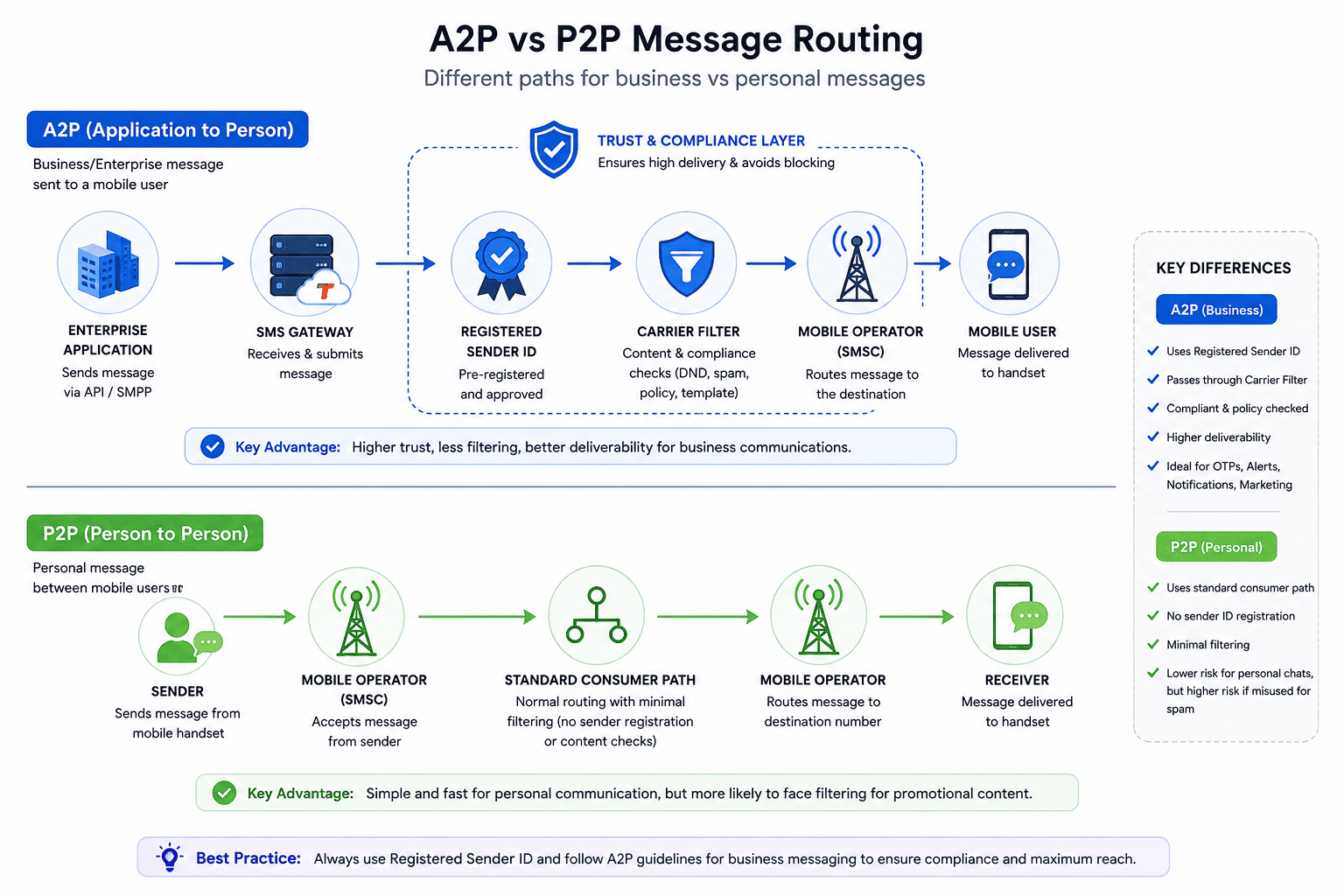
Application to person (A2P) messaging and person to person (P2P) messaging travel through different infrastructure because carriers price and monitor them differently. A2P messaging refers to automated messages sent from a business system to a consumer, such as a one time password or a delivery notification. P2P texting refers to messages exchanged directly between two individuals through their phones.
Carriers treat A2P traffic as commercial and apply throughput limits, sender ID registration, and content filtering rules that don’t apply to P2P traffic. An SMS gateway provider handling A2P messaging needs registered short codes or long codes, application to person routes recognized by the destination carrier, and monitoring to prevent that traffic from being misclassified as P2P, which is a practice known as SMS grey routing.
For example, a two factor authentication platform sending login codes must route through a carrier approved A2P messaging platform rather than a consumer SIM based route. If the provider sends that traffic through a P2P path to cut costs, the carrier can detect the pattern and block the sender entirely, which is exactly the kind of outage that damages trust with end users.
Key Features to Look For in an SMS Gateway Provider
Not every feature matters equally, but a few consistently separate reliable providers from the rest.
Direct carrier connections:
A provider with direct interconnects to mobile operators, rather than routes purchased through several resellers, gives you more visibility into delivery issues and fewer points of failure.
Protocol flexibility:
Support for both SMPP and HTTP based APIs matters because telecom operators and large aggregators often need the persistent, high throughput connections SMPP provides, while smaller enterprise integrations usually prefer a simpler REST API.
Real time delivery reporting:
A delivery report (DLR) confirms whether a message reached the handset, was queued, or failed. Without accurate DLRs, you can’t debug delivery problems or prove compliance during an audit.
Intelligent routing and least cost routing:
Least cost routing selects the cheapest available path for a message while still meeting quality thresholds. Good providers let you set quality floors so cost optimization doesn’t come at the expense of delivery rate.
Failover and redundancy:
When one carrier route degrades, the gateway should automatically shift traffic to an alternate route without manual intervention.
A regional bank rolling out SMS based fraud alerts is a useful example here. The bank needs sub second delivery during a suspected fraud event, so route redundancy and real time DLRs aren’t optional extras, they’re the difference between stopping a fraudulent transaction and missing the window entirely.
What Compliance Standards Should an SMS Gateway Provider Meet?
Compliance requirements vary by country, and a provider that ignores them puts your delivery rates and your legal standing at risk. In the United States, The Campaign Registry (TCR) requires businesses to register 10DLC campaigns before sending A2P traffic on long codes, and carriers use that registration to filter unregistered traffic. In India, the Telecom Regulatory Authority of India (TRAI) enforces Distributed Ledger Technology (DLT) registration for any commercial sender, and unregistered messages are blocked at the network level rather than just flagged.
Beyond country specific registration, the GSM Association (GSMA) publishes industry guidelines on messaging security and anti-fraud practices that reputable providers align with, including protections against SIM box fraud and interconnect bypass. A provider that can explain exactly how it screens for grey routes and SIM box activity is signaling that it takes route integrity seriously, not just sales volume.
A practical example: an e-commerce company expanding into India without TRAI DLT registration will see its OTP messages silently fail once it crosses a small volume threshold, because Indian carriers block unregistered commercial senders by default. Any SMS gateway provider serving that market should flag this requirement before onboarding, not after the first blocked campaign.
Can an SMS Gateway Provider Support Global Bulk Messaging Campaigns?
Yes, a properly built SMS gateway provider can support global bulk messaging campaigns, but capacity and route quality vary significantly between vendors. Bulk messaging at scale requires enough throughput (measured in transactions per second, or TPS) to push large volumes without queuing delays, along with carrier relationships across every target country rather than a handful of major markets.
A global retailer running a flash sale campaign across the US, UK, and Southeast Asia needs a provider that can sustain high TPS simultaneously across all three regions, not just one. If the provider’s route into Southeast Asia is thin or resold through multiple intermediaries, that regional leg becomes the bottleneck even if the US and UK routes perform well. This is why checking a provider’s route coverage market by market, rather than trusting a single global delivery rate figure, matters more than it might first appear.
SMS Gateway Provider Pricing Models
Pricing structures differ based on traffic volume and use case, and understanding the model helps you avoid unexpected costs.
| Pricing Model | How It Works | Best Fit For |
| Per message billing | Fixed rate charged per SMS sent, often tiered by destination country | Startups and mid size enterprises with variable volume |
| Committed volume contracts | Discounted rate in exchange for a minimum monthly commitment | Enterprises with predictable, high volume traffic |
| Wholesale SMS termination | Rate negotiated per route for bulk interconnect traffic, typically used between operators and aggregators | Telecom operators and SMS aggregators reselling capacity |
| Hybrid billing | Base platform fee plus usage based charges for API access, number leasing, or DLR retrieval | Enterprises needing bundled infrastructure and messaging |
The key takeaway from this table is that the cheapest per message rate isn’t automatically the best deal. A committed volume contract with a lower effective rate only pays off if your actual traffic meets the commitment, and wholesale termination rates depend heavily on route quality, which a quoted price alone won’t tell you.
How to Choose the Best SMS Gateway Provider
Selecting a provider comes down to matching their capabilities to your actual traffic profile, not just comparing headline features.
Map your traffic type first:
Determine what share of your volume is A2P versus P2P, and whether you need SMPP, HTTP API, or both, before you start evaluating vendors.
Ask for country level delivery data:
A global average delivery rate hides weak regional routes. Request delivery statistics broken down by the specific countries you operate in.
Verify compliance support for your markets:
Confirm the provider actively manages TCR registration, TRAI DLT compliance, or equivalent requirements in every country you send to.
Test failover behavior:
Ask how the provider handles a carrier outage in practice, not just in a sales deck, and request evidence of past incident response.
Review the SLA in detail:
Look for specific uptime commitments and delivery rate guarantees, not vague language about “high reliability.”
Evaluate support responsiveness:
A provider that takes 48 hours to respond to a routing issue during a live campaign is a liability regardless of how competitive its pricing looks.
An SMS aggregator reselling capacity to smaller enterprises illustrates why this order matters. If that aggregator signs a wholesale SMS termination deal based purely on price, without verifying the underlying carrier relationships, they inherit any route instability on the wholesaler’s end and pass that risk directly to their own customers.
Common Mistakes to Avoid
- Choosing on price alone: The lowest quoted rate often reflects routing through intermediaries with lower delivery guarantees, which shows up later as failed messages rather than upfront cost.
- Ignoring sender ID and registration requirements: Skipping 10DLC or DLT registration to save setup time almost always results in blocked traffic once volume increases past a carrier’s tolerance threshold.
- Mixing A2P and P2P traffic on the same route: This is a common shortcut that carriers actively detect, and it can lead to route suspension for all traffic, not just the misrouted portion.
- Underestimating support needs during launch: The first two weeks after a new integration goes live are when routing issues are most likely to surface, and a provider without responsive support during that window can turn a minor issue into a major delivery failure.
Best Practices for Enterprise Text Messaging Solutions
Enterprises that run stable, high volume messaging programs tend to follow a consistent set of practices. They monitor delivery rates by country on an ongoing basis rather than only at contract signing, since carrier policies and route quality change over time. They maintain a secondary provider or route for critical traffic like OTPs, so a single point of failure doesn’t take down authentication flows. And they keep sender ID registrations current, since expired or lapsed registrations are a frequent, avoidable cause of delivery drops.
A healthcare provider sending appointment reminders is a good illustration of why ongoing monitoring matters more than a one time evaluation. Even after selecting a strong SMS gateway provider, a carrier policy change in one region can quietly degrade delivery rates weeks later, and only continuous monitoring catches that before it affects patients.
Conclusion
Choosing an SMS gateway provider isn’t just a procurement decision, it directly affects whether your OTPs, alerts, and campaigns reach your customers. The providers that hold up over time are the ones with direct carrier relationships, transparent country level delivery data, active compliance support, and a support team that responds quickly when a route degrades. Price matters, but it should never be the only criterion you weigh.
If you’re evaluating providers for A2P messaging, wholesale SMS termination, or enterprise texting solutions, TeleOSS offers SMS gateway software and SMS wholesale solution built around direct routing control and compliance support. Explore how TeleOSS’s platform fits your traffic profile before you commit to a vendor.
FAQs
What is the role of an SMS gateway in enterprise messaging?
An SMS gateway acts as the connection point between a business application and mobile networks, converting API requests into messages that reach handsets and returning delivery confirmations. In enterprise messaging, it handles authentication codes, alerts, and notifications at a scale that would be impractical to manage through direct carrier agreements.
How does an SMS gateway provider handle A2P vs P2P traffic?
A2P traffic is routed through carrier approved commercial paths that require sender ID registration and content compliance, while P2P traffic moves through standard consumer routes. Reputable providers keep these paths separate to avoid violating carrier terms and triggering route blocks.
What compliance standards should an SMS gateway provider meet?
Requirements depend on the destination market, but common standards include TCR 10DLC registration in the US, TRAI DLT registration in India, and general anti-fraud guidance published by the GSMA. A provider should be able to explain how it supports registration in each country you send to.
Can an SMS gateway provider support global bulk messaging campaigns?
Yes, but capacity and route quality vary by provider and by region. Confirm throughput limits and country specific delivery rates before committing to a provider for a global campaign, rather than relying on a single blended delivery statistic.
What is the typical pricing model for an SMS gateway provider?
Most providers offer per message billing, committed volume contracts, or wholesale termination rates for operators and aggregators. The right model depends on your traffic predictability and volume, and the lowest listed rate isn’t always the lowest effective cost once route quality is factored in.
How long does it take to integrate an SMS gateway provider?
Integration timelines depend on the protocol used and the compliance registrations required. A basic HTTP API integration can often go live within days, while SMPP setups with carrier specific registration, such as 10DLC campaign approval, typically take one to three weeks.