

If you are looking at ways to generate recurring revenue from messaging without building your own SMS infrastructure, a bulk SMS reseller panel is probably already on your shortlist. It lets you buy SMS capacity at wholesale rates from a provider and sell it to your own customers under your own brand, without owning a single connection to a mobile network operator.
This article explains how a bulk SMS reseller model actually works, what you need to get started, how pricing and margins are structured, and what separates a reliable reseller platform from one that will cost you customers.
Quick Answer
A bulk SMS reseller buys SMS message capacity in bulk from a wholesale SMS provider, then resells that capacity to end customers, usually through a white-label panel with its own branding, pricing, and billing. The reseller does not need its own SMPP connections or operator agreements. Margins typically come from the gap between the wholesale rate and the retail rate the reseller sets for its customers.
Key Takeaways
- A bulk SMS reseller does not need to build or maintain SMS gateway infrastructure. That work sits with the wholesale provider.
- Reseller panels are usually white-labeled, meaning your customers see your brand, not the provider’s.
- Margins depend on route quality and destination mix, not just the headline wholesale rate.
- API access matters as much as the web panel. Most serious customers will want to integrate SMS sending into their own systems.
- Delivery reporting accuracy and route transparency are common failure points that separate good reseller programs from weak ones.
- Compliance requirements, such as sender ID registration and A2P messaging rules, vary by country and directly affect what you can sell in each market.
What Is a Bulk SMS Reseller Panel?
A bulk SMS reseller panel is a white-label software platform that lets you buy SMS sending capacity from a wholesale provider and resell it to your own customers under your own brand. The panel handles user accounts, pricing, sms billing, and message routing, while the underlying delivery infrastructure, including operator connections and route management, is owned and operated by the wholesale provider.
In practice, this means you can run an SMS business, complete with your own logo, your own pricing tiers, and your own customer support, without ever negotiating a direct agreement with a mobile network operator.
This model is common across telecom-adjacent businesses. A regional ISP in Kenya might resell SMS to its business customers as an add-on service. A digital marketing agency in the UK might resell SMS credits to clients running promotional campaigns. A telecom operator in Southeast Asia might use a reseller panel to offer SMS services in a country where it does not hold its own network license.
How Does Bulk SMS Reselling Work?
The process has three layers: the wholesale provider, the reseller, and the end customer. The wholesale provider maintains the actual SMS infrastructure and operator relationships. The reseller buys capacity and sets its own retail pricing. The end customer sends messages through the reseller’s panel or API without knowing, or needing to know, who sits behind the scenes.
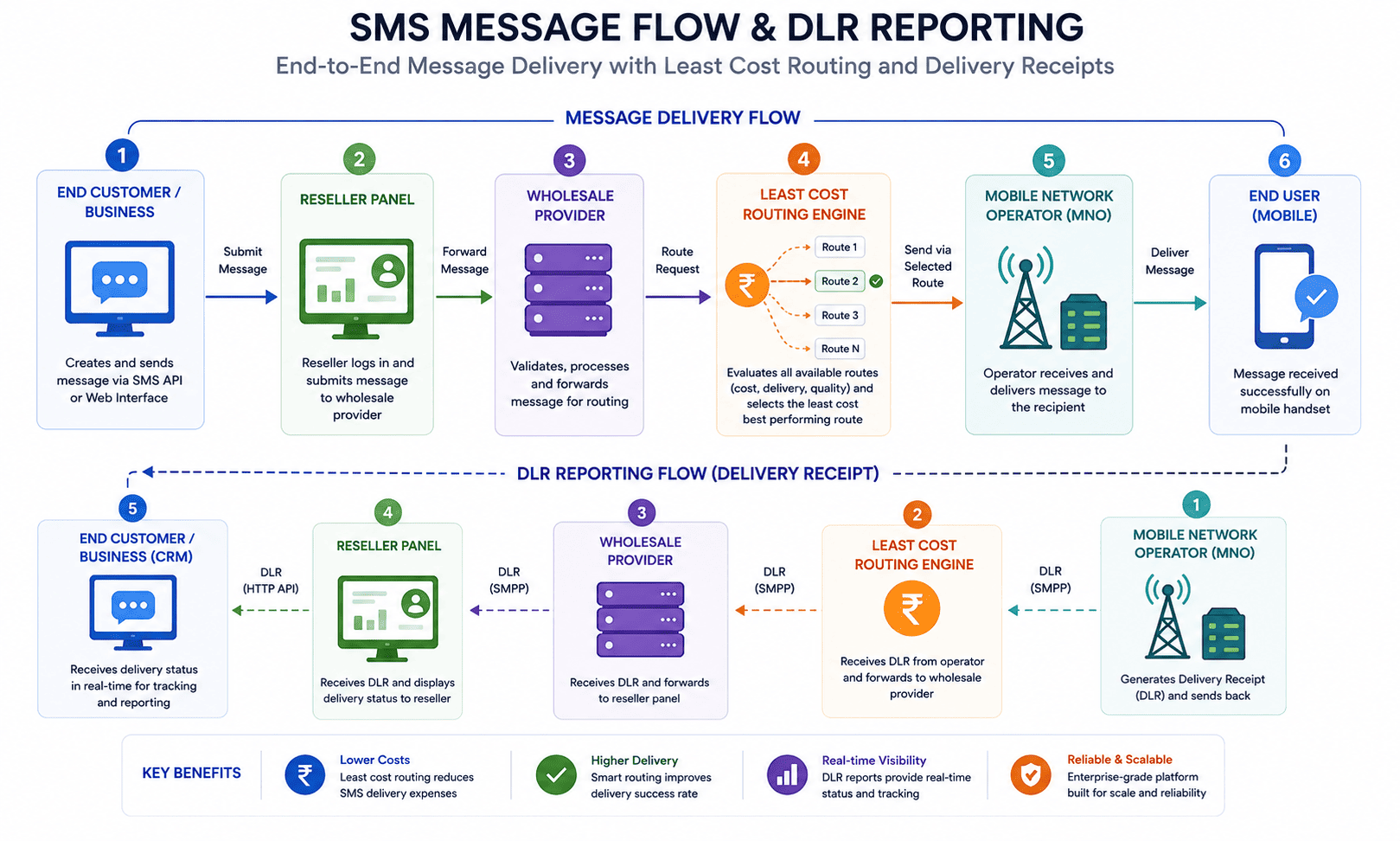
Here is what happens when an end customer sends a message through a reseller platform:
Step 1: The customer submits a message
This happens either through the reseller’s web panel or through an API call, usually an HTTP API or SMPP connection, depending on the customer’s technical setup.
Step 2: The reseller panel authenticates and checks balance
The platform confirms the customer has enough credit and applies the reseller’s own pricing rules for that destination country.
Step 3: The message is forwarded to the wholesale provider
The reseller panel routes the message upstream to the wholesale SMS platform, which the reseller itself does not operate.
Step 4: The wholesale provider applies least cost routing
Least cost routing (LCR) is the process of selecting the most cost-effective, and ideally most reliable, path to deliver a message to a specific mobile network, based on pre-negotiated operator agreements. This step is invisible to both the reseller and the end customer.
Step 5: The message reaches the mobile network operator
The operator delivers the message to the handset and generates a delivery report (DLR), a status update confirming whether the message was delivered, failed, or is still pending.
Step 6: The DLR flows back through the chain
The wholesale provider passes the DLR to the reseller panel, which passes it to the end customer, closing the loop.
A telecom aggregator in the UAE, for example, might resell SMS capacity to a food delivery platform. The platform sends order confirmation texts through the reseller’s API. The reseller never touches SMPP connections or operator contracts directly. It only manages pricing, billing, and the customer relationship.
Key Features of a Bulk SMS Reseller Platform
A reseller platform is only as good as the tools it gives you to run your business. At minimum, look for the following.
- White-label branding: Your logo, your domain, your color scheme. Customers should never see the wholesale provider’s name unless you choose to disclose it.
- Flexible pricing and margin control: You need the ability to set your own retail rates per country, per network, or per customer tier, independent of the wholesale rate you are paying.
- Sub-account and multi-tenant management: If you plan to sell to multiple business customers, you need the ability to create separate sub-accounts, each with its own balance, rate plan, and reporting.
- API access alongside the web panel: Enterprise customers will almost always want to send SMS programmatically through an HTTP API or SMPP connection rather than logging into a web dashboard for every campaign.
- Real-time delivery reporting: DLR accuracy affects trust. If your panel shows delivery status that does not match what actually happened on the network, your customers will notice, usually during a high-stakes send like an OTP campaign.
- Billing and invoicing tools: Automated top-ups, prepaid or postpaid billing, and invoice generation reduce the manual overhead of running a reseller business at scale.
- Route and network visibility: Some platforms show resellers which routes are being used for specific destinations. This matters for reliability, particularly in markets prone to grey routes, unofficial SMS delivery paths that bypass proper operator agreements and often result in unreliable delivery or blocked messages.
Advantages of Using a Bulk SMS Reseller Panel
You Skip the Infrastructure Build:
Building direct SMPP connections with mobile network operators takes time, capital, and ongoing engineering resources. Operator agreements, connection testing, and route optimization are not quick projects. A reseller panel gives you a working SMS business on day one, without that upfront investment.
Faster Time to Revenue:
Because the technical groundwork is already done, you can start onboarding customers and generating revenue almost immediately after setup. For a small telecom operator or a digital agency adding SMS as a service line, this speed matters more than owning the full stack.
Lower Operational Risk:
Route management, operator relationship maintenance, and compliance monitoring for A2P (application-to-person) traffic stay with the wholesale provider. You are not responsible for troubleshooting SMPP binds or renegotiating operator contracts when a route degrades.
Scalable Without Rehiring:
Adding volume through a reseller panel usually means adjusting your account tier or negotiating better wholesale rates, not hiring a telecom engineering team. This makes the model attractive for businesses that want to grow SMS revenue without growing headcount in equal proportion.
Brand Control:
White-label panels mean your customers associate the service with your business, not with the provider behind it. This matters for companies building a long-term brand around communications, marketing, or customer engagement tools.
Limitations and Challenges to Plan For
No reseller model is without trade-offs, and being upfront about them builds a more realistic expectation.
You depend on someone else’s infrastructure quality:
If the wholesale provider’s routes are unreliable or their DLR reporting is inaccurate, that problem becomes your problem, and your customers will hold you accountable for it, not the provider.
Margins can be thin on competitive routes:
Some destination countries have highly competitive wholesale pricing, which compresses the margin you can realistically charge without losing customers to a cheaper reseller.
Compliance still sits partly with you:
Regulations such as 10DLC and TCR (The Campaign Registry) requirements in the US, or sender ID registration rules in markets like the UAE and parts of Africa, often require the reseller to collect and submit customer information, even though the underlying infrastructure belongs to someone else.
You have less control over route changes:
If a wholesale provider changes a route without notice, and delivery quality drops on a specific network, you may not find out until a customer complains.
Fraud exposure exists on both sides:
SIM box fraud, where SIM cards are used to terminate bulk traffic outside legitimate operator agreements, and grey routes can affect resold traffic just as they affect direct traffic. Choosing a provider with clean, GSMA-aligned routing reduces this risk but does not eliminate the need for your own monitoring.
Who Actually Uses Bulk SMS Reseller Panels
Small and mid-sized telecom operators use reseller panels to offer SMS services in markets where they lack direct operator agreements, or to supplement their own infrastructure with additional route diversity.
SMS aggregators and marketing agencies resell SMS capacity as part of a broader marketing or communications service, bundling it with email, WhatsApp, or voice services.
Enterprises with high SMS volume needs, such as logistics companies sending delivery notifications or fintech platforms sending OTPs, sometimes use a reseller arrangement when they want white-label control over pricing across multiple internal business units, without managing operator relationships themselves.
Regional ISPs and value-added service providers, particularly in parts of Africa and Southeast Asia where operator licensing is complex, use reseller panels to add SMS as a revenue line without pursuing a full telecom license.
Bulk SMS Reseller vs Building Your Own SMS Gateway
| Factor | Bulk SMS Reseller | Own SMS Gateway |
| Setup time | Days to weeks | Months, due to operator negotiations |
| Upfront cost | Low, mostly wholesale credit purchase | High, includes infrastructure and connection fees |
| Route control | Limited, managed by provider | Full control over routing decisions |
| Margin ceiling | Set by wholesale rate plus your markup | Potentially higher, but requires scale to justify cost |
| Compliance responsibility | Shared with provider | Fully owned by you |
| Best suited for | Businesses that want speed and lower risk | Businesses with high volume and long-term infrastructure investment plans |
The right choice depends mostly on volume and timeline. A business sending a few million messages a month with no existing operator relationships will usually find reselling faster and cheaper to start. A large telecom operator sending hundreds of millions of messages monthly may eventually find that owning direct routes reduces long-term cost per message, even with the higher upfront investment.
How to Choose a Bulk SMS Reseller Program
Not all reseller programs are built the same way, and the differences show up quickly once you have real customers depending on delivery.
Check route transparency:
Ask the provider directly which regions and networks their routes cover, and whether they can show delivery performance data for the destinations you plan to sell into.
Confirm API documentation quality:
If your customers need to integrate SMS sending into their own applications, unclear or outdated API documentation will slow down every onboarding you do.
Ask about DLR accuracy:
Some providers report “sent” as “delivered.” Ask specifically how delivery reports are generated and whether they reflect actual operator-confirmed delivery status.
Review compliance support:
For US traffic, ask whether the provider supports 10DLC registration workflows. For markets with local regulatory requirements, such as sender ID pre-registration, confirm the provider can guide you through it rather than leaving compliance entirely on your side.
Test support responsiveness before committing volume:
A reseller business lives or dies on your ability to resolve customer delivery issues quickly. If the wholesale provider’s support team is slow to respond during your evaluation period, that pattern usually continues after you sign.
Understand minimum commitments and rate tiers:
Some programs require minimum monthly volume commitments to unlock better wholesale rates. Model your expected volume honestly before agreeing to a tier that assumes growth you have not yet achieved.
Pricing and Margin Structure Explained
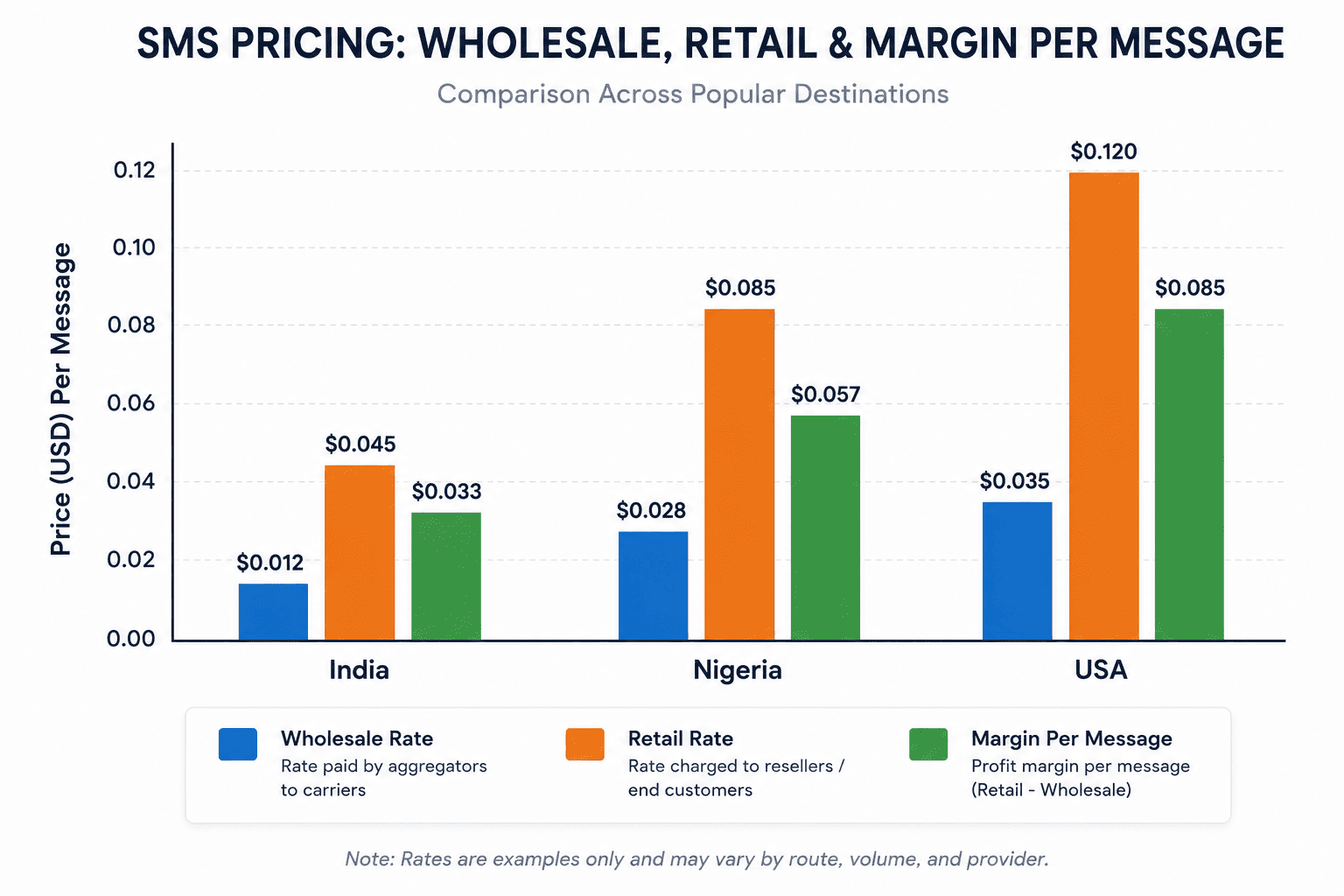
Bulk SMS reseller pricing works on a spread between the wholesale rate you pay and the retail rate you charge. The math looks simple on paper but gets more complicated once the destination mix enters the picture.
Say your wholesale provider charges you $0.008 per message for a specific country, and you set your retail price at $0.012. That is a $0.004 margin per message, or a 50 percent markup. On 500,000 messages a month to that destination, that is $2,000 in gross margin before accounting for platform costs, support, and payment processing fees.
The complication is that wholesale rates vary significantly by destination and even by network within the same country. A reseller selling into multiple countries needs to either set a blended average retail rate, which risks losing margin on expensive routes, or set destination-specific retail pricing, which is more accurate but requires more sophisticated billing tools in the reseller panel.
Expert Insight: Resellers who set a single flat retail rate across all destinations often discover their margin looks healthy on paper but disappears once high-cost destinations make up a larger share of actual traffic. Destination-based pricing, even if it takes longer to set up, protects margin more reliably as your customer base grows into new markets.
Best Practices for Running a Profitable Reseller Business
Set destination-specific pricing rather than a single flat rate, so margin does not erode as your traffic mix shifts toward more expensive routes.
Monitor DLR data weekly, not just when a customer complains, so you catch route degradation before it becomes a support issue.
Keep a small buffer of extra margin on newly added destinations until you have real delivery data showing route reliability.
Automate low-balance alerts and top-up workflows for your sub-accounts to reduce failed sends caused by insufficient credit rather than actual delivery problems.
Document your compliance requirements per country, especially for regulated markets like the US, so onboarding new customers does not stall on paperwork you could have prepared in advance.
Common Mistakes to Avoid
Choosing a provider based only on the lowest wholesale rate:
Cheap routes are sometimes cheap because they use grey routes or unreliable paths. A slightly higher wholesale rate with clean, GSMA-aligned routing usually protects your margin better over time because you spend less on refunds and customer churn caused by failed delivery.
Skipping compliance research before entering a new market:
Sender ID rules, A2P registration requirements, and DLT (Distributed Ledger Technology) frameworks like TRAI’s system in India differ by country. Selling into a market without understanding its rules can result in blocked traffic and, in some cases, penalties.
Underestimating support workload:
Reselling SMS means your customers will contact you, not the wholesale provider, when something goes wrong. Underinvesting in your own support capacity is one of the more common reasons reseller businesses stall after initial growth.
Ignoring route diversity:
Relying on a provider with a single route per destination leaves you exposed if that route degrades. Ask whether your provider offers automatic failover to alternate routes.
Treating the reseller panel as the entire business:
The panel is infrastructure. Your pricing strategy, customer service, and market focus are what actually determine whether the business is profitable.
Conclusion
A bulk SMS reseller panel gives you a way to run an SMS business without owning the infrastructure behind it. The advantage is speed and lower operational risk. The trade-off is that your service quality depends on a provider you do not control directly, which makes choosing the right wholesale partner the single most important decision in the entire model.
If you are evaluating a bulk SMS reseller program, focus less on the lowest headline rate and more on route transparency, DLR accuracy, and compliance support. Those factors determine whether your customers stay with you.
TeleOSS offers an SMS Wholesale Solution built for resellers who need reliable route access, along with SMS Gateway Software for operators who eventually want to move toward owning more of their own infrastructure. If you are exploring which model fits your business, reviewing your expected volume, target markets, and compliance needs first will make that evaluation far more accurate than comparing wholesale rates alone.
FAQs
Can I resell bulk SMS without my own SMS gateway?
Yes. That is the core structure of a bulk SMS reseller model. You do not need to own SMPP connections, operator agreements, or gateway infrastructure. A wholesale SMS provider maintains that layer, and you access it through a white-label reseller panel or API, focusing on pricing, billing, and customer relationships instead.
What does a bulk SMS reseller need to get started?
You need an agreement with a wholesale SMS provider, access to their reseller panel or API, a pricing strategy for your target destinations, and a plan for handling customer support and billing. Depending on your target markets, you may also need to register for local compliance requirements, such as sender ID approval or A2P messaging registration.
How does pricing work in a bulk SMS reseller program?
Pricing works on a margin between the wholesale rate you pay the provider and the retail rate you charge your customers. Wholesale rates vary by destination country and network, so resellers who set destination-specific pricing generally protect margin more effectively than those using a single flat rate across all markets.
Is bulk SMS reselling profitable for small telecom operators?
It can be, particularly because the model avoids the upfront cost of building direct operator connections. Profitability depends on setting realistic margins per destination, managing support costs, and choosing a wholesale provider with reliable route quality. Thin margins on highly competitive routes can limit profitability if pricing is not managed carefully.
What features should a bulk SMS reseller platform include?
At minimum, look for white-label branding, sub-account management, API access alongside a web panel, real-time delivery reporting, flexible destination-based pricing, and billing automation. Route transparency and support responsiveness from the wholesale provider are equally important, even though they are not panel features you can see directly.