

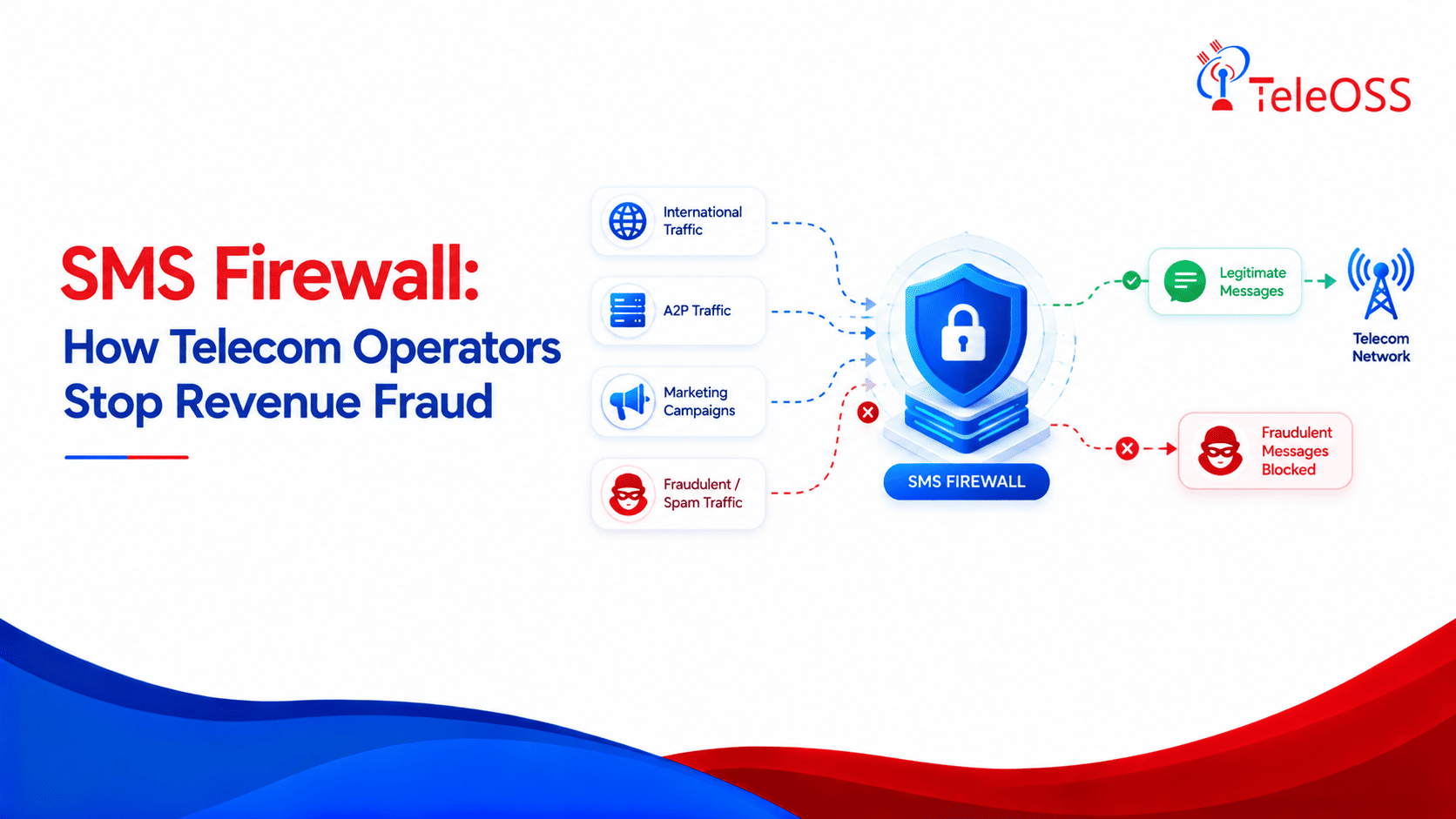
If you run network operations or revenue assurance at a mobile operator, you already know the problem before you read a single definition. A2P traffic keeps growing, aggregators keep multiplying, and somewhere between the enterprise sending the message and the subscriber receiving it, money disappears. An SMS firewall is the system operators deploy to find where that money goes and close the gap without breaking legitimate delivery.
This blog explains what an SMS firewall actually does, how it separates real A2P traffic from disguised P2P traffic, and what to look for if you are evaluating one for your network.
Quick Answer
An SMS firewall is a network element that inspects inbound and outbound SMS traffic in real time to detect and block fraudulent or unauthorized routing, most commonly grey route bypass and SIM box fraud. It sits between the SMSC or SMS gateway and the interconnect, analyzing message signatures, sender behavior, and traffic patterns to classify each message as legitimate A2P, legitimate P2P, or fraud, then applies routing, blocking, or monetization rules accordingly.
Key Takeaways
- An SMS firewall protects revenue by classifying and controlling A2P traffic, not by filtering spam content the way a consumer spam filter does.
- Grey route traffic is estimated to have caused between $30 billion and $37 billion in cumulative global operator revenue leakage over separate multi-year forecast periods, according to industry research firm Mobilesquared.
- SIM box and interconnect bypass fraud cost the telecom industry roughly $3.11 billion in a single year according to CFCA’s 2021 Global Fraud Loss Survey.
- A firewall works by analyzing traffic in real time using signature detection, behavioral analysis, and origin validation, then enforcing policy through blocking, re-routing, or billing correction.
- Operators and aggregators need firewalls for different reasons: operators protect termination revenue, aggregators protect route quality and client trust.
- Choosing a firewall depends on network size, existing SMSC or gateway architecture, detection method coverage, and how the vendor handles false positives on legitimate enterprise traffic.
What Is an SMS Firewall?
An SMS firewall is a network security and revenue protection system deployed by mobile operators to monitor, classify, and control the SMS traffic entering and leaving their network. It sits at the signaling layer, typically between the interconnect (SS7 or SIGTRAN) and the SMSC, where it can inspect every message before it reaches a subscriber or leaves the network toward another operator.
The firewall’s job is narrow but critical: decide whether a message is what it claims to be. A message that presents itself as person to person traffic but actually originates from a bulk enterprise sender is misrepresenting itself to avoid A2P termination fees. The firewall’s detection engine looks for exactly this kind of mismatch.
TeleOSS builds SMS gateway software for operators and aggregators managing exactly this kind of mixed traffic, so the distinction matters in practice, not just on paper. A gateway handles submission, routing, and delivery reporting. A firewall handles classification and enforcement. They are complementary systems, not the same product.
Example: A UK mobile operator receiving international SMPP traffic from an aggregator notices that message volume from a specific bind has a delivery pattern matching a marketing campaign, thousands of messages within a two minute window, identical templated content, sequential destination numbers, but the traffic is arriving over a route billed as P2P. The firewall flags this signature mismatch and either blocks the traffic, re-routes it through the correct A2P interconnect, or holds it for manual review depending on the operator’s configured policy.
How Does an SMS Firewall Work?
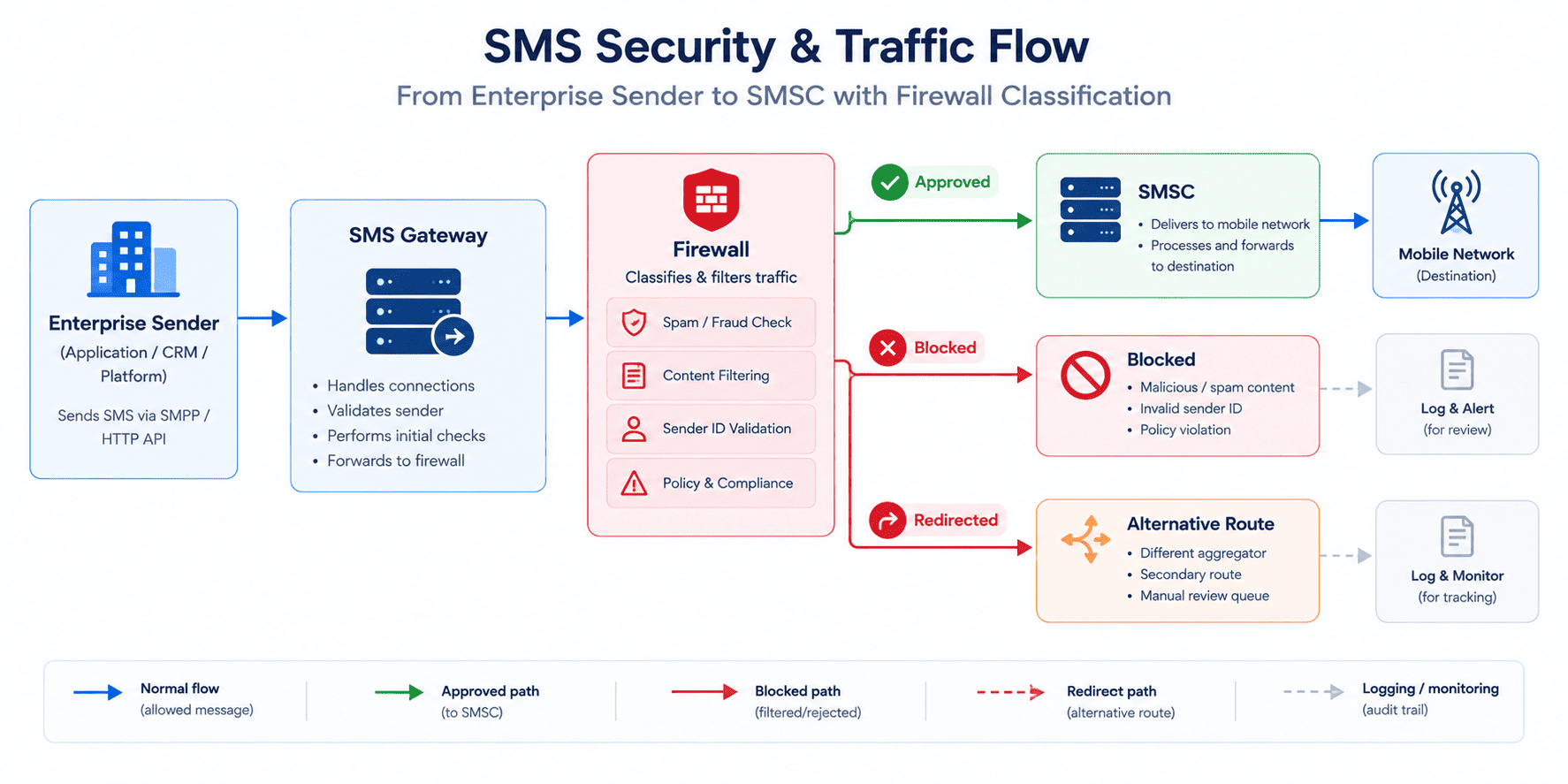
An SMS firewall works by intercepting SMS traffic in real time, running it through a series of detection rules and machine-learned traffic models, and then applying an enforcement action based on the result. The process happens in milliseconds so legitimate messages are not delayed.
Step 1: Traffic interception
The firewall sits inline or in monitoring mode at the SS7, SIGTRAN, or SMPP layer, capturing message metadata such as sender ID, originating network, destination MSISDN, message length, and submission pattern.
Step 2: Signature and pattern analysis
The system compares the message against known fraud signatures. This includes checking sender ID against registered A2P senders, comparing MCC/MNC (Mobile Country Code/Mobile Network Code) combinations against expected roaming or interconnect agreements, and analyzing submission velocity from a single origin.
Step 3: Behavioral scoring
Beyond static signatures, modern firewalls apply behavioral models. A number that suddenly sends five hundred messages in a minute after months of normal P2P usage gets flagged even if no single message looks obviously fraudulent on its own.
Step 4: Policy enforcement
Based on the classification, the firewall either passes the message through unchanged, blocks it outright, redirects it to the correct billing route, or throttles the sender pending investigation.
Step 5: Reporting and revenue reconciliation
Every decision gets logged so revenue assurance teams can reconcile expected sms billing against actual delivered volume, which is often where the financial case for the firewall gets proven internally.
This sequence mirrors how a bank’s fraud detection system screens a card transaction: check identity, check pattern, check velocity, then approve or decline, all before the customer notices any delay.
Grey Route Fraud and How Firewalls Detect It
A grey route is an SMS delivery path that is technically functional but commercially unauthorized. It is not illegal on both ends the way black route traffic is, but it violates the commercial terms between the sender and the terminating operator, usually by disguising A2P messages as P2P traffic to avoid A2P termination fees.
Grey route abuse has been a persistent problem for over a decade. Industry analyst firm Mobilesquared, in a study conducted with Vox Carrier, projected cumulative global grey route revenue leakage of $37.1 billion between 2020 and 2024, alongside a finding that just under half of mobile operators had not yet deployed a next generation SMS firewall at the time of the study.
Firewalls detect grey route traffic through a few concrete mechanisms:
- Sender ID validation: Legitimate A2P senders register alphanumeric or numeric sender IDs with the operator or through schemes like the UK’s approved sender ID list. Traffic using an unregistered or spoofed sender ID gets flagged.
- Termination pattern analysis: P2P traffic from a real subscriber has irregular timing and low volume. A route suddenly carrying thousands of messages per hour from a single number looks nothing like real subscriber behavior.
- Content fingerprinting: Repeated identical or near identical message bodies sent to many different destinations in a short window is a strong bulk messaging signature, regardless of what route it claims to use.
- Interconnect origin checks: The firewall cross references the signaling origin against the commercial agreement on file. If a message claims to originate from a roaming partner’s network but the signaling path does not match that partner’s known routes, it gets held.
Case reference: AdaptiveMobile’s threat intelligence research, drawn from real time network analysis across five continents, documented that A2P bypass fraud through grey routes was a persistent and evolving problem across every region studied, reinforcing that this is not a market specific issue confined to one region or operator size.
SIM Box Fraud and Interconnect Bypass
SIM box fraud, sometimes called interconnect bypass fraud, is a related but distinct threat that SMS and voice firewalls both need to address. A SIM box is a physical or virtual device loaded with dozens or hundreds of prepaid SIM cards. Fraudsters route international traffic through these SIM cards so it terminates as if it were a local call or local message, letting them collect international rates from the originator while paying only local, often heavily discounted, termination costs to the operator.
The Communications Fraud Control Association’s 2021 Global Fraud Loss Survey estimated that SIM box and broader interconnect bypass fraud cost the global telecom industry approximately $3.11 billion in a single year, representing roughly 7.8% of total industry fraud losses reported in that survey.
For SMS specifically, SIM box operators exploit the same price gap logic for messaging traffic. Bulk A2P messages get split across many prepaid SIM identities and injected as if each one were an individual subscriber sending a personal text, which lets the fraud operation collect enterprise sending fees while paying negligible termination cost.
Firewalls counter this by watching for the operational fingerprint of SIM box hardware: many different SIM identities on the same physical cell tower or IP range, near identical message content across supposedly unrelated numbers, and SIM cards that show messaging behavior but almost no voice or data usage, which is unusual for a genuine subscriber.
Expert insight: In gateway deployments TeleOSS has supported, the clearest early warning sign of SIM box activity is rarely the message content itself. It is the SIM registration pattern: dozens of SIMs activated in the same short window, on the same device fingerprint or cell ID, with billing behavior that never matches typical consumer usage. Firewalls that only inspect message payload without correlating registration and device data will miss this pattern entirely.
SMS Firewall vs Spam Filter
These two systems get confused often, but they solve different problems and operate at different layers.
| Aspect | SMS Firewall | Spam Filter |
| Primary purpose | Protect operator revenue by detecting fraud and bypass routing | Protect subscribers from unwanted or malicious content |
| Deployment layer | Network signaling layer (SS7, SIGTRAN, SMPP) | Application or handset layer, sometimes SMSC content scanning |
| Detection method | Route analysis, sender ID validation, traffic pattern, MCC/MNC checks | Keyword matching, sender reputation, content classification |
| Who deploys it | Mobile network operators, sometimes aggregators | Operators, handset manufacturers, third party apps |
| Financial impact | Directly tied to termination revenue and route monetization | Indirectly tied to subscriber satisfaction and churn |
| Regulatory relevance | Central to 10DLC, TRAI DLT, and grey route enforcement | Relevant to unsolicited commercial message rules |
A firewall can and often does incorporate some content level checks, but its core function is traffic classification for revenue protection, not content moderation for subscriber protection. A message can be perfectly legitimate content, a delivery notification or an OTP, and still get flagged by a firewall if it arrives over an unauthorized route.
Key Features of a Modern SMS Firewall
- Real time traffic classification: The firewall needs to make a pass, block, or redirect decision in the time it takes a normal message to transit the network, typically under a few hundred milliseconds, so legitimate delivery is not delayed.
- Sender ID and A2P registration checks: This matters increasingly given regulatory frameworks like 10DLC in the United States managed through The Campaign Registry (TCR), and TRAI’s DLT framework in India, both of which require registered sender identities for A2P traffic.
- MCC/MNC and origin based routing rules: The firewall needs current, accurate mobile country code and mobile network code data to validate that traffic claiming a specific origin actually matches known interconnect paths for that origin.
- Machine learning behavioral models: Static rules catch known fraud patterns. Behavioral models catch new patterns that have not been seen before by looking at deviation from a sender’s or route’s historical baseline.
- Revenue reconciliation reporting: A firewall that blocks fraud but produces no usable reporting makes it hard for revenue assurance teams to quantify the value of the deployment or to build the business case for expanding coverage.
- Integration with the SMS gateway and SMSC: The firewall needs to communicate cleanly with the operator’s existing SMS gateway software and SMSC so that legitimate traffic continues flowing without manual intervention every time a rule changes.
Do Aggregators Need Their Own Firewall?
Yes, and the reason is different from why operators deploy one. Operators use a firewall to protect termination revenue on their own network. Aggregators sit between enterprise senders and multiple operators, so their exposure is different: a compromised or poorly vetted enterprise client sending traffic through the aggregator’s platform can get that aggregator’s entire connection blacklisted by an operator if the operator’s firewall detects consistent bypass attempts coming from that aggregator’s routes.
An aggregator level firewall protects the aggregator’s relationship with every operator it connects to, not just one network’s revenue. It also protects the aggregator’s own margin, since misclassified or fraudulently routed traffic through the aggregator’s own infrastructure can result in unexpected termination charges the aggregator did not budget for.
Example: A regional SMS aggregator connecting operators across Southeast Asia may run traffic through several countries with different regulatory requirements. Without its own firewall layer, the aggregator has no visibility into whether one of its enterprise clients is submitting traffic that looks like grey route abuse until an operator on the receiving end blocks the connection entirely, which then affects every other legitimate client routed through that same connection.
Benefits and Limitations
Benefits
- Recovers revenue that would otherwise leak through unauthorized routing, directly improving A2P monetization.
- Improves delivery reliability for legitimate enterprise senders because their traffic is not competing with, or getting mistaken for, fraudulent bulk traffic.
- Supports regulatory compliance for frameworks that require registered sender validation, such as 10DLC and TRAI DLT.
- Provides audit grade reporting that revenue assurance and finance teams can use to reconcile billing.
Limitations
- False positives are a real operational risk. Overly aggressive rules can block legitimate enterprise traffic, particularly time sensitive messages like one time passcodes, which creates customer complaints and business risk for the operator.
- Firewalls require ongoing tuning. Fraud patterns evolve, and a rule set that worked well a year ago can miss new bypass techniques without regular updates.
- Deployment complexity varies. Integrating a firewall into an existing SMSC and interconnect architecture takes planning, especially for operators running legacy signaling infrastructure alongside newer SMPP based gateways.
- A firewall alone does not solve every fraud vector. SIM box fraud detection benefits from correlation with voice network data and device fingerprinting that a pure SMS level firewall may not have visibility into on its own.
How to Choose an SMS Firewall?
Selecting a firewall is a technical and commercial decision at the same time, so the evaluation criteria need to cover both.
- Detection coverage: Confirm the vendor’s detection methods explicitly cover grey route bypass, SIM box fraud signatures, and sender ID spoofing, not just generic spam keyword filtering.
- False positive rate and tuning process: Ask for real numbers, not marketing claims, on how the system handles legitimate high volume senders like OTP providers, and how quickly rules can be adjusted when a legitimate client gets misclassified.
- Integration with existing infrastructure: Verify compatibility with your current SMSC, SMS gateway software, and signaling stack (SS7 or SIGTRAN) before committing, since a poor integration can create latency that affects delivery times.
- Reporting and revenue reconciliation tools: The system should produce reports your finance and revenue assurance teams can actually use to demonstrate return on investment.
- Regulatory alignment: If you operate in markets with A2P registration requirements like 10DLC or TRAI DLT, confirm the firewall’s validation logic is kept current with those specific frameworks.
- Vendor track record and support model: Given how quickly fraud tactics change, ongoing vendor support and update cadence matters as much as the initial feature set.
Cost varies significantly by network size, traffic volume, and deployment model, and reliable published benchmarks for mid-size operator firewall pricing are limited.
Common Mistakes to Avoid
- Treating the firewall as a one time deployment: Fraud patterns change constantly. A firewall configured once and left alone loses effectiveness within months as new bypass techniques emerge.
- Setting rules too aggressively without a review process: Blocking too much legitimate A2P traffic, especially OTPs and transactional messages, creates real business harm and can damage trust with enterprise clients faster than the fraud it was meant to stop.
- Ignoring aggregator level fraud exposure: Operators sometimes assume their firewall alone is sufficient, without accounting for the fact that fraud can enter through an aggregator’s infrastructure before it even reaches the operator’s network boundary.
- Underinvesting in reporting: A firewall that blocks fraud silently, without clear before and after revenue reporting, makes it hard to justify continued investment or expansion of the system internally.
- Failing to correlate SMS and voice fraud signals: SIM box fraud often shows up in both voice and SMS behavior. Firewalls or fraud teams that only look at one channel miss the full picture.
Conclusion
An SMS firewall exists to answer one question for every message crossing an operator’s network: is this traffic what it claims to be. Grey route bypass and SIM box fraud both rely on disguising bulk commercial traffic as ordinary subscriber activity, and the financial impact of that disguise, measured in billions of dollars in leaked revenue across the industry, is why firewalls have become standard infrastructure rather than an optional add on.
The right firewall for your network depends on your traffic profile, your existing SMSC and gateway architecture, and how much false positive risk you can tolerate on your legitimate enterprise senders. Operators and aggregators evaluating their messaging infrastructure often look at fraud protection and gateway routing together, since the two systems need to work in sync to protect both revenue and delivery quality.
If you are reviewing how your current SMS gateway software handles A2P classification and routing, TeleOSS’s SMS gateway platform is built to integrate with firewall level fraud controls as part of a broader messaging infrastructure stack. You can review the technical details on the TeleOSS SMS Gateway Software to see how routing, delivery reporting, and fraud control fit together in a single deployment.
FAQs
What is an SMS firewall and how does it work for telecom operators?
An SMS firewall is a network system that inspects SMS traffic at the signaling layer to detect fraud and unauthorized routing, particularly grey route bypass and SIM box fraud. It works by analyzing sender ID, traffic patterns, and message signatures in real time, then applying rules to block, redirect, or allow each message based on whether it matches known legitimate A2P or P2P behavior.
How does an SMS firewall detect and block grey route fraud?
It compares incoming traffic against expected P2P and A2P behavior patterns, checking sender ID registration, message velocity, content repetition, and whether the signaling origin matches the operator’s known interconnect agreements. Traffic that claims to be P2P but behaves like bulk enterprise messaging gets flagged, then blocked, throttled, or re-routed to the correct billing path depending on the operator’s configured policy.
What is the difference between an SMS firewall and a spam filter?
An SMS firewall focuses on network level fraud and revenue protection by classifying traffic routes and sender legitimacy. A spam filter focuses on content level protection for subscribers by blocking unwanted or malicious message content. A firewall can incorporate some content checks, but its core purpose is different from a spam filter’s subscriber facing role.
Do SMS aggregators need a separate SMS firewall from operators?
Yes. Operators deploy firewalls to protect their own network’s termination revenue. Aggregators need their own firewall layer to protect their relationships across multiple operator connections and to catch fraudulent traffic from enterprise clients before it reaches an operator’s network, since a blocked connection due to one bad client can affect every other client routed through the same aggregator link.
How much does an SMS firewall solution cost for a mid-size operator?
Pricing depends heavily on network size, traffic volume, deployment model (on premises versus hosted), and the vendor’s licensing structure, and there is no single reliable published benchmark figure across the market. Operators evaluating cost should request vendor specific quotes based on their actual traffic profile rather than relying on generic published estimates. [VERIFY: current vendor pricing before publishing any specific figures.]
Can a firewall accidentally block legitimate messages?
Yes, this is a known operational risk called a false positive. It happens most often with high volume legitimate senders like OTP or transactional alert providers whose traffic pattern can resemble bulk fraud at a glance. A well configured firewall includes a tuning process and a fast path for verified enterprise senders to reduce this risk.
Does an SMS firewall help with regulatory compliance like 10DLC or TRAI DLT?
It can support compliance by validating that A2P traffic matches registered sender information required under frameworks like 10DLC, managed through The Campaign Registry in the United States, or TRAI’s DLT framework in India. The firewall itself does not replace the registration process, but it enforces that only properly registered traffic is treated as legitimate A2P.