
If you have ever received a delivery update, a one time password, or an appointment reminder by text, an SMS gateway made that happen. It is the piece of infrastructure that sits between software and the mobile network, and understanding how it works matters if you are building anything that sends messages at scale.
This guide explains what an SMS gateway actually does, how a message moves from an application to a handset, and what separates a gateway that will hold up under real traffic from one that will not.
Quick Answer
An SMS gateway is a system that lets applications send and receive text messages by connecting to mobile network infrastructure, typically through an SMPP connection or an HTTP based API. It converts a message request from software into a format the telecom network can deliver, routes it through the right carrier, and returns a delivery status back to the sender. Businesses use gateways to automate SMS instead of sending messages manually through a phone.
Key Takeaways
- An SMS gateway connects applications to mobile networks so messages can be sent and received programmatically instead of manually.
- Gateways typically use SMPP for high volume connections or HTTP/REST APIs for simpler integration.
- A2P (application to person) traffic, such as OTPs and alerts, is routed differently from P2P (person to person) traffic and is subject to separate carrier rules.
- SMS Delivery reports (DLRs) confirm whether a message reached the handset, which matters for compliance and troubleshooting.
- Choosing a gateway depends on throughput needs, route quality, protocol support, and whether you need two way messaging.
What Is an SMS Gateway?
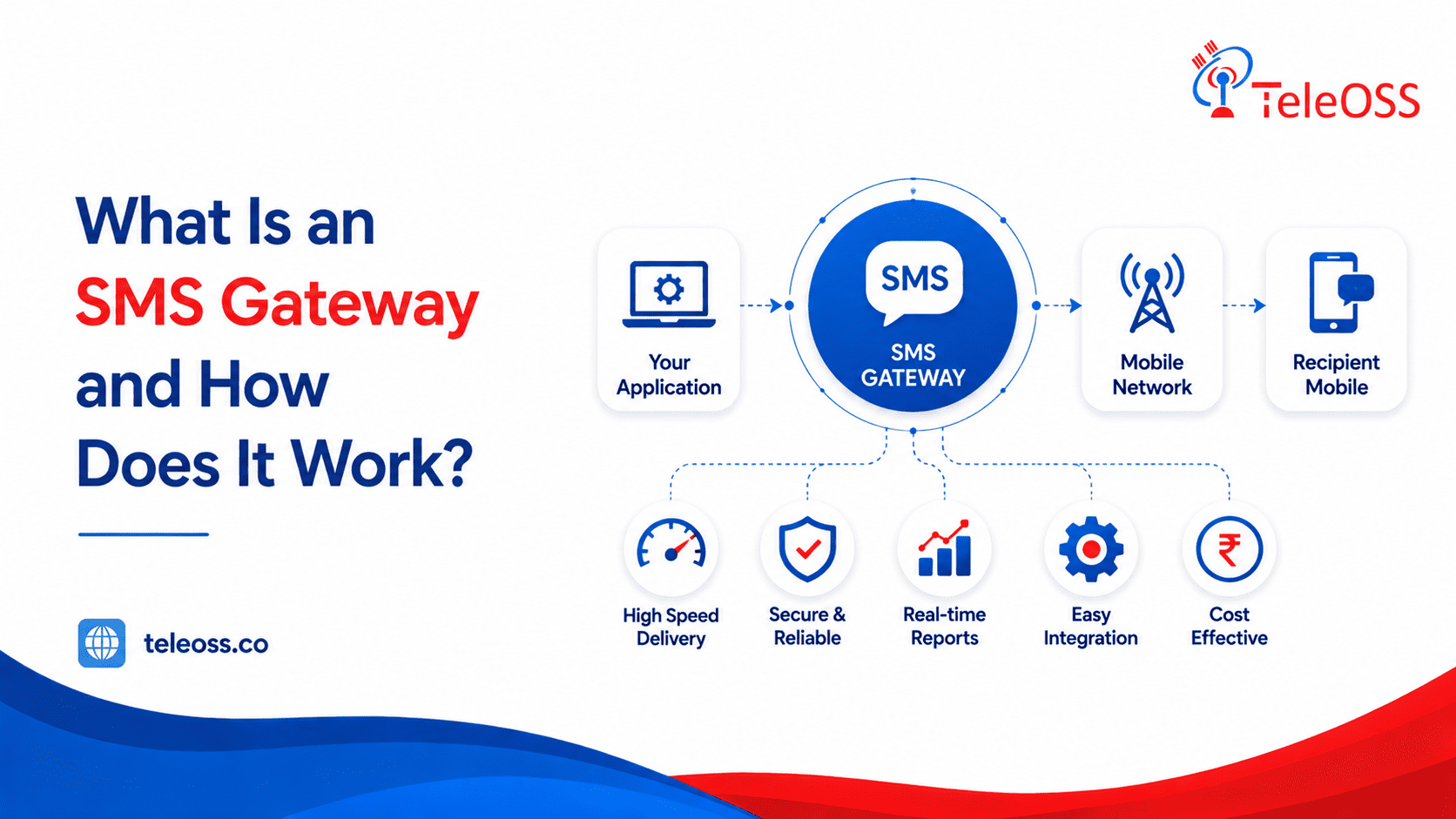
An SMS gateway is software or hardware that lets an application send and receive text messages by interfacing with a telecom network. It works by accepting a message from a source such as a website, CRM, or billing system, translating that request into a protocol the network understands, and passing it along to a mobile operator for final delivery.
Think of it as a translator sitting between two systems that would not otherwise be able to talk to each other. Your CRM knows how to make an API call. It does not know how to talk to a mobile operator’s SMSC (Short Message Service Center). The gateway bridges that gap.
Example: An e-commerce platform wants to text customers when their order ships. The platform’s backend sends a request to an SMS gateway with the recipient number and message content. The gateway checks the number, selects an appropriate route, and forwards the message to the operator network that serves that number. Within seconds, the customer gets the text, and the gateway sends a delivery confirmation back to the platform.
How Does an SMS Gateway Work?
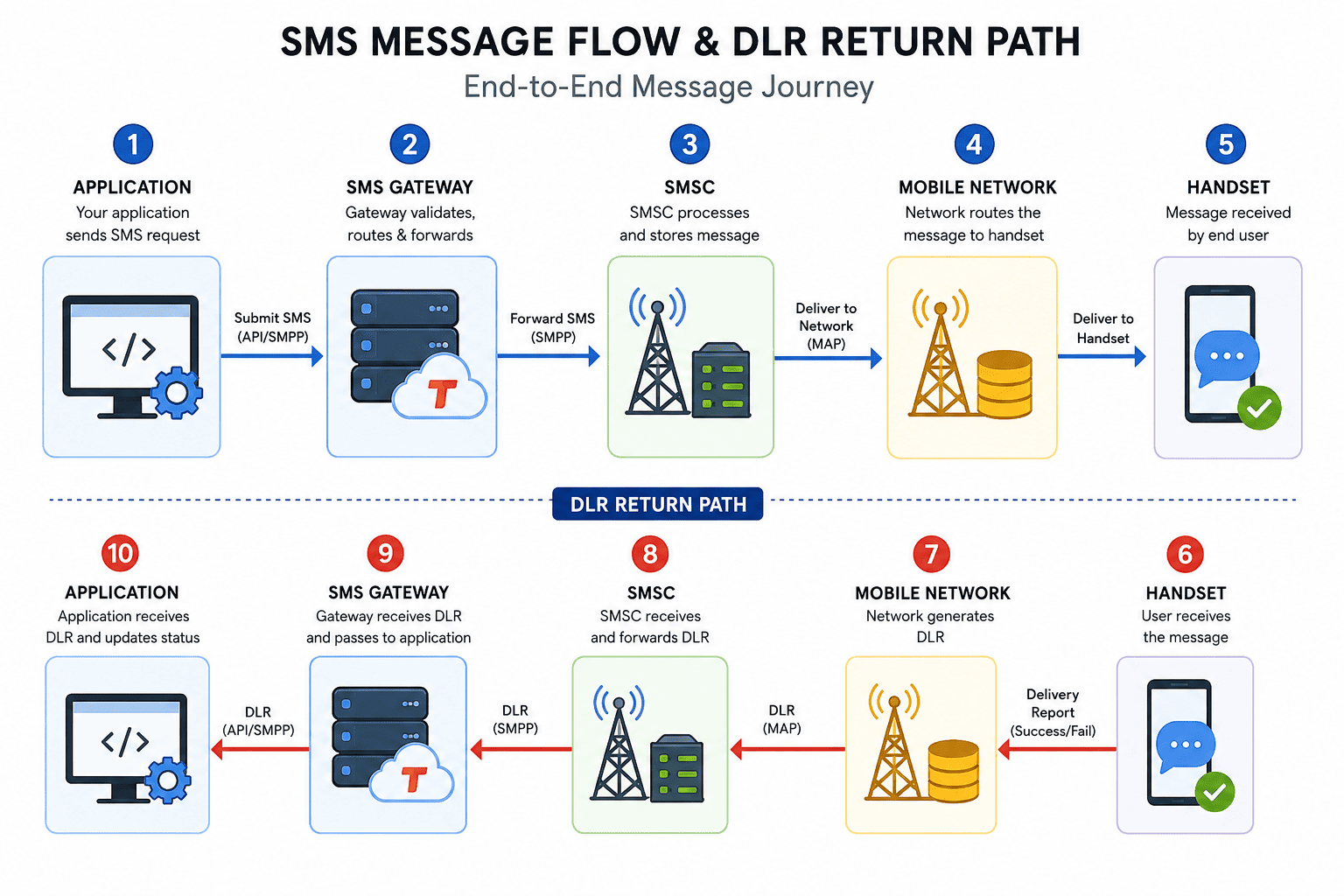
An SMS gateway works by receiving a message request from an application, converting it into a carrier-compatible format, routing it through the correct network path, and returning delivery status once the message reaches the handset or fails.
Here is the sequence in more detail:
Step 1: Message submission. An application sends a request to the gateway, usually through an API call or an SMPP bind. The request includes the sender ID, recipient number, and message body.
Step 2: Validation and formatting. The gateway checks the number format, applies any required encoding (GSM 03.38 for standard text, Unicode for non-Latin scripts or emoji), and splits long messages into multiple segments if needed.
Step 3: Routing. The gateway decides which carrier or interconnect path will handle the message. Larger platforms use least cost routing (LCR) logic here, balancing cost against delivery quality across multiple routes.
Step 4: Delivery to the SMSC. The message is handed off to the destination operator’s SMSC, which queues it for delivery to the subscriber’s handset.
Step 5: Delivery confirmation. Once the handset acknowledges receipt, the SMSC generates a delivery report (DLR), which travels back through the same chain to the original application.
For two way SMS, the same path runs in reverse when a subscriber replies, with the gateway routing the inbound message back to the originating application.
Example: A bank’s authentication system generates a one time password and sends it to its SMS gateway through a REST API. The gateway formats the message, routes it via an interconnect partner with strong delivery rates in that country, and the SMSC pushes it to the subscriber’s handset. The gateway then returns a “delivered” status to the bank’s system within a few seconds, which the bank uses to unlock the next step in the login flow.
SMS Gateway vs Messaging API: What Is the Difference?
An SMS gateway is the infrastructure that actually connects to telecom networks and moves messages across them. A messaging API is the interface a developer uses to talk to that infrastructure. In practice, most modern SMS gateway providers expose their gateway through an API, so the terms get used loosely, but the distinction matters when you are evaluating vendors.
| Aspect | SMS Gateway | Messaging API |
| Core function | Connects to carrier networks and routes messages | Provides a developer interface to trigger messages |
| Ownership | May be operated directly or through interconnect partners | Usually a layer built on top of one or more gateways |
| Protocol | Often supports SMPP for carrier-grade connections | Typically HTTP/REST, sometimes with SMPP as an option |
| Best fit | Telecom operators, aggregators, high-volume senders | Developers building apps that need to send messages without managing telecom infrastructure |
Some vendors, including TeleOSS, offer both layers, an SMPP-based gateway for operators and aggregators who need direct network control, and a REST API for teams that just need reliable message delivery without managing routing logic themselves.
SMPP vs HTTP API: Which Connection Type Do You Need?
SMPP (Short Message Peer-to-Peer) is a binary protocol built specifically for exchanging SMS traffic at high volume. It maintains a persistent connection between the sender’s system and the SMSC, which makes it efficient for sustained, high-throughput traffic such as wholesale routing between operators or large-scale A2P campaigns.
HTTP APIs are simpler to integrate. A developer sends a standard web request with the message details and gets a response back, similar to any other REST API call. This is usually the better fit for applications with moderate volume or teams that want to get started quickly without managing persistent connections.
As a general rule, SMPP is selected when throughput, low latency, and fine-grained connection control matter, such as telecom operators exchanging traffic or aggregators handling millions of messages a day. HTTP APIs are selected when ease of integration and development speed matter more than raw throughput.
Example: An SMS aggregator handling several million messages daily across multiple countries will typically maintain SMPP binds with each carrier or interconnect partner, since the persistent connection avoids the overhead of establishing a new HTTP session for every message. A mid-sized SaaS company sending appointment reminders to a few thousand customers a day, on the other hand, is usually better served by a straightforward HTTP API integration.
Key Features of an SMS Gateway Software
- Multi-route delivery: connects to multiple carriers or interconnect partners so traffic can shift automatically if one route degrades.
- Delivery reporting (DLR): confirms whether a message was delivered, failed, or is pending, which matters for both troubleshooting and regulatory recordkeeping.
- Protocol flexibility: supports SMPP, HTTP/REST, or both, depending on the sender’s technical needs.
- Sender ID management: lets businesses register and use recognizable sender names or numbers, subject to local regulations.
- Throughput controls (TPS): manages how many messages per second are sent to avoid overwhelming a route or triggering carrier filtering.
- Two way support: routes inbound replies back to the originating application for use cases like SMS surveys or customer support.
- Encoding and concatenation handling: automatically manages character encoding and message segmentation for longer texts.
Can an SMS Gateway Support Two Way Messaging?
Yes, a properly configured SMS gateway supports two way messaging, allowing subscribers to reply to a message and have that reply routed back to the originating application. This is what powers use cases like SMS-based customer support, appointment confirmations where a customer texts “yes” or “no,” and interactive surveys.
Two way SMS requires the gateway to maintain a mapping between the long code, short code, or virtual number a message was sent from and the application that should receive the reply. When a subscriber responds, the SMSC forwards the message to the gateway, which matches it to the correct account and delivers it, usually through a webhook or callback URL.
Example: A logistics company sends a delivery window text asking the customer to reply “R” to reschedule. When the customer replies, the gateway receives the inbound message, matches it against the original conversation thread using the sender number, and pushes it to the logistics company’s system in real time, triggering a rescheduling workflow.
What Is A2P SMS and How Does a Gateway Handle It?
A2P SMS (application to person) refers to messages sent from a business system to an individual, such as OTPs, shipping alerts, marketing texts, and appointment reminders. It is distinct from P2P (person to person) traffic, which is one individual texting another.
Carriers treat A2P traffic differently from P2P traffic because of its volume and its potential for spam or fraud. In the United States, A2P traffic on long codes typically needs to be registered through The Campaign Registry (TCR), a system created in coordination with mobile carriers to vet business messaging campaigns before they reach subscribers at scale. Similar registration and filtering frameworks exist in other markets, such as India’s DLT registration overseen by TRAI.
An SMS gateway handles A2P traffic by applying the correct routing class, respecting registered throughput limits, and, where relevant, ensuring the sender ID or campaign matches what was registered with the carrier or regulator. Gateways that do not properly separate A2P from P2P traffic risk having messages filtered or blocked by carrier spam detection systems, which is one of the most common causes of poor delivery rates.
Example: A healthcare provider registers an A2P campaign for appointment reminders under 10DLC rules in the US. Their SMS gateway tags outbound messages from that campaign with the registered sender ID and respects the approved throughput, which keeps delivery rates high and avoids the carrier-level filtering that unregistered traffic often triggers.
SMS Gateway Use Cases
- Authentication: sending OTPs for login or transaction verification.
- Transactional alerts: order confirmations, shipping updates, appointment reminders.
- Marketing: promotional campaigns, sent with proper consent and opt-out handling.
- Customer support: two way conversations for service requests.
- Internal operations: shift alerts, on-call notifications, system monitoring alerts sent to staff.
- Wholesale and aggregator routing: operators and aggregators using gateways to exchange bulk traffic across networks and countries.
How to Choose the Best SMS Gateway
There is no single best SMS gateway for every business. The right choice depends on your traffic volume, technical resources, and regulatory footprint. Here is a practical framework:
- Match the protocol to your scale. If you are sending millions of messages a day across multiple countries, prioritize SMPP support and route diversity. If you are sending thousands a day from a single application, a well-documented HTTP API may be all you need.
- Check delivery reporting depth. Ask whether DLRs are near real time and whether failure reasons are granular enough to actually troubleshoot problems, not just “failed” with no further detail.
- Confirm route quality, not just route count. A provider with connections to fifty carriers is not automatically better than one with fifteen strong direct or Tier 1 interconnects. Ask about direct operator connections versus grey routes.
- Verify compliance support. For US traffic, confirm the provider supports 10DLC registration through TCR. For India, confirm DLT compliance. Gateways that ignore these requirements will see rising filter rates over time.
- Evaluate two way and automation capabilities if your use case needs replies, keyword triggers, or workflow automation rather than one-directional sending.
- Test throughput under real load, not just in a sales demo. TPS limits that look fine in testing sometimes bottleneck once real campaign volume hits.
Common Mistakes to Avoid
- Treating all routes as equal. Cheaper routes are sometimes grey routes that violate carrier terms and carry a higher risk of being blocked without warning.
- Skipping A2P registration. Sending unregistered A2P traffic on long codes in markets that require registration, like the US, typically results in filtering and dropping messages over time.
- Ignoring DLR data. Businesses that do not monitor delivery reports often do not notice degrading delivery rates until customer complaints pile up.
- Overlooking throughput limits. Sending a large campaign faster than the negotiated TPS can trigger carrier throttling or temporary blocks.
- Choosing based on price alone. The cheapest per-message rate is not useful if a meaningful percentage of messages never reach the handset.
Best Practices for SMS Gateway Integration
- Register A2P campaigns proactively rather than reactively, especially in the US and India.
- Monitor DLR success rates by route and adjust or escalate with your provider when a specific corridor underperforms.
- Use dedicated short codes or registered long codes for high-volume transactional traffic instead of relying on shared or unregistered numbers.
- Build retry logic for temporary failures, but respect carrier throughput limits rather than retrying aggressively.
- Keep opt-out handling automated and immediate, both because it is required in most jurisdictions and because it protects your sender reputation.
Conclusion
An SMS gateway is the connective layer between your application and the mobile networks that actually deliver a text message to someone’s phone. Whether you are sending OTPs, running A2P campaigns, or handling wholesale traffic as an aggregator, the gateway you choose determines how reliably those messages land, how well you can troubleshoot problems through delivery reports, and how easily you stay compliant with carrier and regulatory requirements.
If you are evaluating options, start with your actual traffic profile, not a feature checklist. Decide whether you need SMPP-grade throughput or a simpler API integration, check route quality over route count, and confirm the provider handles A2P registration properly in the markets you operate in.
TeleOSS builds SMS gateway software and wholesale messaging infrastructure for telecom operators, aggregators, and enterprises that need dependable routing and clear delivery visibility. If you want to see how it fits your traffic and route requirements, you can explore TeleOSS’s SMS gateway software or reach out to talk through your specific setup.
FAQs
What is the difference between an SMS gateway and a messaging API?
An SMS gateway is the infrastructure that connects to telecom networks and routes messages. A messaging API is the interface developers use to send requests to that infrastructure. Many providers combine both, offering an API that sits on top of their own gateway and carrier connections.
How do I choose the best SMS gateway for my business?
Match the gateway to your volume and technical needs. High-volume senders typically need SMPP support and route diversity, while smaller senders often do better with a simple HTTP API. Also check delivery reporting quality, route quality, and compliance support for markets like the US (10DLC/TCR) or India (DLT).
Can an SMS gateway support two way messaging and replies?
Yes. A gateway configured for two way SMS routes subscriber replies back to the originating application, usually through a webhook. This supports use cases like SMS-based customer service, confirmations, and surveys where a response triggers a workflow.
What is A2P SMS and how does an enterprise gateway handle it?
A2P (application to person) SMS is messaging sent from a business system to an individual, such as OTPs and alerts. Enterprise gateways handle A2P traffic by applying registered routing classes, respecting approved throughput, and aligning sender IDs with campaign registrations required by carriers and regulators.
How does SMS automation work through a gateway platform?
SMS automation works by connecting a gateway’s API to a business system, such as a CRM or billing platform, so messages trigger automatically based on events like an order status change or a scheduled reminder, without manual sending.
Do SMS gateways work internationally?
Most gateways support international delivery, but route quality and regulatory requirements vary significantly by country. It is worth confirming direct or Tier 1 interconnect coverage for the specific countries you send to rather than assuming global coverage means consistent delivery everywhere.