

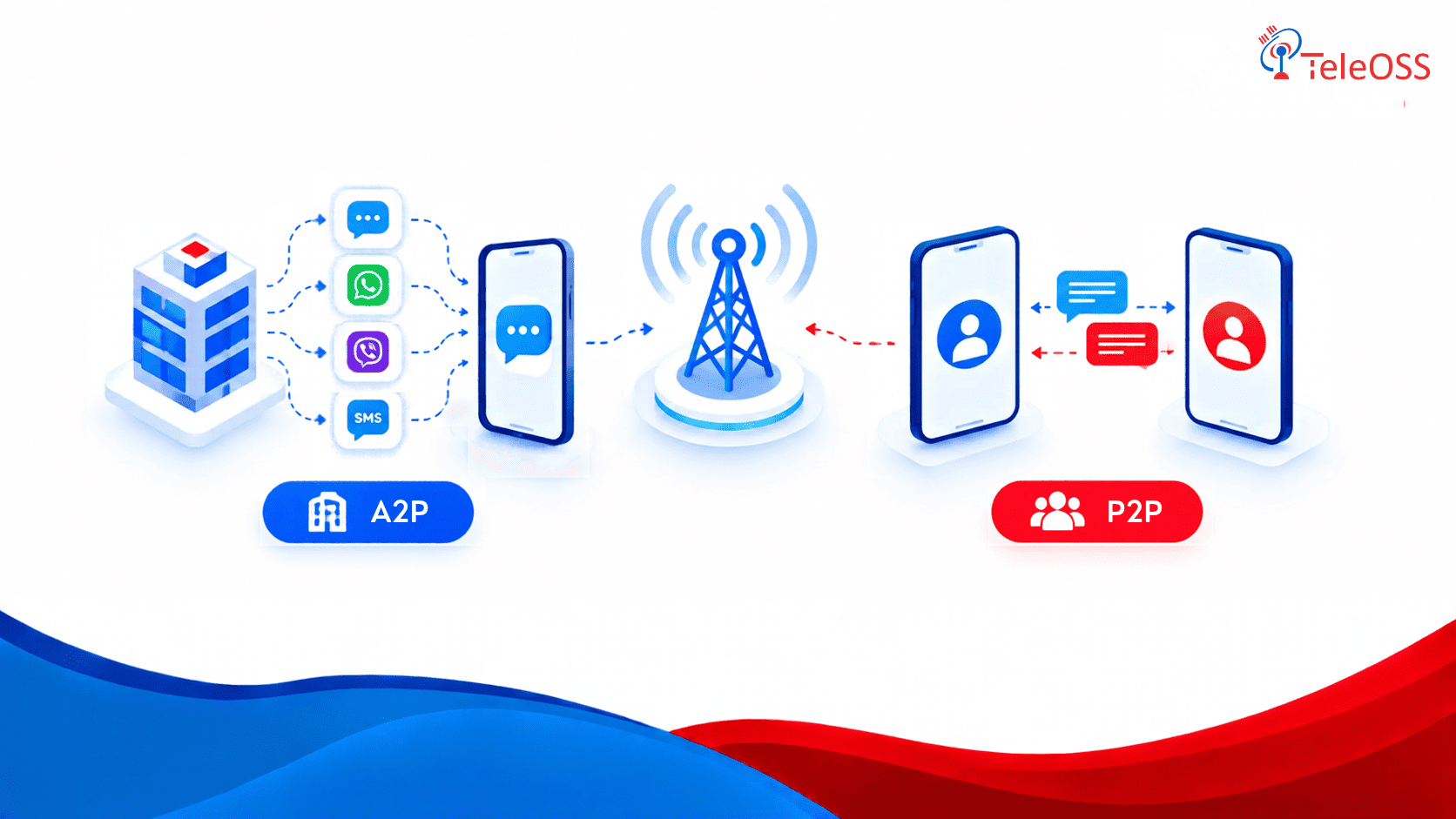
Two SMS can look identical on a handset and still be treated as different products by the network. One is a person texting a friend. The other is a bank, a retailer, or a platform sending a message through software.
That split sits at the center of a2p vs p2p messaging. It decides how traffic is routed, filtered, and priced, and whether it needs registration at all.
If you buy or sell messaging capacity, a wrong classification shows up as blocked traffic, surprise fees, and terminated routes. This guide explains how carriers draw the line, how aggregators enforce it, and what to check before you sign a messaging contract.
Quick Answer
A2P (application to person) messaging is SMS sent by software on behalf of a business to individuals. P2P (person to person) messaging is SMS typed by one individual to another from a handset. Carriers treat them differently: A2P needs authorised routes and, in many markets, registration, while P2P travels on consumer plans. Sending A2P traffic over P2P paths is called a grey route and risks blocking.
Key Takeaways
- Classification depends on who or what sends the message, not on the message content.
- A2P traffic is expected to use authorised routes. P2P paths are built for consumer conversation, not business volume.
- In the US, A2P traffic over 10 digit long codes must be registered through The Campaign Registry. Unregistered traffic has been blocked since early 2025.
- UK and UAE destinations filter A2P traffic that uses unregistered or generic sender IDs.
- Judge a route by cost per delivered message, not cost per submitted message.
- Misclassification rarely brings a single fine. It brings blocking, number suspension, pass through fees, and lost trust with upstream partners.
A2P vs P2P Messaging at a Glance
The core difference is the originator. P2P starts with a human on a handset. A2P starts with an application, usually connected to an SMS gateway over SMPP or an HTTP API.
| Factor | A2P (application to person) | P2P (person to person) |
| Originator | Software acting for a business or organization | An individual using a handset |
| Typical connection | SMPP bind or HTTP API to a gateway or aggregator | Subscriber SIM on the operator’s network |
| Volume pattern | Bursty, high volume, repeated content | Low volume, unique content |
| Direction | Heavily outbound | Roughly balanced in both directions |
| Registration | Often required (US 10DLC brand and campaign, sender ID registration in several countries) | None |
| Routing | Authorised A2P routes with termination agreements | Consumer interconnect |
| Filtering | Policy and content based, tied to registration | Behaviour based, aimed at abuse |
| Pricing basis | Per message wholesale rates plus any carrier pass through fees | Included in a consumer plan |
Read the table as a map of expectations. Carriers expect A2P senders to identify themselves in advance. They expect P2P senders to behave like people. Trouble starts when traffic breaks the expectation of the path it uses.
How Carriers Define A2P and P2P Traffic
CTIA, the US wireless industry association, separates consumer messaging from non-consumer messaging in its Messaging Principles and Best Practices. The older 2019 edition used the terms Consumer (P2P) and Non-Consumer (A2P). Later versions use Consumer and Non-Consumer, and some wireless providers still use the legacy terms.
The definition is about the sender. A message typed by a person is P2P, even if the content is commercial. A message generated or sent by an application is A2P, even if it looks personal.
CTIA also describes typical consumer behaviour in terms a filter can measure. Secondary summaries of the 2019 edition list these attributes:
- One telephone number per consumer
- Message rates in the range of roughly 15 to 60 messages per minute at most
- A limited set of unique recipients
- An approximate 1:1 ratio of outgoing to incoming messages
- Little repetition of identical content, with repeated sends above about 25 treated as an A2P attribute
These thresholds come from secondary summaries. Confirm exact figures against the current CTIA Messaging Principles and Best Practices document before publishing.
The practical point holds whatever the exact numbers: a sender that blasts repeated content to many recipients, with almost no replies, looks like an application.
How to Classify A2P vs P2P SMS Traffic
Use the sender, the connection, and the behaviour. If any one points to an application, treat the traffic as A2P.
Here is a workflow an operator or aggregator can apply at onboarding and again in monitoring.
Step 1: Check the entry point: Traffic arriving over an SMPP bind or an API key from a customer account is A2P by construction. Traffic originating from a subscriber SIM is P2P by default.
Step 2: Check the sender identity: Alphanumeric sender IDs and long codes assigned to a business account point to A2P. A consumer number sending business content is a flag.
Step 3: Check direction balance: Compare mobile originated (MO) and mobile terminated (MT) volumes per number. A consumer number sending thousands of messages and receiving a handful of replies does not look like a person.
Step 4: Check content repetition: Group messages by template. High repetition across many recipients signals automation.
Step 5: Check throughput: A number that sustains a rate no human could type is automated, whatever the SIM says.
Step 6: Record the decision: Log the classification, the evidence, and the route assigned. You will need it when a partner or carrier disputes a block.
Hypothetical example
A dental clinic wants to send appointment reminders. Staff load 400 patient numbers into a phone app tied to a consumer SIM and send the same reminder text to each one. No one registered a campaign.
The content is helpful and the patients expect it. It is still A2P: an application is sending repeated content to many recipients from a consumer number. A filter will see low reply volume, high repetition, and a rate no individual would sustain. Expect the number to be flagged. The correct path is a registered A2P route with an approved sender identity.
This is an illustration, not a customer case.
How SMS Aggregators Separate A2P and P2P Traffic
Aggregators separate the two at the point of entry, not at delivery. This is common practice, though implementations vary by vendor.
An SMS aggregator buys termination from operators and resells it to businesses and platforms. Its A2P customers connect through SMPP binds or HTTP APIs, so every message arrives tagged with a customer account. P2P traffic never enters that pipe. It lives on the operator’s own network between subscribers.
To keep the two clean, aggregators typically combine these controls:
- Customer onboarding: Business verification and a declared use case such as OTP, alerts, or marketing.
- Sender ID and number controls: Whitelisting of approved sender IDs per account.
- Per account rate limits: Transactions per second (TPS) caps that match the declared use case.
- Content templates or rules: Pre-approved templates in markets that require them.
- MO and MT monitoring: Alerts when ratios drift from the declared profile.
- Delivery receipt (DLR) analysis: Falling delivery rates often show up before a carrier complaint.
- Routing by traffic type: A2P traffic goes only to A2P capable routes.
Expert angle: If your platform lets one customer account carry several sender identities with no per sender limits, you have a classification hole. Split limits and reporting at the sender level, not just the account level.
Can P2P Plans Be Used for A2P Messaging?
No. A consumer P2P plan is priced and approved for personal conversation. Using it to send application driven messages at volume breaches the expectation of the route and, in most cases, the terms of the plan.
CTIA’s principles name the practice. A grey route is a setting, method, or path that a service provider has not authorised for A2P messages. The appeal is cost: consumer paths are cheaper and skip registration. The price is that the traffic is unexpected, so filters treat it harshly.
Common grey route techniques include SIM boxes, handset farms, and routing A2P traffic through international P2P interconnects. Each exists because it looks like consumer traffic. Each is a recognised failure mode, not an undiscovered loophole.
Some operators have a separate, legitimate answer for businesses that want to text from handsets. Always confirm such a service in writing with the operator and confirm how it is classified.
What Happens If A2P Traffic Is Sent as P2P?
There is no single penalty. The outcome depends on the market and the partner, but the pattern is consistent.
For senders:
- Messages are filtered or blocked, often without a clear error.
- Numbers or sender IDs are suspended.
- Carrier pass through fees apply in markets that charge for unregistered traffic.
- Delivery reports become unreliable, so you cannot prove what was delivered.
- Upstream partners may terminate the account.
For operators and aggregators:
- Revenue leaks to unauthorised paths instead of paid A2P termination.
- Consumer subscribers receive spam that damages brand trust.
- Reputation with interconnect partners drops when grey traffic is traced to your network.
On fines: some secondary sources report US carrier non-compliance fees of up to $10,000 per violation. Confirm against the carrier’s own code of conduct or campaign terms before quoting any figure.
Hypothetical example
A wholesale buyer takes a low priced route from an unfamiliar supplier. Delivery looks fine for 2 weeks. Then a destination operator tightens filtering and delivery on that route drops sharply. The buyer’s OTP traffic fails, support tickets rise, and the supplier cannot explain why. The cheap route was grey. The buyer learned it from customers, not from a dashboard.
This is an illustration, not a customer case.
Does A2P Messaging Require Carrier Registration?
Often yes, but the requirement is set by the destination country, not by a global rule. Plan registration per market.
| Market | What applies | Notes |
| United States | A2P 10DLC brand and campaign registration through The Campaign Registry | Unregistered 10DLC traffic blocked since early 2025. Toll-free and short codes follow separate processes. |
| United Kingdom | Branded alphanumeric or UK domestic numeric sender IDs. The industry runs MEF SMS SenderID Protection Registry. | Ofcom declined to mandate a central registry in 2026, but carriers still filter unregistered or generic sender IDs. |
| UAE | Sender ID registration, with TDRA oversight | Generic or numeric sender IDs are reported as blocked. Promotional prefixes and time windows are reported. |
| Spain | CNMC Alias Registry for alphanumeric sender IDs | Introduced to fight smishing. |
| Rest of Europe | Varies by country | Check each destination. Some require shortcodes instead of alphanumeric IDs. |
| Africa and Southeast Asia | Varies by country. Sender ID registration is reported in markets such as Nigeria, Kenya, Ghana, the Philippines, and Thailand. | Rules change often. Confirm with your destination partner. |
UAE promotional rules, UK Ofcom position, and the Africa and Southeast Asia list come from secondary and vendor sources. Confirm each against the regulator or destination operator before publishing.
Two lessons apply everywhere. First, registration protects the sender as much as the carrier, because it gives filters a reason to trust the traffic. Second, registration is rarely one time. Expect renewals, content changes, and re-vetting.
10DLC A2P vs P2P Registration Requirements
10DLC stands for 10 digit long code, the standard US local phone number format. P2P messaging between individuals on these numbers needs no registration. A2P messaging over them does.
Registration follows a fixed order:
- Register the brand: The business identity goes to The Campaign Registry (TCR), usually through a campaign service provider (CSP).
- Register each campaign: A campaign is a use case such as account alerts or appointment reminders. One campaign per use case.
- Carrier review: Carriers vet the campaign.
- Assign numbers: Numbers are attached to the approved campaign through the CSP.
Nothing should be sent until the campaign clears. Numbers not attached to a campaign are treated like unregistered traffic.
Optional extras exist. Brand vetting can return a trust score that influences throughput. Fees for registration, vetting, and carrier pass through have changed several times, so check current schedules with your CSP.
For operators and aggregators: your own customers’ registrations are your risk too. If you pass unregistered traffic to a US carrier, your route can be blocked, not just your customer.
A2P Messaging Cost Compared to P2P Messaging
P2P looks cheaper because it sits inside a consumer plan. A2P looks more expensive because every layer is visible. The honest comparison is cost per delivered message.
A2P cost layers usually include:
- The gateway or aggregator rate per message
- Registration and vetting fees where required
- Carrier pass through fees, which in the US have been changed more than once during 2026
- Compliance overhead such as opt-in records and template approvals
Grey P2P routing has its own costs that rarely appear on an invoice: blocked traffic, reruns, support load, and the risk of losing the route.
An illustrative calculation
These numbers are invented to show the method, not market prices.
| Route | Price per submitted message | Delivery rate | Effective cost per delivered message |
| Registered A2P route | 1.00 unit | 95% | 1.05 units |
| Grey route | 0.60 unit | 55% | 1.09 units |
The grey route is 40% cheaper on paper and more expensive per delivered message. It also adds risk that a table cannot show. Run this calculation with your own delivery data before you compare vendors.
How to Choose a Gateway or Wholesale Partner
If you are an enterprise buying A2P capacity, or an operator selling it, ask these questions.
- Is every route authorised for A2P? Ask for written confirmation by destination.
- How is traffic classified at entry? Look for account level and sender level controls.
- Which registrations does the partner handle? US 10DLC, UK sender IDs, UAE sender IDs, and others.
- What do delivery reports show? Real handset or network delivery receipts, not only submit acknowledgements.
- How are filtering events reported? You want blocks and rejections visible, not silent.
- Can routing adapt? Dynamic routing helps when a route degrades.
- What fraud controls exist? An SMS firewall, HLR lookups, and artificial inflation traffic (AIT) detection protect both sides.
- Is the interface right for your volume? SMPP suits high throughput and persistent connections. HTTP APIs are simpler for web applications.
- Is the cost model transparent? Ask for pass through fees to be itemised.
No single answer is right for every buyer. A small enterprise sending OTPs in one country needs a different setup from an aggregator terminating in forty.
Common Mistakes to Avoid
- Treating content as the test: A friendly personal tone does not make an application message P2P.
- Registering once and forgetting: Campaign descriptions drift from real use. Update them.
- Sharing one sender ID across brands: Resellers who do this risk blocking for every brand on the ID.
- Buying on price alone: Compare effective cost per delivered message.
- Skipping opt-in records: CTIA principles call for consent, and express written consent for marketing messages. Keep proof.
- Ignoring MO traffic: Opt-out handling and reply ratios feed classification.
- Assuming one market’s rules apply elsewhere: US 10DLC logic does not carry to the UAE or the UK.
Conclusion
A2P vs P2P messaging comes down to who sends and which path the traffic is meant to use. Applications belong on authorised, registered A2P routes. People belong on consumer paths. Mixing them saves money for a short while and then costs delivery, reputation, and revenue.
Before you buy, classify your traffic, map registration by destination, and compare routes on cost per delivered message. Ask every vendor how they separate A2P from P2P at the point of entry.
If you are building or upgrading that infrastructure, TeleOSS offers SMS Gateway Software and an SMS Wholesale Solution for operators, aggregators, and enterprises. Contact the TeleOSS team to walk through your traffic mix and destination markets, and ask for a deployment review of how A2P classification, routing, and reporting would work in your network.
FAQs
Can P2P plans be used for A2P messaging?
No. P2P plans are priced and approved for personal conversation. Using them for application driven traffic is a grey route under CTIA’s principles. Carriers filter it, block it, and may suspend the numbers involved. Use an authorised A2P route through a gateway or aggregator instead.
What happens if A2P traffic is sent as P2P?
Messages are typically filtered or blocked, often silently. Numbers can be suspended, pass through fees can apply, and upstream partners may end the relationship. There is no single standard penalty. The result depends on the destination carrier and your contract.
How do SMS aggregators separate A2P and P2P traffic?
They separate at the entry point. A2P customers connect over SMPP or HTTP API with account level identity, declared use cases, sender ID controls, and rate limits. P2P traffic stays on the operator’s network. Monitoring of MO and MT ratios, repetition, and delivery reports catches drift.
Does A2P messaging require carrier registration?
In many markets, yes. The US requires 10DLC brand and campaign registration through The Campaign Registry. The UK and UAE filter unregistered or generic sender IDs. Rules differ by country, so confirm each destination before launching.
What is the penalty for A2P to P2P misclassification?
There is no universal penalty. Typical outcomes are blocked messages, suspended numbers, carrier pass through fees, and route termination. Some sources report US carrier non-compliance fees up to $10,000 per violation. Verify against carrier terms before citing.
How much more does A2P cost than P2P?
It depends on destination, volume, and registration. A2P adds gateway fees, registration costs, and in the US carriers pass through fees. Compare effective cost per delivered message, because cheaper unauthorised routes often lose the savings through blocked traffic.
Is 10DLC the same as A2P?
No. A2P describes the type of messaging. 10DLC is one number format used for A2P in the US. Short codes and toll-free numbers also carry A2P traffic and follow their own registration processes.