
If you run messaging for a telecom operator, an SMS aggregator, or an enterprise sending millions of customer notifications a month, you’ve probably hit the same wall from three different directions. Your SMS traffic works fine. Your WhatsApp integration is a separate contract with a separate provider. MMS sits in a corner nobody has touched since 2019. Three systems, three logins, three sets of delivery reports that never quite line up.
Multichannel messaging is the fix for that specific problem. This blog covers what it actually means at the infrastructure level, how it’s different from omnichannel messaging (a term people use interchangeably but shouldn’t), and what to check before you commit a budget to a platform that claims to support “all channels.”
Quick Answer
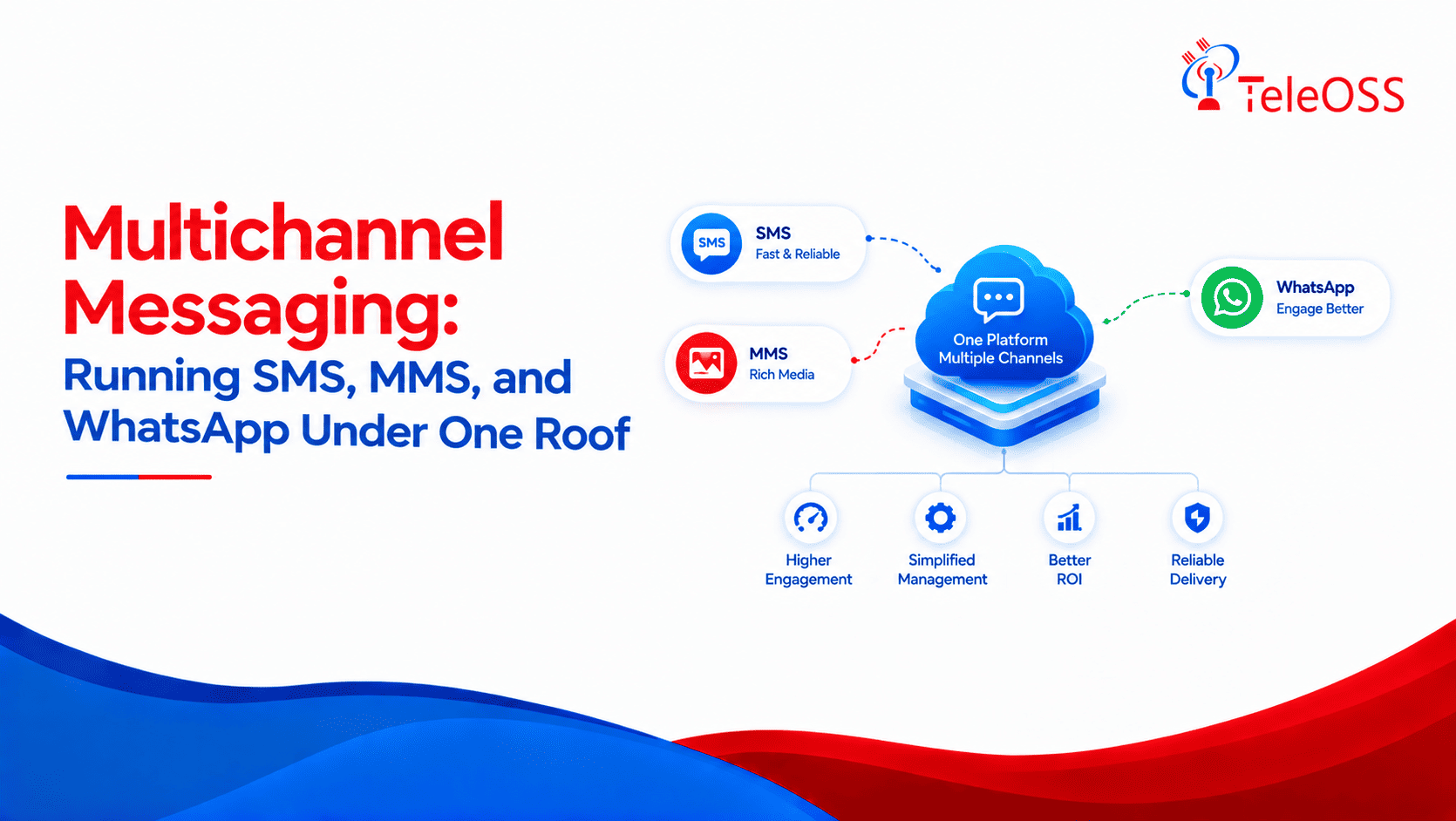
Multichannel messaging is the practice of sending and managing communications across multiple channels, typically SMS, MMS, WhatsApp, and RCS, through a single platform or API instead of maintaining separate integrations for each one. It lets telecom operators, aggregators, and enterprises reach customers on whichever channel they use, while consolidating routing, delivery tracking, and billing into one system. It reduces integration overhead but does not automatically sync conversation context across channels, which is what separates it from omnichannel messaging.
Key Takeaways
- Multichannel messaging consolidates SMS, MMS, WhatsApp, and often RCS into one platform, but each channel still runs on its own delivery infrastructure underneath.
- It is not the same as omnichannel messaging. Multichannel gives you multiple doors into the same building. Omnichannel makes sure the person walking through any door is recognized as the same customer.
- WhatsApp crossed 3 billion monthly active users globally as of Meta’s Q1 2025 earnings report, making it a channel most consumer-facing businesses can no longer skip.
- RCS business traffic is projected by Juniper Research to grow from roughly 70 billion messages in 2025 to more than 200 billion by 2027, driven largely by Apple’s iOS 18 RCS support.
- SMS aggregators need multichannel capability mainly to protect margin and retain enterprise clients who now expect WhatsApp and RCS as default options, not add-ons.
- Channel fallback logic, sending SMS when WhatsApp fails to deliver, is where most multichannel implementations either succeed or quietly fail. It depends on real-time delivery receipts, not assumptions.
What Is Multichannel Messaging?
Multichannel messaging is the ability to send, receive, and manage communications across more than one messaging channel, commonly SMS, MMS, WhatsApp, and RCS, from a single platform rather than juggling separate vendor integrations for each one. It works by routing outbound messages to the correct channel-specific gateway (an SMSC for SMS, the WhatsApp Business Platform API for WhatsApp, an RCS hub for RCS) while presenting one unified API and reporting layer to the sender.
The word “multichannel” gets used loosely in marketing copy, so it’s worth being precise. A multichannel platform gives you access to several channels through one interface. It does not automatically mean those channels talk to each other or share customer history. That distinction matters more than most vendor pages let on, and it’s the difference explained in the next section.
Example: A logistics company sends a delivery notification by SMS because it’s cheap and universal. If the customer has opted into WhatsApp, the same platform can send a richer message with a map link and a reply button instead. Both messages originate from one API call and one contact record, but they travel through completely separate networks to reach the phone.
How Multichannel Messaging Works?
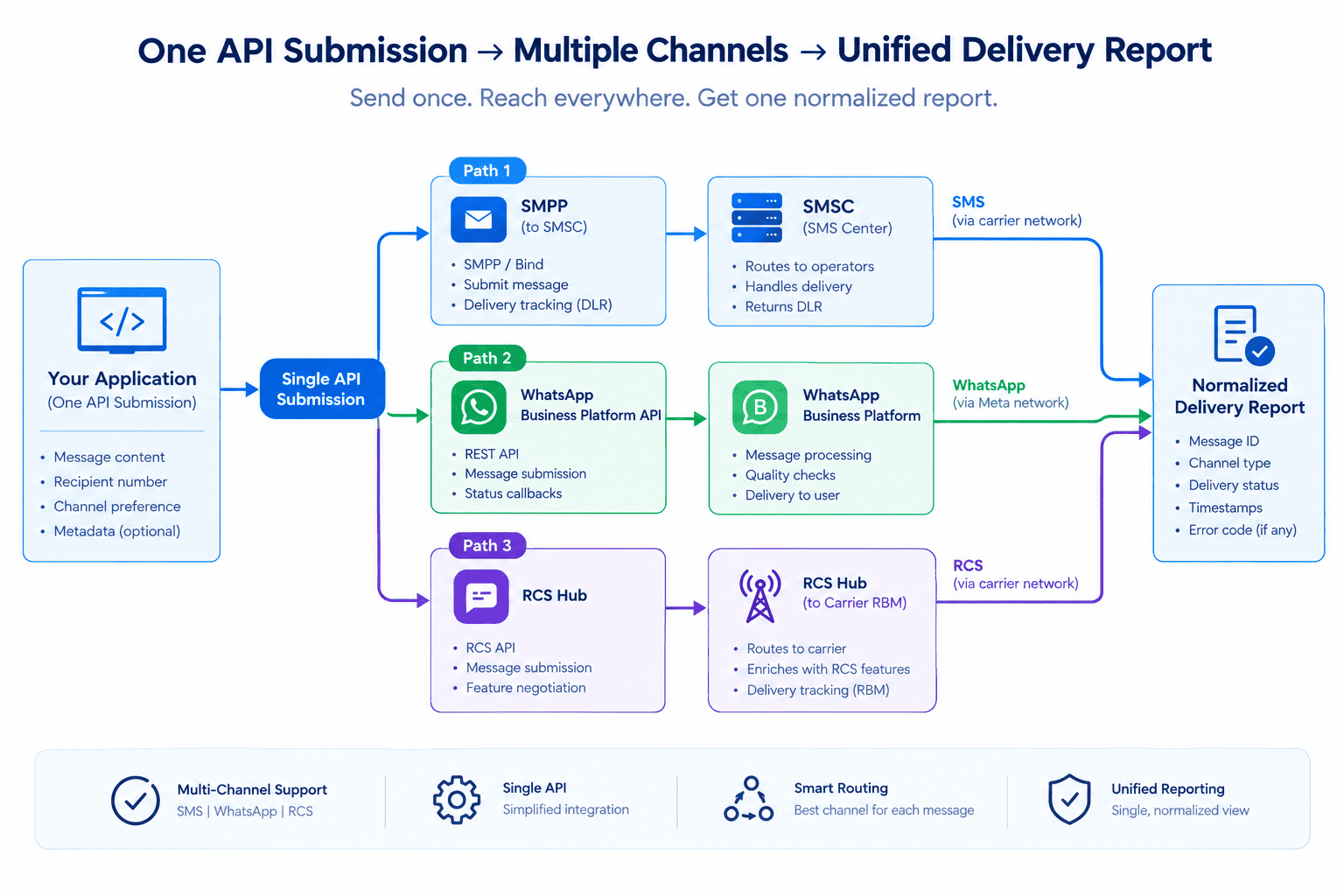
At a technical level, multichannel messaging works by abstracting several channel-specific protocols behind one interface, then routing each message based on channel selection rules.
Step 1: Message submission
An application submits a message through a single API or SMPP connection to the messaging platform, specifying (or letting the platform decide) which channel to use.
Step 2: Channel routing
The platform’s routing engine checks channel availability, opt-in status, and cost rules, then hands the message to the correct downstream connection. SMS goes through an SMPP link to an SMSC or aggregator route. WhatsApp goes through the WhatsApp Business Platform’s Cloud API or an on-premises API client. RCS goes through an RCS hub connected to carrier RBM (RCS Business Messaging) platforms.
Step 3: Delivery and receipts
Each channel returns delivery confirmations in its own format. A well-built platform normalizes these into one reporting structure so a business analyst doesn’t need to understand SMPP delivery receipt codes versus WhatsApp’s message status webhooks.
Step 4: Fallback logic (where used)
If the primary channel fails, such as a WhatsApp message not marked delivered within a defined window, the platform can automatically resend through SMS. This only works if delivery status is tracked in near real time, which is a genuine engineering requirement, not a checkbox feature.
Example: A bank’s fraud alert system sends a one-time password. The routing rule says “try RCS first, fall back to SMS after 15 seconds if undelivered.” The platform checks handset capability, attempts RCS delivery through the carrier’s RBM connection, receives no delivery confirmation in the window, and automatically resubmits the same OTP over SMS through a separate SMPP bind. The customer sees one message. The infrastructure did two attempts across two protocols.
Multichannel Messaging vs Omnichannel Messaging
This is one of the most searched comparisons in this space, and the two terms get swapped constantly in vendor marketing even though they describe different capabilities.
| Aspect | Multichannel Messaging | Omnichannel Messaging |
| Core capability | Sends messages across multiple separate channels | Sends messages across channels AND unifies customer context across them |
| Customer view | Each channel may have its own conversation thread | Single customer thread regardless of which channel they use |
| Typical use case | Broadcast notifications, OTPs, alerts, marketing blasts | Customer support conversations, sales follow-up, service continuity |
| Infrastructure complexity | Moderate: channel gateways plus a routing layer | Higher: requires a unified customer data layer and conversation state management |
| Who typically needs it | Aggregators, operators, transactional senders | Enterprises running customer service or sales across channels |
The practical takeaway: if your use case is sending an OTP, a delivery update, or a marketing broadcast, multichannel messaging is sufficient and usually cheaper to implement. If your use case is a customer starting a support conversation on WhatsApp and continuing it by SMS without repeating themselves, you need omnichannel capability, which is built on top of multichannel infrastructure but adds a customer identity and conversation history layer.
Key Channels Under One Platform: SMS, MMS, WhatsApp, and RCS
SMS remains the baseline channel because it works on every handset without an app or internet connection, and it’s still the most reliable channel for time-sensitive transactional messages like OTPs and delivery alerts. It runs over SMPP or SS7-based SMSC infrastructure and has near-universal reach, which is why it stays the fallback channel even in a multichannel setup built around richer channels.
MMS adds image, audio, and longer-format content support over the same carrier messaging infrastructure as SMS, using a different underlying protocol (MM1 to MM7 interfaces depending on the network). It’s used less than it was five years ago because OTT messaging gateway now offer richer media with better delivery confirmation, but it still matters in markets and use cases (certain US carrier requirements, some picture-based verification flows) where an app-based channel isn’t guaranteed to reach the recipient.
WhatsApp, through the WhatsApp Business Platform, is the channel most enterprises are adding first. WhatsApp crossed 3 billion monthly active users globally, according to Meta’s Q1 2025 earnings disclosure, and it supports interactive buttons, quick replies, catalogs, and media in a single conversation thread. The tradeoff is that WhatsApp requires template pre-approval for business-initiated conversations and operates on a conversation-based pricing model rather than a per-message model like SMS.
RCS (Rich Communication Services) is the carrier-native successor to SMS, delivering branded sender verification, suggested replies, and rich media without requiring the recipient to install an app. Juniper Research projects RCS business messaging traffic to grow from approximately 70 billion messages in 2025 to more than 200 billion by 2027, a trajectory accelerated significantly by Apple’s decision to support RCS in iOS 18, which removed the long-standing gap between Android and iPhone messaging experiences.
Expert Insight: In practice, the channel mix that works best rarely spreads evenly across all four. Most operators and enterprises we work with run SMS as the guaranteed-delivery backbone, layer WhatsApp on top for markets where adoption is high (Latin America, India, the Middle East, and parts of Europe show particularly strong WhatsApp penetration), and treat RCS and MMS as situational rather than default channels. Building a platform that assumes equal traffic across all four channels usually means over-engineering for channels your actual customer base barely touches.
Why SMS Aggregators and Operators Need Multichannel Messaging?
SMS aggregators sit in a specific bind. Their core business, SMS termination and A2P traffic routing, faces margin pressure from grey routes, SIM box fraud, and increasingly aggressive operator firewall filtering. At the same time, their enterprise clients are asking for WhatsApp and RCS support as a default part of the contract, not an upsell.
An aggregator that only offers SMS is competing purely on price in a commoditized market. An aggregator that can offer SMS, WhatsApp, and RCS through one connection can compete on capability and retain enterprise accounts that would otherwise split their traffic across a specialist SMS vendor and a separate CPaaS provider for OTT channels.
Example: A regional aggregator serving e-commerce clients in Southeast Asia was losing enterprise accounts to CPaaS platform that bundled WhatsApp with SMS. Rather than losing the SMS volume entirely, adding a WhatsApp Business Platform connection alongside existing SMPP routes lets the aggregator keep the full account, including the SMS traffic it would otherwise have lost as collateral damage.
For mobile network operators, the driver is different. Operators increasingly want to monetize RCS directly through RBM rather than watching that revenue go entirely to OTT platforms, and a multichannel gateway that supports RCS alongside SMS gives them a commercial path to do that without building carrier-grade RCS infrastructure from scratch.
How Multichannel Messaging Improves Message Delivery Rates
Delivery rate improvement in a multichannel setup comes from three specific mechanisms, not from “sending more messages.”
Channel-appropriate routing:
Sending a rich, interactive message to a feature phone fails. Sending a plain SMS to a customer who has explicitly opted into WhatsApp and expects a richer experience underperforms on engagement even if it technically delivers. Matching the channel to the device and the customer’s demonstrated channel preference improves both delivery and response rates.
Real-time fallback:
When a primary channel fails or times out, an automatic fallback to SMS (the channel with the most universal reach) catches messages that would otherwise be lost. This is the single biggest lever for delivery rate improvement in transactional messaging like OTPs, where a failed delivery has a direct cost in abandoned transactions.
Consolidated delivery reporting:
When delivery receipts from SMS, WhatsApp, and RCS are normalized into one reporting layer, operations teams can actually see which channel and which route is underperforming and correct it, instead of manually cross-referencing three separate dashboards that update on different schedules.
None of this is a guarantee of a specific delivery rate improvement. Actual gains depend heavily on the existing route quality, the country mix, and how well fallback thresholds are tuned. A platform vendor claiming a fixed percentage improvement across all use cases should be treated with the same skepticism you’d apply to any unqualified performance claim.
Benefits of a Multichannel Messaging Platform
- Single integration point: One API and one set of credentials instead of separate SDKs and contracts for SMS, WhatsApp, and RCS providers.
- Consolidated billing and reconciliation: One invoice and one set of usage reports instead of reconciling three vendor statements against internal cost centers.
- Faster time to add a new channel: Adding RCS or WhatsApp to an existing SMS-based application generally takes days through an existing multichannel gateway versus weeks or months building a net-new integration.
- Better cost control: Routing logic can prioritize the cheapest appropriate channel first (SMS for simple alerts, WhatsApp only where the richer format justifies the cost) instead of defaulting everything to the most expensive channel.
- Improved customer reach: Customers who have opted out of SMS marketing, for instance, may still be reachable through WhatsApp, and vice versa, so a multichannel approach captures audience segments a single-channel strategy misses.
Limitations and Challenges
Multichannel messaging is not a drop-in replacement for good customer data or a substitute for compliance work, and it introduces its own operational overhead.
- Channel-specific compliance stays channel-specific: WhatsApp template approval rules, 10DLC registration requirements for US SMS, and RCS carrier verification processes don’t merge into one compliance framework just because the platform is unified. Each channel still has its own rulebook.
- Cost structures don’t compare directly: SMS is typically priced per message. WhatsApp is typically priced per conversation (a 24-hour session that can contain multiple messages). Comparing “cost per message” across channels without normalizing for this difference leads to bad routing decisions.
- Fallback logic requires real engineering, not a toggle: Automatic channel fallback sounds simple in a sales deck. Implementing it correctly requires reliable, low-latency delivery receipts from every channel and clear business rules for what counts as a failure worth falling back on. Get the timing wrong and you either send duplicate messages across two channels or wait too long and miss the value of a time-sensitive message.
- Not every market has the same channel mix: WhatsApp dominates in markets like India, Brazil, and much of the Middle East. It has far lower relevance in markets like the US and Japan, where other channels or apps dominate. A platform strategy built around one region’s channel preferences won’t transfer cleanly to another.
Multichannel Messaging Use Cases
- OTP and authentication: Send the OTP over RCS or WhatsApp where supported for a richer, more trustworthy branded message, with automatic SMS fallback to guarantee delivery within seconds.
- Order and delivery notifications: E-commerce and logistics platforms send order confirmations and delivery windows over WhatsApp where the customer has opted in, with SMS covering customers who haven’t or whose device doesn’t support rich messaging.
- Appointment reminders: Healthcare providers and service businesses send reminders with reply-to-confirm buttons over WhatsApp or RCS, falling back to plain SMS text reminders for reach.
- Marketing campaigns with channel segmentation: Retail and telecom marketing teams split campaign sends by customer channel preference and past engagement data, sending richer WhatsApp campaigns to engaged segments and simpler SMS campaigns to cost-sensitive or lower-engagement segments.
- Two-way customer service triage: Enterprises route inbound customer messages from any channel into the same support queue, even if full omnichannel context sharing isn’t yet in place, so support agents aren’t monitoring three separate inboxes.
How to Choose a Multichannel Messaging Platform
Evaluate a platform against these criteria rather than a generic feature checklist:
- Direct carrier and channel connections versus reseller layers: A platform with direct SMPP binds to operators and a direct WhatsApp Business Solution Provider (BSP) relationship generally offers better reliability and pricing than one reselling capacity from another aggregator.
- Real-time delivery receipt normalization: Ask specifically how the platform converts SMS DLRs, WhatsApp status webhooks, and RCS delivery events into one reporting format, and how fast that conversion happens.
- Fallback rule configurability: Can you set your own fallback timing and channel priority per use case, or is fallback logic fixed and generic?
- Compliance support per channel: Does the vendor actively help with WhatsApp template submission, US 10DLC registration, and RCS carrier onboarding, or leave that entirely to you?
- Route quality transparency: Will the vendor show you actual route-level delivery performance by country and channel, or only aggregate numbers that hide underperforming routes?
- Scalability under peak load: Ask for real throughput numbers (messages per second, or TPS) under peak conditions, not theoretical maximums.
Organizations evaluating this space often start from Two Way SMS Chat Platform and expand it with WhatsApp and RCS connectivity, since the SMPP-based routing and delivery infrastructure that supports high-volume SMS traffic is the same foundation a multichannel gateway builds on.
Common Mistakes to Avoid
- Treating all channels as equally important everywhere: Building fallback logic and reporting for RCS in a market where RCS adoption is near zero wastes engineering effort. Prioritize based on actual regional channel usage.
- Ignoring WhatsApp’s conversation-based pricing until the first invoice: Teams that plan WhatsApp costs using SMS-style per-message math are frequently surprised by conversation-based billing, especially with high message volume inside a single 24-hour session.
- Skipping opt-in management per channel: A customer opting into SMS marketing has not automatically opted into WhatsApp marketing under most regulatory frameworks and WhatsApp’s own commerce policy. Treating consent as a single blanket toggle creates compliance risk.
- Underestimating template approval lead time: WhatsApp business-initiated message templates require approval before they can be used at scale, and approval isn’t instant. Launching a time-sensitive campaign without accounting for this lead time is one of the most common avoidable delays teams run into.
Conclusion
Multichannel messaging solves a real, specific problem: managing SMS, MMS, WhatsApp, and RCS through separate systems doesn’t scale once your customer base spans multiple channels and your enterprise clients expect all of them supported by default. It’s not the same as omnichannel messaging, and it won’t fix a bad customer data strategy or skip past channel-specific compliance work. But for telecom operators, SMS aggregators, and enterprises that need reliable reach across the channels their customers actually use, consolidating that infrastructure into one platform is the more sustainable path than maintaining three separate vendor relationships that don’t talk to each other.
If you’re currently running SMS through dedicated gateway infrastructure and evaluating how to add WhatsApp or RCS without rebuilding your routing layer from scratch, it’s worth reviewing what your existing SMS gateway software can extend into before signing a separate contract for each new channel.
FAQs
What is multichannel messaging in telecom?
In telecom, multichannel messaging refers to the ability to send and manage traffic across SMS, MMS, WhatsApp, and RCS through one gateway or platform instead of separate systems per channel. Operators and aggregators use it to consolidate routing, billing, and delivery reporting while giving enterprise clients access to multiple channels through a single integration.
How is multichannel messaging different from omnichannel messaging?
Multichannel messaging means you can send through multiple separate channels. Omnichannel messaging adds a shared customer identity and conversation history layer so a customer’s interaction is recognized consistently no matter which channel they use. Multichannel is about channel access. Omnichannel is about channel access plus context continuity.
What channels does a multichannel messaging platform typically support?
Most multichannel platforms support SMS, MMS, WhatsApp Business Platform, and increasingly RCS. Some also add OTT channels like Viber or Telegram depending on the target market, though SMS, WhatsApp, and RCS cover the large majority of business messaging volume globally.
Why do SMS aggregators need multichannel messaging?
SMS aggregators face margin pressure from grey routes and operator firewall filtering on pure SMS traffic. Adding WhatsApp and RCS capability lets them retain enterprise clients who now expect those channels as standard, protecting both the OTT revenue and the SMS volume that would otherwise move to a competing CPaaS provider.
How does multichannel messaging improve message delivery rates?
It improves delivery outcomes through channel-appropriate routing (matching message format to device capability and customer preference), automatic fallback to a more reliable channel like SMS when a primary channel fails, and consolidated delivery reporting that helps operations teams identify and fix underperforming routes faster.
Does multichannel messaging cost more than single-channel SMS?
It depends on usage. Base SMS costs stay the same. Adding WhatsApp introduces conversation-based pricing, which can cost more or less than SMS depending on message volume per conversation. The efficiency gain usually comes from reduced integration and operational overhead rather than a straight per-message cost reduction.
Can a multichannel platform work with an existing SMS gateway?
Yes. Most multichannel platforms are built as an extension of SMPP-based SMS gateway infrastructure, adding WhatsApp Business Platform and RCS hub connections alongside existing SMS routes rather than replacing the SMS layer entirely.