
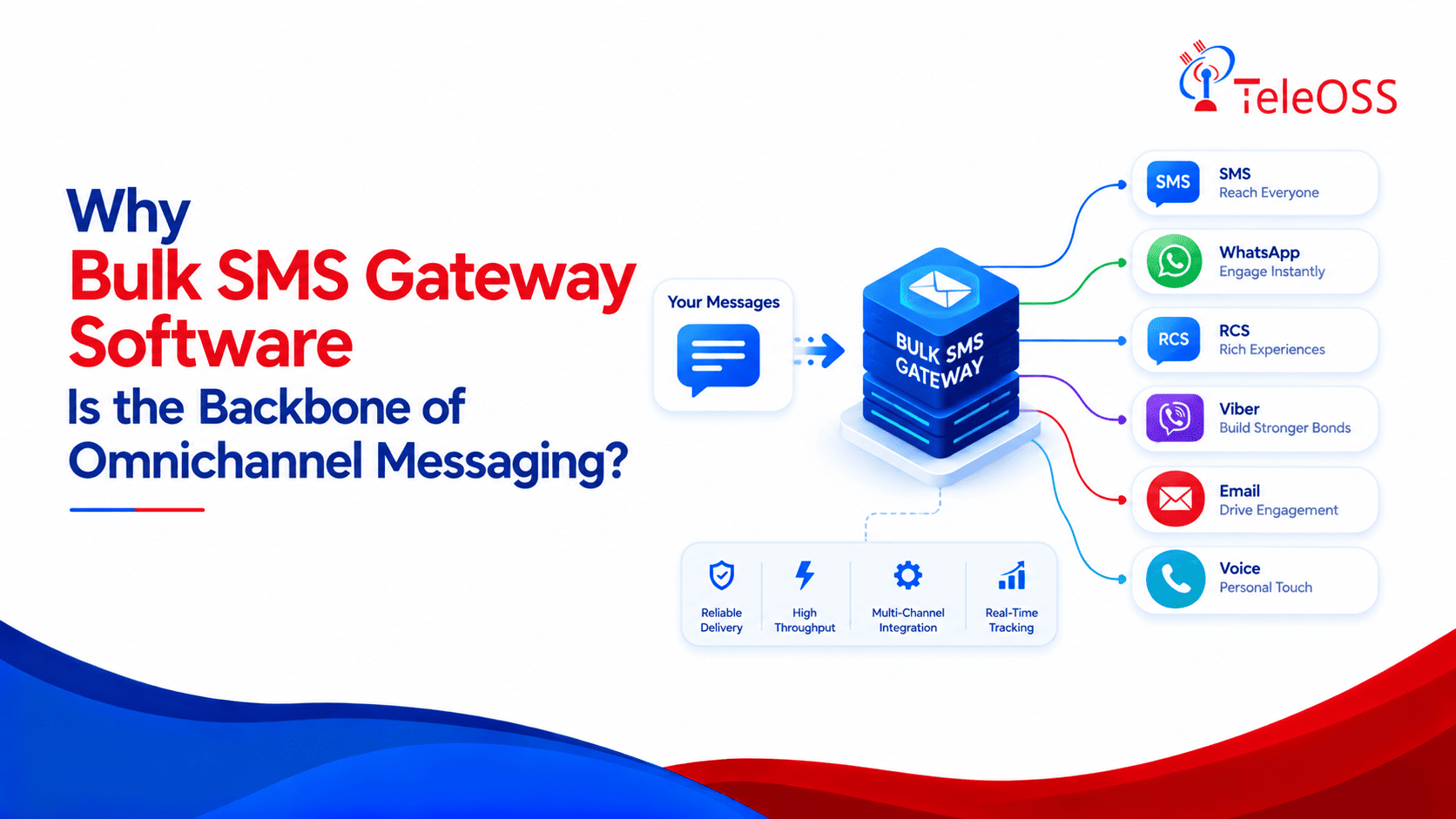
Every omnichannel messaging strategy eventually depends on SMS, whether as the primary channel or the fallback when WhatsApp, RCS, or push notifications fail to deliver. A bulk SMS gateway is the piece of infrastructure that makes that dependency work reliably. It connects your applications, CRM, or messaging platform to mobile networks, handling routing, throughput, compliance, and delivery tracking so messages actually reach a handset instead of disappearing into a queue.
This blog explains what a bulk SMS gateway does, how it fits into an omnichannel stack, and what to look for whether you are a telecom operator building infrastructure, an aggregator reselling capacity, or an enterprise choosing a provider.
Quick Answer
A bulk SMS gateway is software or a hosted platform that lets applications send and receive large volumes of SMS messages through connections to mobile network operators or intermediary aggregators. It handles message queuing, routing across multiple carrier connections, delivery reporting, and compliance filtering. Businesses use it to power OTPs, alerts, marketing campaigns, and as the reliable fallback channel in omnichannel messaging setups, since SMS reaches any handset without requiring an app or internet connection.
Key Takeaways
- A bulk SMS gateway is distinct from bulk SMS software: the gateway is the connectivity and routing layer, while the software is often the application layer built on top of it.
- Reliable delivery depends on multiple carrier routes with automatic failover, not a single connection to one aggregator.
- Compliance requirements differ by country. The US uses 10DLC and TCR registration, India uses TRAI’s DLT framework, and other markets have their own sender ID and content filtering rules.
- Throughput capacity should be measured in messages per second (MPS) and matched to your actual traffic pattern, including burst periods like OTP spikes.
- In an omnichannel strategy, SMS is usually the fallback channel for RCS, WhatsApp Business, and app push notifications, which makes gateway reliability a dependency for the entire messaging stack.
What Is a Bulk SMS Gateway?
A bulk SMS gateway is a software platform that connects applications to mobile network infrastructure so they can send and receive high volumes of SMS messages programmatically. It sits between the sender, which could be a CRM, a banking app, or a marketing platform, and the mobile operator’s network, translating API or SMPP requests into messages that carriers can deliver.
The mechanism is straightforward at a high level. An application submits a message through an API or an SMPP connection. The gateway validates the request, checks it against compliance rules, selects a route based on cost and reliability, and hands the message to a carrier or aggregator connection. The carrier delivers it to the recipient’s handset, and the gateway receives a delivery report (DLR) confirming success or failure.
A payment app is a useful example. When a customer requests a one time password, the app’s backend sends the OTP request to the gateway through an HTTP API. The gateway checks the destination country’s compliance rules, picks the lowest cost route that still meets the required delivery speed, and submits the message through an SMPP connection to the carrier. The DLR comes back within seconds, and the app either confirms the OTP was sent or triggers a retry through a backup route.
How Does a Bulk SMS Gateway Handle Routing and Failover?
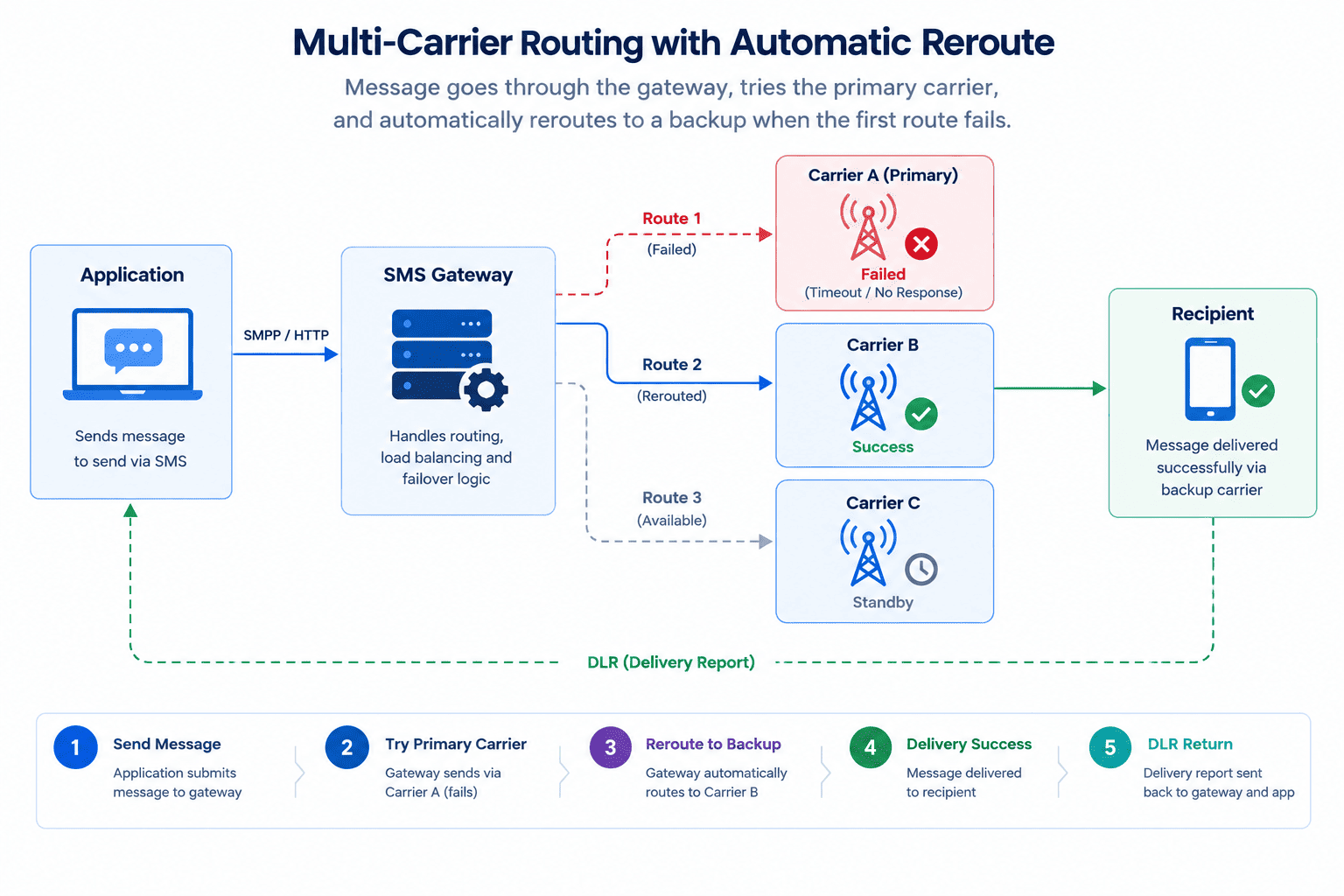
A bulk SMS gateway handles routing by maintaining connections to multiple carriers or aggregators and selecting the best available path for each message based on cost, delivery speed, and current route health. If the primary route fails or a carrier reports high latency, the gateway automatically switches traffic to an alternative route without the sending application needing to do anything.
This process is usually called least cost routing (LCR) when the priority is cost, but pure LCR without a quality check can hurt deliverability, since the cheapest route is not always the most reliable one. A better-designed system uses a hybrid approach: it ranks routes by a blended score of cost and recent delivery performance, then falls back automatically when a route’s success rate or latency crosses a threshold.
Failover matters because carrier routes go down more often than most non-technical buyers expect. A route can degrade because of network congestion, a change in a carrier’s filtering rules, or a temporary block on a specific sender ID. Without automatic failover, those failures show up as silent message loss, which is far more damaging to a business than a slightly higher per-message cost.
Expert Insight: Route health should be monitored in near real time using delivery report data, not just uptime checks. A route can stay technically “up” while its actual delivery rate drops because of carrier-side content filtering, and that kind of degradation only shows up in DLR analysis.
Bulk SMS Software vs SMS Gateway: What Is the Difference?
Bulk SMS software and an SMS gateway are related but not identical. The gateway is the connectivity and routing layer that talks directly to carriers and aggregators. Bulk SMS software is typically the application layer built on top of a gateway, providing a user interface, campaign management, contact list handling, and reporting dashboards for people who are not writing code against an API.
In practice, many products bundle both. A telecom operator or a technically capable enterprise might use the gateway directly through SMPP or an HTTP API, integrating it into their own systems. A marketing team without developer resources is more likely to use bulk SMS software that already includes the gateway underneath a web interface.
The distinction matters when evaluating vendors, because “bulk SMS provider” can mean either a company selling raw gateway connectivity or one selling a full software product. Aggregators and operators generally need the former, since they are building their own layer on top. Enterprises without a technical team usually need the latter.
Where the Bulk SMS Gateway Sits in an Omnichannel Stack
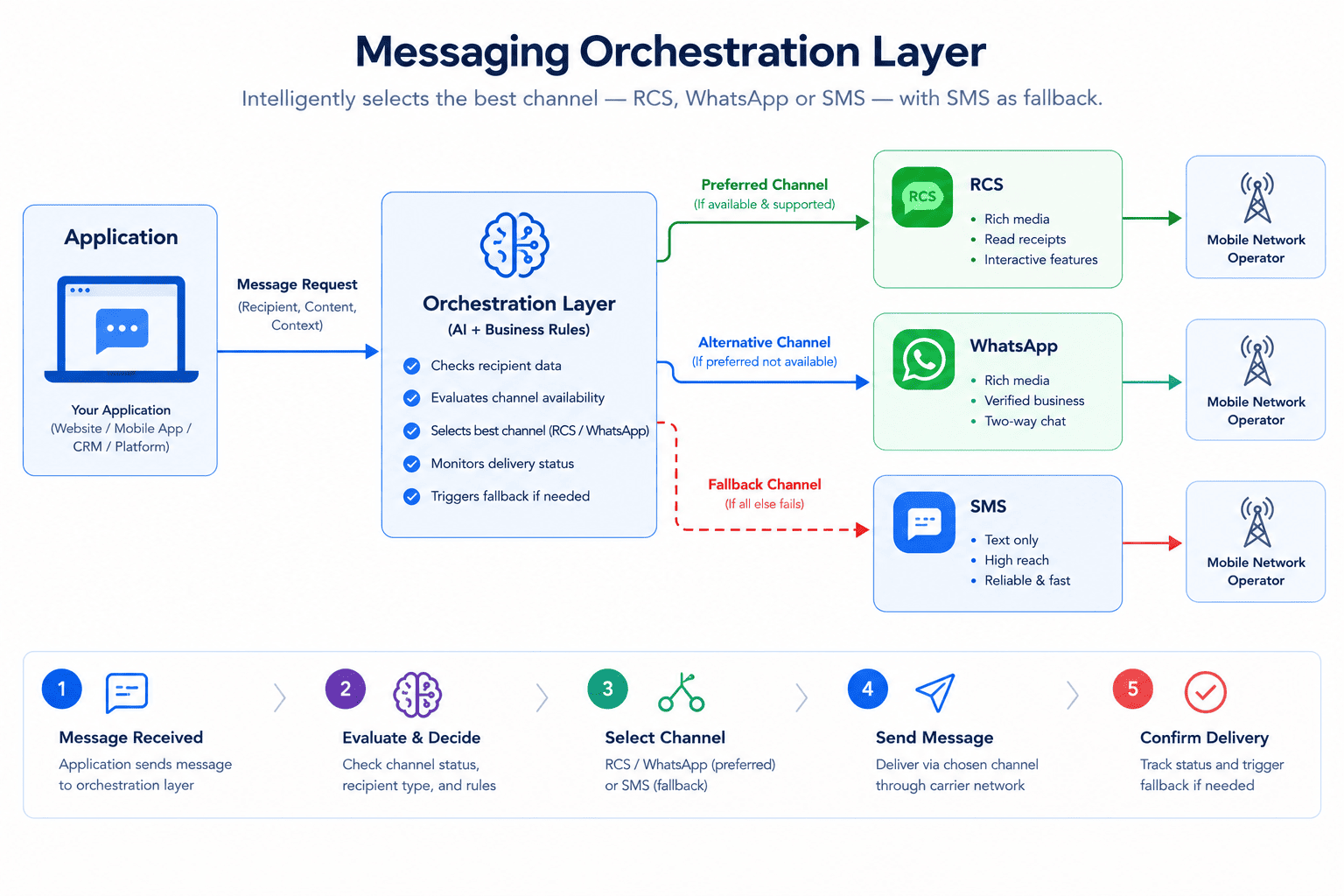
Omnichannel messaging means reaching customers across SMS, RCS, WhatsApp Business, push notifications, and email through a single orchestration layer, with the system choosing the best channel per message or per recipient. SMS almost always plays two roles in that stack: it is a direct channel in its own right, and it is the fallback channel when a richer channel is unavailable.
RCS and WhatsApp both require the recipient to have a compatible device, an active data connection, and in WhatsApp’s case, an existing account. When any of those conditions is not met, a well-built orchestration system falls back to SMS, since SMS works on any handset with network coverage and does not depend on an internet connection. This is why the reliability of the underlying bulk SMS gateway affects the reliability of the entire omnichannel strategy, not just the SMS channel in isolation.
A retail brand running an order confirmation flow illustrates this. The system first attempts delivery through RCS for a richer, branded message. If the RCS attempt fails or the device is not RCS-capable, the orchestration layer immediately routes the same content through the bulk SMS gateway as plain text. The customer still gets their confirmation, and the business does not need to build separate fallback logic for every channel, since the gateway’s delivery reporting tells the orchestration layer whether the SMS fallback succeeded.
What Throughput Capacity Should a Bulk SMS Gateway Support?
Throughput capacity should be sized to your peak traffic, not your average traffic, and measured in messages per second (MPS) rather than daily or monthly volume alone. A gateway that comfortably handles average load can still fail during a burst, such as an OTP spike after a product launch or a scheduled marketing blast that goes out to an entire list at once.
A reasonable approach is to calculate your highest expected concurrent send requirement, then add headroom for growth and unexpected spikes. An enterprise sending 500,000 OTPs a day with even distribution needs far less peak MPS than one sending the same volume concentrated into a two hour login window. SMPP connections typically support configurable throughput per bind, so the gateway architecture should allow multiple binds per carrier connection to scale MPS horizontally rather than being capped by a single connection’s limit.
For aggregators and operators, throughput planning also needs to account for downstream carrier limits. Even if your own gateway can process 5,000 MPS, a specific carrier route might only accept 200 MPS before throttling or blocking traffic, which is another reason multi-route failover matters as much as raw platform throughput.
How Do Bulk SMS Providers Handle Compliance in Different Countries?
Bulk SMS providers handle compliance by applying country-specific registration, filtering, and content rules before a message is allowed onto a carrier network, since SMS regulation is set at the national or regional level rather than globally. A provider operating across the US, UK, UAE, Europe, Africa, and Southeast Asia needs a different compliance configuration for each market.
In the United States, application to person (A2P) traffic over 10-digit long codes (10DLC) must be registered through The Campaign Registry (TCR), which assigns a trust score affecting deliverability and throughput limits. [VERIFY current TCR fee structure and registration requirements before publishing]. In India, the Telecom Regulatory Authority of India (TRAI) requires sender IDs, content templates, and consent records to be registered on the Distributed Ledger Technology (DLT) platform before a message can be delivered. [VERIFY current TRAI DLT registration process before publishing]. The UAE and several Gulf markets require pre-approval of sender IDs and, in some cases, local hosting or registration with the telecom regulator. [VERIFY current UAE sender ID registration requirements before publishing].
Because these frameworks change, a bulk SMS gateway used across multiple regions needs a compliance engine that can apply different filtering rules by destination country automatically, rather than relying on manual checks for every campaign. Providers that skip this step risk having entire routes blocked, which shows up as a sudden drop in delivery rate rather than an outright error message.
Integrating a Bulk SMS Gateway With an Existing Telecom Network
Integrating a bulk SMS gateway with an existing telecom network typically happens through one of two interfaces: an SMPP bind for high-volume, low-level connections, or an HTTP API for simpler, application-level integration. The right choice depends on who is doing the integration and what throughput and control they need.
Assess the integration point:
Decide whether the gateway will connect directly to a carrier’s SMSC (Short Message Service Center), to an intermediate aggregator, or both, since operators often need direct SMSC connections while enterprises typically connect through an aggregator’s API.
Choose the protocol:
SMPP is generally selected when the integrator needs persistent connections, precise throughput control, and lower latency, which matters for operators and aggregators managing large volumes. An HTTP API is usually simpler for enterprise developers who do not need to manage a persistent socket connection.
Configure routing rules:
Map which traffic type (transactional, promotional, OTP) should use which route, since regulators in many countries require these categories to be handled differently.
Set up delivery reporting:
Confirm the gateway can receive and forward DLRs back to the originating application, since delivery confirmation is often a compliance and business requirement, not just a nice-to-have.
Test failover behavior:
Simulate a route failure in a staging environment to confirm the gateway actually reroutes traffic rather than just logging an error.
Monitor post-launch:
Track delivery rate, latency, and MPS against expected baselines for at least the first few weeks, since carrier-side issues often only appear under real production load.
Bulk SMS Gateway vs SMS Aggregator
The terms “bulk SMS gateway” and “SMS aggregator” are often used interchangeably, but they describe different roles in the delivery chain.
| Criteria | Bulk SMS Gateway | SMS Aggregator |
| Primary role | Software or platform that routes and manages message delivery | Company that maintains direct carrier connections and resells capacity |
| Who typically uses it | Operators, aggregators, and enterprises building their own messaging stack | Businesses that need SMS capacity without managing carrier relationships |
| Carrier relationship | May or may not have direct carrier connections; can route through aggregators | Usually has direct or near-direct connections to mobile network operators |
| Control level | High, since the buyer configures routing, compliance, and integrations | Lower, since routing decisions happen on the aggregator’s side |
| Best fit | Teams that want to control routing logic, cost, and compliance directly | Teams that want SMS delivery without operating the underlying infrastructure |
In practice, many aggregators build their commercial offering on top of gateway software, and many enterprises never interact with the gateway layer directly since their aggregator handles it. The distinction matters most when you are deciding whether to build, license, or fully outsource your SMS infrastructure.
Common Mistakes to Avoid
- Relying on a single carrier route: A single connection has no failover option, so any carrier-side issue becomes a full outage for your messaging.
- Ignoring country-specific compliance until a campaign is blocked: Registering sender IDs and content templates after launch, rather than before, is one of the most common causes of sudden deliverability drops.
- Sizing throughput for average volume instead of peak volume: OTP and alert traffic is rarely evenly distributed, and a gateway that cannot handle bursts will queue or drop messages during the moments that matter most.
- Treating delivery reports as optional: Without DLR data, you cannot distinguish between a message that was never sent, one that was sent but not delivered, and one that was delivered successfully, which makes troubleshooting and compliance reporting far harder.
- Assuming least cost routing alone guarantees good deliverability: The cheapest route by price is sometimes the lowest quality route by delivery rate, and choosing purely on cost can quietly damage OTP and transactional messaging performance.
Best Practices for Choosing a Bulk SMS Gateway
- Confirm the provider supports both SMPP and HTTP API connections, so you are not locked into one integration method as your needs change.
- Ask for real delivery rate data by country and carrier, not just an overall average, since performance can vary significantly by region.
- Verify how the provider handles compliance for each market you operate in, including sender ID registration and content filtering rules.
- Check whether failover between routes is automatic or requires manual intervention during an outage.
- Evaluate reporting and analytics depth, since visibility into DLRs, latency, and route performance is what lets you catch problems before they affect customers.
- Consider how the gateway fits into a broader omnichannel setup if you plan to add RCS, WhatsApp Business, or push notifications later, since SMS will likely remain your fallback channel.
Conclusion
A bulk SMS gateway is not just a tool for sending marketing texts. It is the routing, compliance, and delivery infrastructure that keeps SMS reliable at scale, and reliable SMS is what makes an omnichannel messaging strategy actually work, since it is almost always the fallback channel when RCS, WhatsApp, or push notifications cannot reach a device. Choosing or building one comes down to a few concrete questions: does it support multi-route failover, does it handle compliance for every market you operate in, can it scale to your peak throughput, and does it give you real delivery visibility rather than just a send confirmation.
If you are evaluating SMS gateway software for your own infrastructure or looking to strengthen the SMS layer behind an existing omnichannel setup, TeleOSS builds SMS gateway software designed around multi-route failover, SMPP and API connectivity, and delivery reporting built for operators, aggregators, and enterprises managing traffic across multiple regions. You can review the technical documentation or reach out to walk through your specific routing and compliance requirements.
FAQs
What is the difference between an SMS gateway and an SMS API?
An SMS gateway is the full platform that handles routing, compliance, and carrier connections. An SMS API is the interface developers use to send requests to that gateway. Most gateways expose their functionality through an API, so the two are closely linked but not the same thing.
Can a bulk SMS gateway send messages internationally?
Yes, provided it has routing agreements or aggregator connections covering the destination countries. International delivery also depends on each country’s compliance requirements being met, since a message can be blocked even if the technical route exists.
Do bulk SMS gateways support two-way messaging?
Many do, allowing recipients to reply to a message and have that reply routed back to the originating application. This is commonly used for confirmations, opt-outs, and simple conversational flows.
How is bulk SMS gateway pricing usually structured?
Pricing is typically per message, often tiered by destination country and message type (transactional versus promotional), since carrier termination costs vary significantly by region. [VERIFY current pricing structures before publishing, since these change frequently by provider and region].
What happens if a carrier route goes down?
A well-configured gateway detects the failure through delivery report data or connection health checks and automatically reroutes traffic to an alternative carrier or aggregator connection, ideally without the sending application noticing any disruption.