

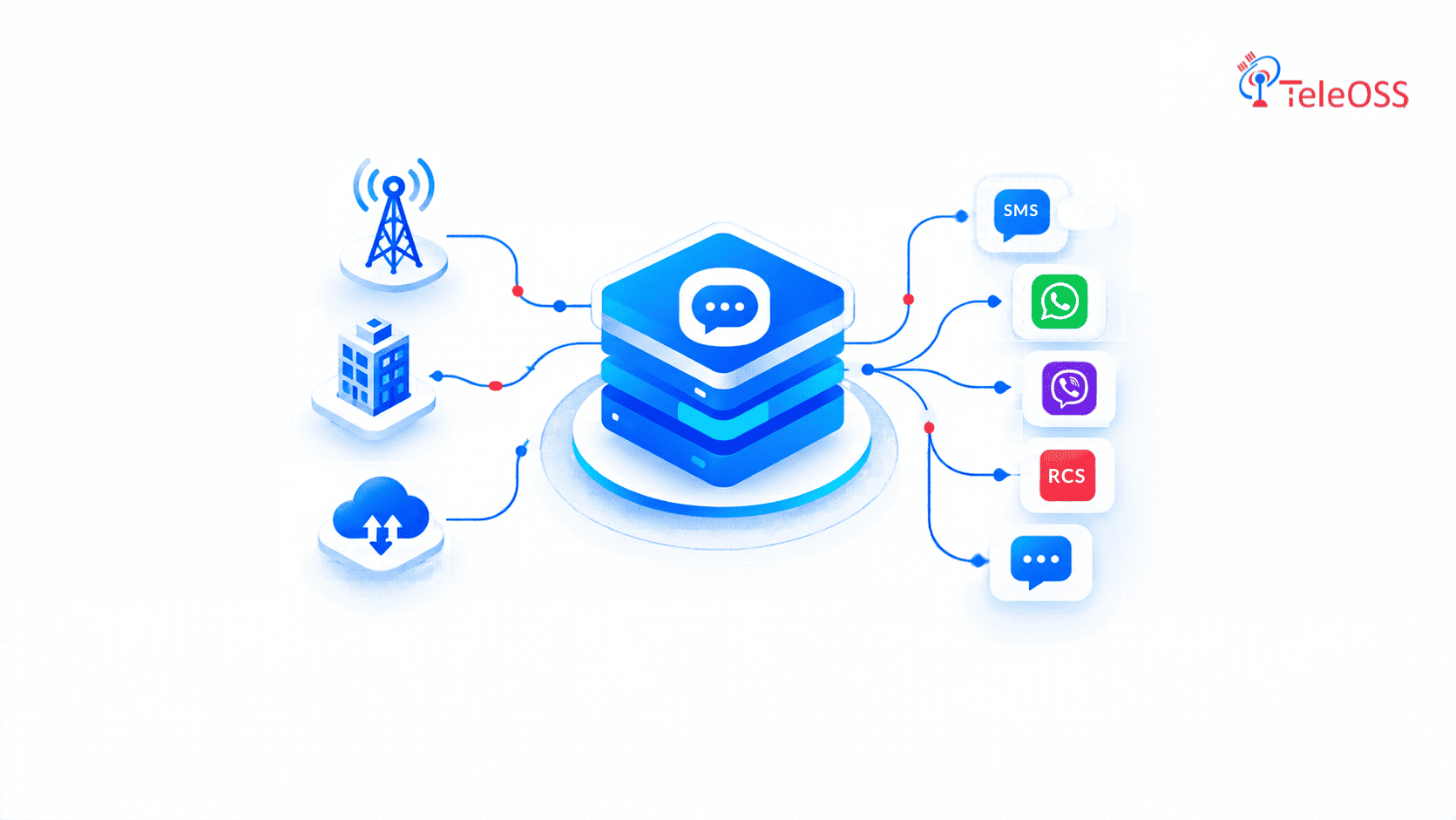
If you run messaging traffic for an operator or an aggregator, you have probably felt the strain. Every new partner means another connection to build, test, monitor, and bill. Every route that fails at 2 AM means someone has to notice and reroute by hand.
An SMS hub exists to remove that work. This guide explains what an SMS hub is, how SMS hubbing works at the protocol level, how it differs from direct interconnects and an SMS gateway, and what to check before you commit to one.
Quick Answer
An SMS hub is a messaging platform that sits between many SMS senders and many operator or aggregator connections. It accepts traffic over protocols such as SMPP, applies routing rules, forwards each message to the best available route, and returns delivery reports. Operators use it to manage multiple interconnects, control cost, and block unauthorized routes from one point.
Key Takeaways
- An SMS hub replaces many separate bilateral connections with one managed routing layer. The number of connections you maintain drops, and the rules that govern them move to one place.
- SMS hubbing is a business model as well as a technology. A hub operator interconnects with many networks and resells reach to others.
- A hub is not the same as an SMS gateway. A gateway connects an application to a network. A hub routes between many networks and many senders.
- Grey route control works best at the hub because the hub sees sender, content, and route together. No hub removes fraud entirely, though.
- Direct interconnects still win for your largest, most stable traffic corridors. Most mature operators use both.
- Judge a hub on routing logic, DLR accuracy, throughput headroom, and compliance tooling, not on connection count alone.
What Is an SMS Hub in Telecom?
An SMS hub is a central messaging platform that connects multiple message senders to multiple operator and aggregator routes. It receives SMS submissions, decides where each message should go, delivers it over the chosen connection, and reports the outcome back to the sender. In telecom, it acts as the traffic control layer between message sources and mobile networks.
Think of an airport hub. Passengers do not need a direct flight to every city. They connect through one place that has routes to many destinations. An SMS hub does the same for messages. A sender submits once, and the hub handles the onward path.
A hub typically contains four functional parts:
- Connection layer: Accepts inbound binds from customers and opens outbound binds to suppliers.
- Routing engine: Chooses a route per message using rules such as destination prefix, price, quality, and time.
- Message and DLR handling: Queues messages, retries failures, and maps delivery receipts back to the original submission.
- Control and reporting: Provides credit limits, filtering, rate controls, and traffic analytics.
Here is a hypothetical example: A mid-sized aggregator in the UAE has twelve enterprise customers and nine upstream suppliers. Without a hub, that can mean up to 108 customers to supplier paths to configure and monitor. With a hub, each party connects once to the hub, and the hub decides the path. The numbers are illustrative, but the arithmetic is the reason hubs exist.
What Is SMS Hubbing?
SMS hubbing is the practice of interconnecting many mobile networks and messaging partners through a central hub so that traffic between them can be routed, translated, and settled in one place. Operators use hubbing to reach networks they do not connect to directly, and hub providers earn revenue by carrying that traffic.
The term covers two things that are easy to confuse:
- The platform: The software that does the routing, which is what this article mostly covers.
- The service: A commercial arrangement where a hub operator gives you access to its interconnects, often with settlement handled through the hub.
Some operators run their own hub platform. Others buy hubbing as a service from a larger carrier. Many do both, using their own hub for traffic they control and a partner hub for corridors where they have no direct agreement.
How Does an SMS Hub Work?
An SMS hub works by accepting a message from a sender, checking it against rules, selecting a route, delivering the message upstream, and passing the delivery receipt back. Each step produces data the hub uses for billing, reporting, and later routing decisions.
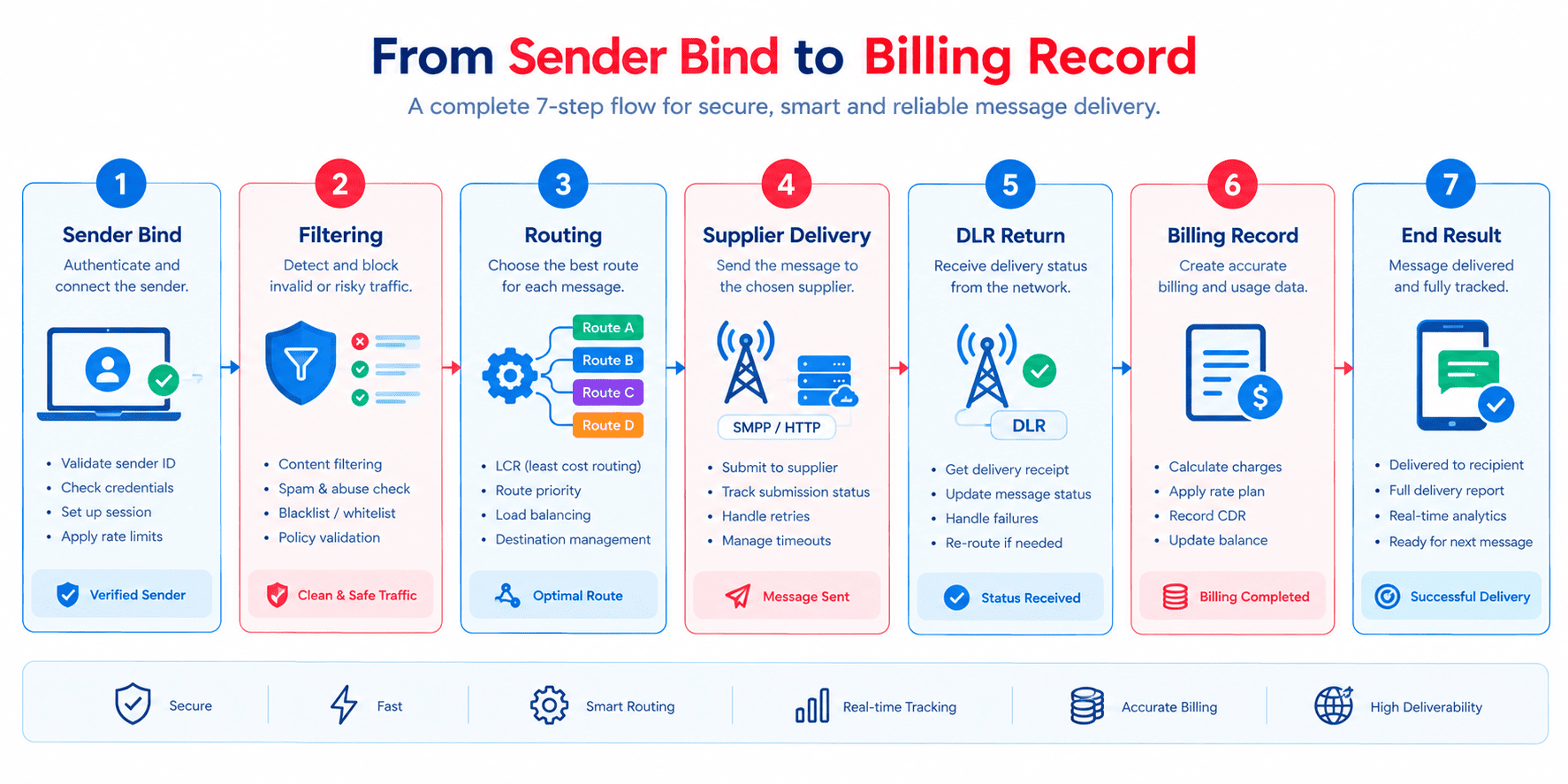
Here is the sequence for one message:
Step 1: Authenticate and accept
The sender binds to the hub, usually over SMPP, using credentials tied to an account. The hub checks credit, rate limits, and permitted destinations.
Step 2: Inspect and filter
The hub checks sender ID, destination, and content against filtering rules. Messages that fail can be rejected, held, or flagged.
Step 3: Resolve the destination
The hub reads the destination number and determines the country and network, typically through MCC/MNC and numbering plan data. Some deployments add an HLR lookup to confirm the current network when numbers have been ported.
Step 4: Select the route
The routing engine ranks the available supplier connections for that destination. This is where least cost routing (LCR), quality scoring, and failover rules apply.
Step 5: Deliver upstream
The hub submits the message to the chosen supplier or directly to the operator SMSC, translating protocols if needed.
Step 6: Track the delivery receipt
The hub receives a delivery report (DLR), matches it to the original message ID, and sends the status back to the sender in the format the sender expects.
Step 7: Record and settle
The hub logs the message, cost, and revenue so billing and route analysis stay accurate.
What the routing decision actually looks like
Routing is the part that separates a hub from a simple connector. A practical routing table for one destination might look like this (illustrative values):
| Priority | Supplier | Condition | Reason |
| 1 | Supplier A | Delivery rate above threshold, latency normal | Lowest cost among healthy routes |
| 2 | Supplier B | Used when A drops below threshold | Quality fallback |
| 3 | Supplier C | Used for traffic classes needing high priority such as OTP | Higher cost, higher reliability |
The key point is that route choice depends on message class as well as price. Sending a one time password down the cheapest route can cost you more in failed logins and support calls than you saved on the message.
What Protocols Does an SMS Hub Use?
An SMS hub most commonly uses Short Message Peer to Peer (SMPP) to exchange messages with customers and suppliers. For connections into operator signaling networks it may also use SS7 or SIGTRAN, and for simple application integrations it may offer an HTTP API.
| Protocol | Typical role in a hub | Notes |
| SMPP | Customer and supplier connections | Persistent binds, high throughput, widely supported by SMSCs and aggregators |
| HTTP/REST API | Enterprise and developer submission | Easier to integrate, usually mapped to SMPP inside the hub |
| SS7 (MAP) | Direct signaling to operator networks | Used in traditional interconnects, traffic carried over legacy signaling |
| SIGTRAN (SS7 over IP) | Signaling over IP networks | Carries SS7 style signaling over IP using SCTP based transport |
| OTT messaging APIs | Reach over app based channels | Separate from SMS routing, often added to broaden the hub |
Protocol translation matters in practice. A supplier may expose only SMPP while an enterprise customer submits over HTTP. A hub that converts between them cleanly saves both sides from custom integration work. The same applies to the SMPP to SIGTRAN case, where an SMPP based sender needs to reach an operator through a signaling link.
SMPP and HTTP are not rivals. SMPP is usually chosen when throughput and connection control matter. HTTP is usually chosen when a web team wants a fast integration. A good hub supports both and does not force a choice.
SMS Hub vs Direct Carrier Interconnects
An SMS hub gives you one connection that reaches many networks, while a direct carrier interconnect gives you a dedicated connection to one network. Direct links offer control and often lower per message cost on high volume corridors. Hubs offer breadth, faster launch, and simpler operations across many destinations.
| Criteria | Direct Interconnect | SMS Hub |
| Setup time | Weeks to months per operator, including commercial and technical testing | Faster for new destinations once the hub is connected |
| Reach | One network per agreement | Many networks through one connection |
| Cost per message | Often lower at scale on one corridor | Includes hub margin, can be lower on low volume corridors |
| Operational load | Each link monitored separately | Centralized monitoring and rules |
| Control over route quality | Full control of that link | Depends on hub supplier mix and transparency |
| Failover | You must build it | Built in when multiple routes exist |
| Best for | Large, stable corridors | Long tail of destinations, new markets, backup routes |
A pattern that works for many operators is to use direct interconnects for the five or ten corridors that carry most of the volume, and a hub for everything else plus failover. The right split depends on your traffic mix and is worth modeling with your own numbers.
The trade off to watch is transparency. When you route through another hub, you may not know which downstream path your message takes. That affects both quality and fraud exposure, which is why supplier vetting matters.
Do Enterprises Need an SMS Hub or Just an SMS Gateway?
Most enterprises need an SMS gateway, not an SMS hub. A gateway lets an application send and receive SMS through a connection to a carrier or aggregator. A hub becomes relevant only when an enterprise manages several suppliers itself and wants to control routing, cost, and failover across them.
The test is simple. If you send messages through one provider, a gateway or that provider’s API is enough. If you contract with several providers across countries and need to choose between them per message, you are doing hub work, and a hub platform will save you effort.
Large enterprises with global OTP, alert, or notification traffic sometimes reach that point. Banks, ride platforms, and marketplaces are common examples of businesses with worldwide user bases and uneven delivery quality by country. A hypothetical case: a marketplace that sends OTPs in forty countries notices that one supplier performs well in South East Asia but poorly in parts of Africa. Routing by country and by delivery performance, rather than using one supplier everywhere, is where a hub earns its place.
Why Do Operators Need an SMS Hub?
Operators and aggregators need an SMS hub to reduce the number of connections they manage, route traffic by cost and quality, protect revenue from unauthorized routes, and meet compliance obligations. The reasons vary by business type.
For MNOs: A hub gives the operator one place to apply policy for inbound A2P traffic from many senders and partners. It supports wholesale pricing by destination, controls over which senders can reach subscribers, and reporting for settlement. For international inbound traffic, it concentrates enforcement at the edge instead of spreading it across links.
For MVNOs: MVNOs often rely on a host network and have limited direct interconnect leverage. A hub lets them reach destinations beyond the host’s agreements and apply least cost routing across suppliers they select. The hub also gives them routing and reporting controls that a basic connection to the host does not.
For SMS aggregators: Aggregators live on margin. A hub lets them compare supplier cost against delivery quality continuously and move traffic when a route degrades. It also standardizes customer onboarding, since each new customer connects to the hub the same way.
For enterprises with scale: As covered above, only those managing multiple suppliers need one.
Where the value shows up
- Cost: Least cost routing selects the cheapest route that meets quality thresholds. The word “meets” matters. Cheapest alone often produces poor delivery.
- Resilience: When a supplier connection drops or degrades, the hub moves traffic to the next route without waiting for a person to intervene.
- Speed to market: A new customer or destination is a configuration change, not a new interconnect project.
- Visibility: DLR data across all routes lives in one system, which makes route comparisons evidence based.
Can an SMS Hub Prevent Grey Route Fraud?
An SMS hub can reduce grey route fraud significantly but cannot eliminate it. Grey routes carry A2P traffic through channels that bypass official A2P agreements, often by disguising it as person to person messages. A hub can detect and block much of this at the point where traffic enters, but it needs good rules and data.
A grey route usually benefits the sender and the intermediary while the destination operator loses A2P termination revenue. Operators therefore have a direct financial interest in controlling it.
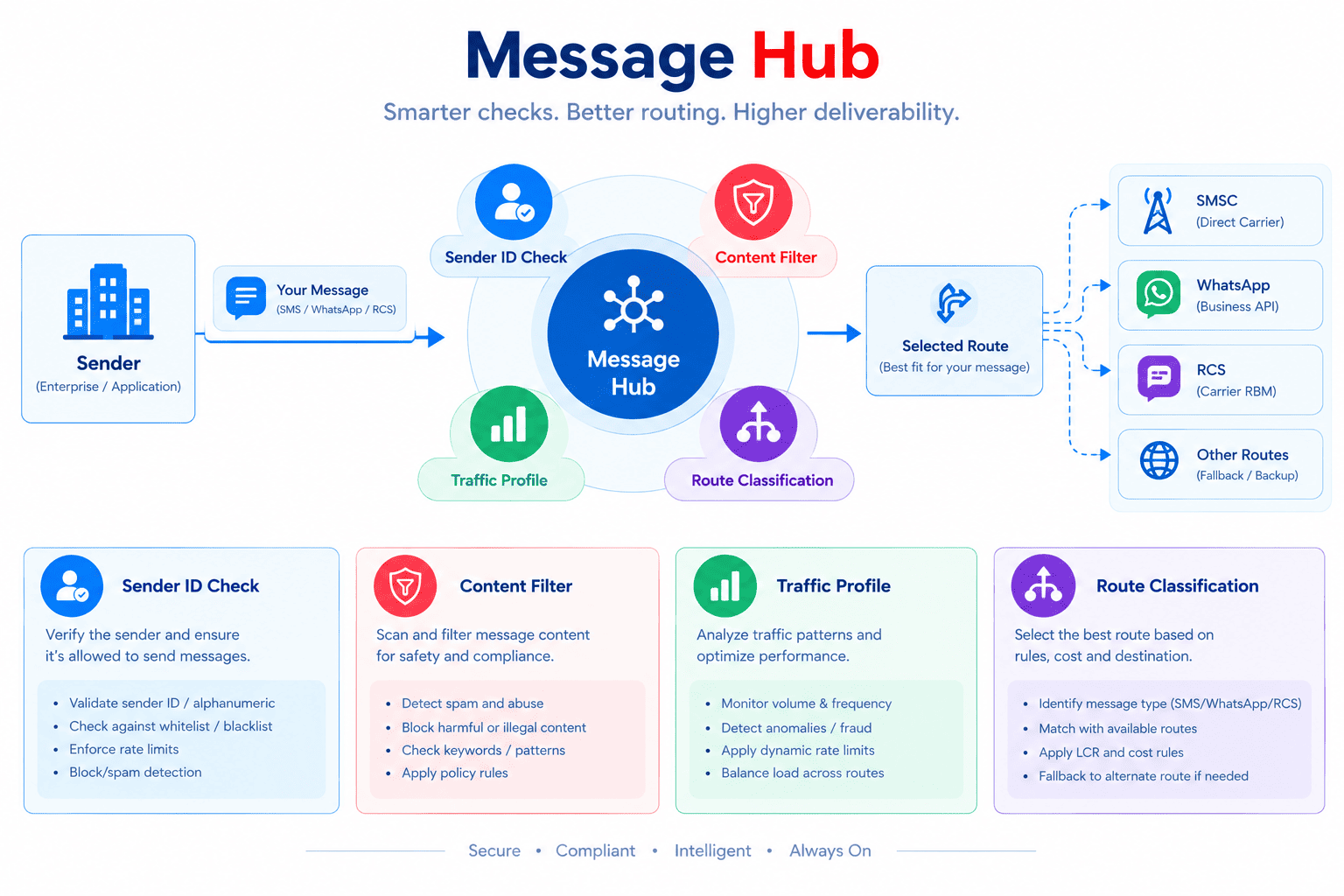
A hub helps in these specific ways:
- Sender ID controls: Registered or allowed sender IDs per customer, with rejection of mismatches.
- Content and pattern filtering: Identifying commercial templates, repeated content, and bulk patterns arriving on routes meant for personal traffic.
- Traffic profiling: Flagging sudden volume, odd timing, or unusual destination mixes for a given account.
- Route classification: Tagging supplier routes by type so A2P traffic cannot silently move onto a P2P labeled connection.
- Audit trail: Logs showing which customer sent what, through which route, to support investigation and enforcement.
The limits are real. A hub only sees traffic passing through it. Fraud that enters through another path, such as SIM box activity at the network edge, needs separate controls. Detection rules also need regular tuning because fraudsters adapt. Treat a hub as one layer in a wider protection setup that may include a dedicated SMS firewall.
Key Features to Evaluate
Evaluate an SMS hub on routing depth, delivery tracking accuracy, capacity, protocol support, and compliance tooling. A longer feature list matters less than how well each capability matches your traffic.
- Routing logic: Can you route by prefix, MCC/MNC, sender ID, message class, time, supplier health, and cost? Can rules be changed without downtime?
- Least cost routing with quality guardrails: LCR should factor delivery performance, not price alone.
- SMPP gateway capability: Support for multiple concurrent binds, window sizes, and configurable throttling per account and per supplier.
- DLR tracking: Accurate mapping of receipts to messages, handling of missing or late receipts, and clear status codes. Poor DLR handling corrupts billing and route scoring.
- Throughput headroom: Check sustained messages per second, not only peak claims, and confirm what limits apply at the database and queue level.
- A2P messaging compliance: Support for sender registration requirements and filtering rules that apply in your markets. These differ by country, so confirm local needs with your legal team.
- Number intelligence: HLR lookup integration and number portability handling where required.
- Billing and settlement: Per route and per customer pricing, rate plans, prepaid and postpaid support.
- Redundancy: High availability design, geographic redundancy options, and clear failure behavior.
- Reporting: Route level and customer level analytics you can export.
Build, Buy, or Use a Hub Service
You have three realistic options, and the right one depends on traffic volume, engineering capacity, and how much control you need.
| Option | Strengths | Weaknesses | Fits when |
| Build in house | Full control, tailored logic | Long development, ongoing maintenance, scarce SMPP and SS7 skills | You have a telecom engineering team and unusual requirements |
| Buy hub software and run it yourself | Control of routes and data, faster than building | You operate it and need suitable infrastructure | You want ownership of routing and supplier relationships |
| Use hubbing as a service | Quickest start, no platform to run | Less transparency, margin on every message, dependence on the provider | You need reach quickly or have low volume |
Many operators start with a service and move to their own platform once volume justifies it. Others keep both. Whatever you choose, check how data portability works. Moving customers and routing history off a platform is much easier if you ask before you sign.
Organizations that want to run their own platform may evaluate SMS gateway software and SMS wholesale solutions that include routing, supplier management, and billing. TeleOSS offers both an SMS hub and SMS wholesale solution along with SMS gateway software. Compare any vendor, including TeleOSS, against the criteria in the section above using a trial or proof of concept with your own traffic.
Common Mistakes After Deployment
These are the issues that tend to appear once a hub is live, based on how routing platforms generally behave rather than on any single deployment.
Routing on price alone: The cheapest route often has the worst delivery. Set a quality floor in the rules before enabling LCR.
Trusting supplier DLRs without checking: Some routes return receipts that say they were delivered when messages were not. Compare DLR rates against customer complaints and independent test messages.
No traffic classes: Treating OTP, alerts, and marketing the same leads to OTPs stuck behind bulk campaigns. Separate queues and priority by class.
Ignoring throttling: Pushing past a supplier’s allowed rate leads to rejections and queue buildup. Match per supplier limits in the hub.
Skipping test routes: Regular test messages per route catch silent degradation early.
Leaving fraud rules static: Review blocked and passed traffic periodically, because patterns change.
Weak monitoring on binds: An SMPP bind that appears up but stops passing traffic can go unnoticed. Alert on traffic and response times, not just connection state.
Conclusion
An SMS hub gives operators and aggregators a single routing layer in place of a tangle of separate connections. It earns its keep through cost control, failover, faster onboarding, and a central place to enforce fraud and compliance rules. It does not replace direct interconnects on your biggest corridors, and it will not stop every grey route on its own.
The practical path is to map your traffic first. Identify your top corridors, your long tail destinations, and your fraud exposure. Then decide how much sits best on direct links and how much on an SMS hub.
If you are evaluating platforms, TeleOSS can walk you through its SMS hub, SMS gateway software, and SMS wholesale solution against your own traffic profile. Contact the team for a technical walkthrough or a proof of concept, so you can compare routing behavior and DLR handling with your real numbers before you commit.
FAQs
What is an SMS hub in telecom?
An SMS hub is a central platform that connects many message senders to many operator and aggregator routes. It receives messages, selects the best route using rules, delivers them upstream, and returns delivery reports. It lets operators and aggregators manage many connections and routing decisions in one place.
How does SMS hubbing differ from direct carrier interconnects?
A direct interconnect is a dedicated link to a single operator, giving you control and often lower unit cost on large corridors. SMS hubbing reaches many networks through one connection, which speeds launch and simplifies operations but adds a hub margin and reduces visibility into downstream paths.
What protocols does an SMS hub use for routing?
Most hubs use SMPP for customer and supplier connections. Many also offer an HTTP API for simple integrations. For direct operator signaling, hubs may use SS7 or SIGTRAN. A strong hub translates between these so each party can connect in the format it already supports.
Can an SMS hub prevent grey route fraud?
It can reduce it, not remove it. A hub can enforce sender ID rules, filter content and traffic patterns, classify routes, and keep audit logs. It only controls traffic that passes through it, so edge threats like SIM box activity need additional controls.
Do enterprises need an SMS hub or just an SMS gateway?
Most need only a gateway or a provider API. An enterprise needs hub functionality when it contracts with several SMS suppliers and wants to route by country, cost, and delivery quality, with automatic failover across them.
Is an SMS hub the same as an SMS aggregator?
No. An aggregator is a business that resells SMS access, while a hub is the platform or arrangement that routes traffic. Many aggregators run a hub platform internally, which is why the terms get mixed up.
How does least cost routing work in an SMS hub?
The hub keeps a price list per supplier and destination, then picks the lowest cost route for each message. Good implementations add quality conditions, such as minimum delivery rate, so cost savings do not come at the expense of failed messages.