
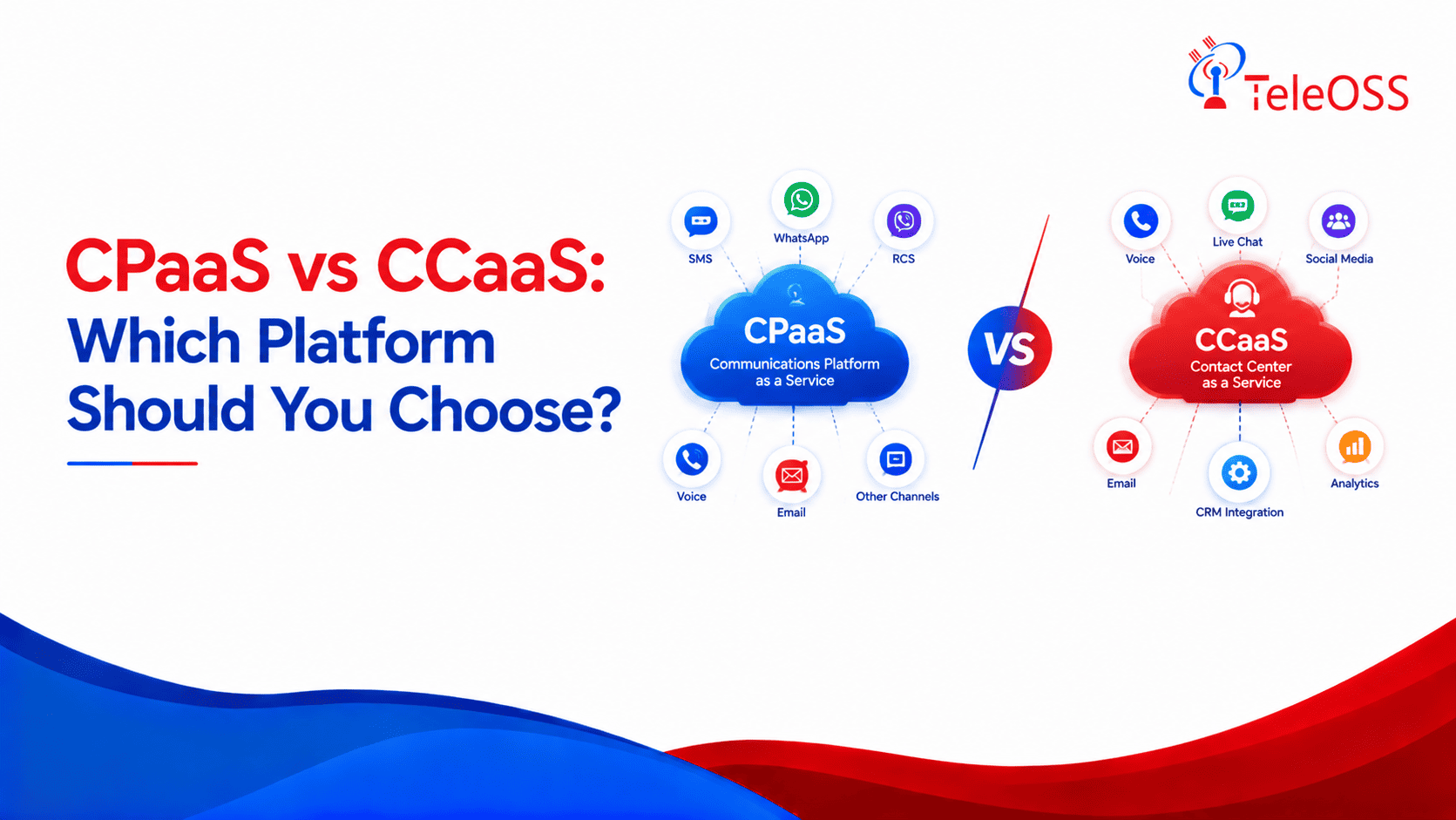
If you’re comparing CPaaS and CCaaS, you’re probably trying to solve one of two problems: you need to add messaging, voice, or video capability into your own application, or you need to run a customer service operation with agents, queues, and reporting. These sound similar on the surface because both categories deliver communication over the cloud, but they’re built for different jobs and different buyers.
This blog breaks down what each platform actually does, where they overlap, and how telecom operators, SMS aggregators, and enterprise teams typically decide between them.
Quick Answer
CPaaS (Communication Platform as a Service) gives developers APIs to build custom messaging, voice, and video features into their own software. CCaaS (Contact Center as a Service) is a ready-made cloud platform for running customer service operations, including agent tools, call routing, and reporting. Choose CPaaS if you need to build custom communication logic into a product. Choose CCaaS if you need to run or scale a customer support or sales team. Many organizations end up using both.
Key Takeaways
- CPaaS is API-first infrastructure for developers. CCaaS is a full application for contact center operations.
- CPaaS pricing is usage-based (per message, minute, or API call). CCaaS pricing is typically per-agent, per-seat, per month.
- Telecom operators and SMS aggregators generally sit on the infrastructure side of CPaaS, since A2P messaging and SMS gateway routing are core CPaaS building blocks.
- CCaaS platforms often consume CPaaS APIs behind the scenes to deliver SMS, voice, and WhatsApp channels to contact center agents.
- The two aren’t mutually exclusive. A common setup uses CPaaS for custom notification and verification flows, and CCaaS for the human-agent support layer.
- Integration complexity and control are the biggest trade-offs: CPaaS gives more flexibility but needs engineering resources, while CCaaS gets you running faster with less custom development.
What Is CPaaS?
CPaaS (Communication Platform as a Service) is a cloud platform that gives developers programmable APIs to add messaging, voice, video, and verification features directly into their own applications. It works by exposing communication functions such as sending an SMS, placing a voice call, or verifying a phone number as API endpoints, so a developer can trigger them from their own codebase instead of building telecom infrastructure from scratch.
In practice, CPaaS is the layer that sits between an application and the underlying telecom network. A developer building a food delivery app, for example, doesn’t need to negotiate connections with mobile operators to send a driver arrival alert. They call a CPaaS API, and the platform handles routing the message through carrier networks.
Core CPaaS capabilities usually include A2P (application-to-person) messaging infrastructure, voice APIs, video SDKs, two-factor authentication and OTP delivery, and sometimes RCS or WhatsApp Business API access. Well-known CPaaS providers include TeleOSS, Twilio, Vonage, Sinch, and MessageBird, though the category also includes wholesale SMS platforms and SMS gateway providers that telecom operators and aggregators rely on to move traffic.
What Is CCaaS?
CCaaS (Contact Center as a Service) is a cloud-hosted platform that provides the full set of tools a customer service or sales team needs to handle calls, chats, and other support interactions, without the business having to own or maintain on-premise contact center hardware.
A CCaaS platform typically bundles interactive voice response (IVR), automatic call distribution (ACD), omnichannel routing across voice, chat, email, and SMS, workforce management, quality monitoring, and reporting dashboards. Agents log into a single interface to handle interactions across channels, and supervisors get real-time visibility into queue length, wait times, and agent performance.
For example, a retail bank running a 200-seat support center can deploy a CCaaS platform to route incoming calls by IVR selection, queue overflow calls to available agents, and log every interaction against the customer’s account, all without maintaining physical PBX hardware. Common CCaaS vendors include Genesys, NICE CXone, Five9, and Amazon Connect.
CPaaS vs CCaaS: Key Differences
| Attribute | CPaaS | CCaaS |
| Primary user | Developers and product teams | Contact center operations and support teams |
| Delivery model | APIs and SDKs for custom integration | Ready-made application with a user interface |
| Core function | Programmable messaging, voice, video, verification | Agent routing, queue management, omnichannel support |
| Typical buyer | Software companies, telecom operators, SMS aggregators | Customer service, sales, and operations leaders |
| Customization | High, requires development resources | Moderate, configured through admin settings |
| Pricing model | Usage-based (per message, minute, API call) | Per-agent or per-seat, monthly subscription |
| Time to deploy | Depends on development effort | Faster, since the interface is pre-built |
| Example capability | Sending an OTP via SMS API | Routing an inbound call to the next available agent |
The core distinction is that CPaaS is infrastructure you build with, and CCaaS is an application you operate on. A business rarely chooses one as a straight replacement for the other because they solve different layers of the communication stack.
How CPaaS Works
CPaaS works by abstracting the technical complexity of telecom networks into a set of API calls a developer can integrate directly into their software.
- A developer sends an API request: For example, a request to send an SMS containing an OTP code to a specific phone number.
- The CPaaS platform processes the request: It validates the number format, checks account credits, and determines the correct route.
- The message is routed through carrier or aggregator connections: This may involve SMPP (Short Message Peer-to-Peer) connections to mobile network operators or SMS aggregators, or HTTP APIs to other messaging providers.
- The network delivers the message to the handset: The mobile operator’s SMSC (Short Message Service Center) delivers the message to the subscriber.
- A delivery report is returned: The CPaaS platform sends a delivery receipt (DLR) back to the developer’s application, confirming whether the message reached the device.
Telecom operators and SMS aggregators often operate the infrastructure layer underneath CPaaS providers rather than the customer-facing API layer itself. Their SMS gateway software and wholesale routing platforms are what actually move traffic across operator networks once a CPaaS API call is triggered.
How CCaaS Works
CCaaS works by centralizing every customer interaction channel into one cloud-hosted platform that agents and supervisors access through a web interface.
- A customer initiates contact: This could be a phone call, a chat message, an email, or an SMS.
- The platform routes the interaction: Rules based on IVR selection, skill-based routing, or priority determine which queue and which available agent receives it.
- The agent handles the interaction from a unified interface: They see customer history, account data, and prior interactions alongside the live conversation.
- The interaction is logged and scored: Call recordings, chat transcripts, and quality scores feed back into reporting dashboards.
- Supervisors monitor and adjust in real time: Staffing levels, queue thresholds, and escalation rules can be adjusted without touching underlying telecom infrastructure.
Many CCaaS platforms rely on CPaaS providers behind the scenes for the actual messaging and voice delivery. When a CCaaS platform sends an SMS notification to a customer, that message is frequently routed through a CPaaS or SMS gateway connection rather than infrastructure the CCaaS vendor owns outright.
CPaaS Use Cases
For telecom operators: Operators use CPaaS-adjacent infrastructure, including SMS gateway software and wholesale SMS platform, to monetize A2P traffic from enterprises and aggregators. Instead of building custom connections for every enterprise client, the operator exposes standardized routing through its own gateway.
For SMS aggregators: Aggregators sit between enterprises and mobile network operators, using dynamic routing and least cost routing (LCR) logic to move messages efficiently across multiple carrier connections. A CPaaS layer or SMS gateway platform gives them the tools to manage multiple SMPP binds, monitor delivery rates, and detect grey route leakage.
For enterprises: A logistics company can use CPaaS APIs to trigger automated SMS updates when a shipment status changes, without building any telecom infrastructure of their own. A bank can generate a one-time password in its authentication system, send it through a CPaaS SMS API, route it through an operator connection, and receive a delivery report confirming the code reached the customer’s handset.
CCaaS Use Cases
Customer support scaling: A subscription software company experiencing rapid growth in support tickets can deploy CCaaS to add agents and channels without procuring new hardware, since the platform scales through configuration rather than physical infrastructure.
Omnichannel service consolidation: A telecom operator’s own customer service division might use CCaaS internally to unify billing support calls, chat inquiries, and SMS complaints into a single agent workspace, separate from the operator’s outbound A2P messaging business.
Sales and outbound campaigns: Contact centers running outbound sales or collections campaigns use CCaaS predictive dialers and campaign management tools to increase agent talk time and track conversion rates against compliance requirements such as call recording consent.
Can You Use CPaaS and CCaaS Together?
Yes. CPaaS and CCaaS are frequently used together rather than as competing choices, because they operate at different layers of the communication stack.
A common setup looks like this: a business uses CPaaS APIs for automated, high-volume notifications that don’t need a human agent, such as delivery alerts, appointment reminders, and OTP verification. The same business uses a CCaaS platform for interactions that require a live agent, such as billing disputes or technical support escalations. When a CCaaS agent needs to send a follow-up SMS during a live call, that message is often routed through the same CPaaS or SMS gateway infrastructure already handling the automated notifications.
This layered approach avoids duplicating messaging infrastructure. Enterprises don’t need to build separate SMS delivery systems for automated and agent-initiated messages if their CCaaS platform already integrates with a CPaaS or SMS gateway provider through an API.
Pricing and Integration Comparison
Pricing structure is one of the clearest ways to tell the two categories apart.
CPaaS pricing is almost always usage-based. You pay per SMS sent, per minute of voice call, or per API transaction. Costs scale directly with traffic volume, which makes CPaaS attractive for variable or high-volume workloads but harder to forecast if usage spikes unexpectedly. Enterprises negotiating CPaaS or SMS gateway contracts should ask about per-message rates by destination country, since international A2P pricing varies significantly by route and regulatory surcharge.
CCaaS pricing is typically per-agent, per-seat, billed monthly or annually. This makes budgeting more predictable for a fixed-size team, but costs don’t necessarily scale down easily if seasonal demand drops, since many CCaaS contracts lock in a minimum seat count.
Integration effort also differs. CPaaS requires development resources to integrate APIs into existing software, write logic for delivery report handling, and manage failover between routes. CCaaS generally requires less custom development since the interface, routing rules, and reporting are pre-built, though integrating a CCaaS platform with existing CRM or sms billing systems still takes configuration work.
How to Choose Between CPaaS and CCaaS
Use these questions as decision criteria:
- Do you need to build custom logic into your own product, or do you need a ready-made agent interface? Custom logic points to CPaaS. An operational team needing tools to work from points to CCaaS.
- Do you have engineering resources to maintain API integrations? CPaaS requires ongoing development support. CCaaS is largely configured by non-developers.
- Is your communication volume automated or human-driven? High-volume automated notifications (OTPs, alerts, reminders) fit CPaaS. Conversational, agent-led interactions fit CCaaS.
- What’s your growth pattern? If you’re scaling messages or call volume unpredictably, usage-based CPaaS pricing may fit better. If you’re scaling headcount in a support team, per-seat CCaaS pricing is more predictable.
- Are you a telecom operator or aggregator, or an enterprise buyer? Operators and aggregators typically operate on the CPaaS infrastructure side, building or reselling gateway capacity. Enterprises are usually buyers of both categories rather than infrastructure providers.
Common Mistakes to Avoid
- Treating CPaaS and CCaaS as interchangeable
Buying a CCaaS platform expecting it to replace the need for API-level messaging infrastructure often leads to disappointment when a business later needs custom automated workflows the CCaaS vendor doesn’t support natively.
- Underestimating integration timelines for CPaaS
Businesses sometimes assume API integration is quick because the vendor markets it as “developer-friendly.” In practice, handling delivery reports, retries, failover routing, and regulatory requirements such as sender ID registration takes real engineering time.
- Ignoring route quality in CPaaS messaging
Not all CPaaS providers own direct operator connections. Some resell capacity through third-party aggregators, which can introduce grey routes and inconsistent delivery rates. Ask any CPaaS or SMS gateway vendor directly whether routes are direct-to-operator or resold, since this materially affects deliverability.
- Overpaying for CCaaS seats you don’t need
Locking into a large seat count during a growth forecast that doesn’t materialize is a common budget mistake. Negotiate flexible seat terms where possible.
Where SMS Gateway Infrastructure Fits In
Regardless of whether an organization ultimately chooses CPaaS, CCaaS, or both, SMS delivery underneath either platform depends on gateway infrastructure that connects to mobile network operators. SMS gateway software handles the routing, connection management, and delivery reporting that both CPaaS providers and CCaaS platforms rely on to actually get an SMS to a handset.
Telecom operators and SMS aggregators building or operating their own messaging infrastructure, rather than reselling a third-party CPaaS platform, typically need SMS gateway software that supports SMPP and HTTP API connectivity, dynamic and least cost routing, delivery report handling, and SMS firewall protection against grey route and SIM box fraud. TeleOSS builds SMS gateway software and wholesale SMS platforms for this exact layer of the stack, supporting operators and aggregators who need direct control over routing and monetization rather than depending entirely on a third-party CPaaS reseller.
Conclusion
CPaaS and CCaaS answer different questions. CPaaS answers “how do I build custom communication into my own software,” while CCaaS answers “how do I run a customer service operation without building it from scratch.” Telecom operators and SMS aggregators generally operate closer to the CPaaS and gateway infrastructure layer, while enterprises evaluating customer engagement tools often need both: CPaaS for automated workflows, and CCaaS for the human-agent layer that sits on top of it.
If your business is evaluating where SMS delivery infrastructure fits into either model, understanding the routing, connectivity, and delivery reporting layer underneath both platforms will save you from integration surprises later.
See how TeleOSS SMS gateway software supports A2P messaging routing for CPaaS and CCaaS integrations.
FAQs
What is the difference between CPaaS and CCaaS?
CPaaS provides APIs for developers to build custom messaging, voice, and video features into their own software. CCaaS provides a ready-made cloud platform for running a customer service or contact center operation, including agent tools and call routing. CPaaS is infrastructure you build with. CCaaS is an application you operate.
Which is better for telecom operators: CPaaS or CCaaS?
Telecom operators generally align with CPaaS, since it maps to their role as infrastructure and connectivity providers rather than contact center operators. Operators building SMS gateway or wholesale messaging platforms are effectively providing the routing layer that CPaaS and CCaaS platforms both depend on for message delivery.
Can a business use both CPaaS and CCaaS at the same time?
Yes. It’s common to use CPaaS for automated, high-volume notifications like OTPs and alerts, while using CCaaS for live agent interactions like support calls and chat. The CCaaS platform often routes its own SMS or voice messages through the same CPaaS or gateway infrastructure.
What are the main use cases for CPaaS vs CCaaS?
CPaaS use cases include OTP verification, automated notifications, and A2P messaging infrastructure for operators and aggregators. CCaaS use cases include customer support scaling, omnichannel service consolidation, and outbound sales or collections campaigns run by contact center teams.
How do CPaaS and CCaaS differ in pricing and integration?
CPaaS is priced on usage, typically per message, minute, or API call, and requires development resources to integrate. CCaaS is priced per agent seat on a monthly or annual basis and requires less custom development since the interface and routing tools are pre-built.
Do CCaaS platforms need CPaaS to function?
Many CCaaS platforms integrate with CPaaS or SMS gateway providers to deliver SMS and voice channels, since building direct carrier connections isn’t typically a CCaaS vendor’s core business. This means the two categories often work together even when a business only directly purchases one of them.