

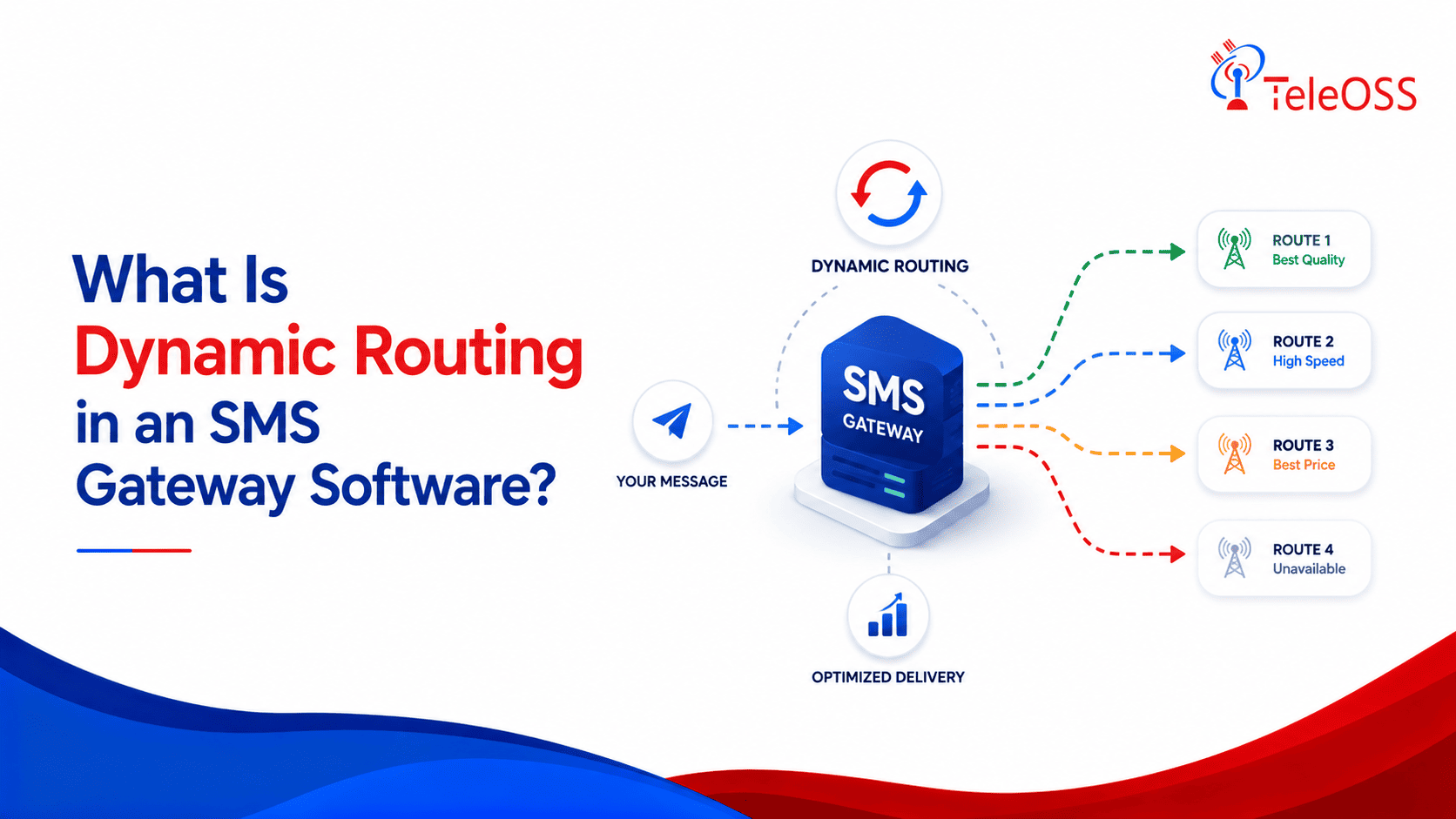
If you’ve spent any time comparing SMS gateway providers, you’ve probably seen “dynamic routing” listed as a feature and moved on without really knowing what it does for you. That’s a mistake, because routing logic is one of the few things that directly controls your delivery rates, your cost per message, and how much downtime you feel when an operator connection has a bad day.
This guide explains what dynamic routing actually is, how it’s different from static routing, what real-time route scoring looks at, and how to tell if a vendor’s dynamic routing is genuinely intelligent or just a marketing label on a basic failover script.
Quick Answer
Dynamic routing is a method SMS gateways use to automatically select the best available path for each message based on real-time conditions like delivery success rate, latency, cost, and network status, instead of relying on a single fixed route. It lets traffic reroute itself when a connection degrades or fails, which reduces message loss and keeps delivery times consistent across regions and operators.
Key Takeaways
- Dynamic routing selects a delivery path per message (or per batch) using live performance data, not a hardcoded route list.
- Static routing sends every message through the same predetermined path regardless of how that route is performing.
- Route scoring typically weighs delivery rate, latency, cost, and recent failure history for each operator connection.
- Failover only works as well as the number of alternate routes and the speed of the health checks behind it.
- Not every vendor implements the same depth of dynamic routing, so it’s worth asking specific questions before signing a contract.
What “Route” Means in SMS Delivery
Before dynamic routing makes sense, it helps to be precise about what a “route” actually is. In A2P (application-to-person) messaging, a route is the specific interconnect path a message travels from your sending platform to the recipient’s handset. That path usually runs through an SMSC (Short Message Service Center) or an aggregator connection tied to a specific operator agreement, identified by the destination’s MCC/MNC (Mobile Country Code and Mobile Network Code).
A single SMS gateway provider might have dozens or hundreds of routes available for the same destination country. For example, a message to a number on a Nigerian mobile network could travel through a direct operator connection, a regional hub, or a third-party aggregator, and each of those paths has its own price, latency, and reliability profile. The route a gateway picks for that message determines how fast it arrives, whether it arrives at all, and how much the sender pays for it.
This is why routing logic isn’t a minor backend detail. It’s the mechanism that decides the outcome of every message you send.
Static Routing vs Dynamic Routing
Static routing sends every message for a given destination through one preassigned path. The route doesn’t change unless someone manually updates the configuration. It’s simple to set up and easy to audit, but it has no ability to react when that specific connection slows down, gets throttled, or goes offline.
Dynamic routing evaluates multiple available paths in real time and picks the best one for each message based on current conditions. If the primary route for a destination starts failing or its delivery rate drops, the routing engine shifts traffic to an alternate path automatically, usually within seconds.
| Factor | Static Routing | Dynamic Routing |
| Route selection | Fixed, manually configured | Automatic, based on live performance data |
| Response to outages | None, requires manual intervention | Automatic failover to backup routes |
| Cost optimization | Manual, requires ongoing review | Can factor cost into route scoring continuously |
| Setup complexity | Lower | Higher, requires monitoring infrastructure |
| Best suited for | Low volume, single region, predictable traffic | High volume, multi region, traffic with SLA requirements |
A practical way to picture this: imagine an enterprise sending appointment reminders through a single fixed route to a Southeast Asian operator. If that operator connection experiences congestion during peak evening hours (a common pattern for consumer SMS traffic), every reminder sent during that window either delays or fails silently. With dynamic routing in place, the gateway would detect the drop in delivery performance and shift new messages to a secondary route before the sender even notices a problem.
How Real-Time Route Scoring Works?
Direct answer: real-time route scoring assigns each available path a live performance score based on a combination of delivery rate, latency, recent failure history, and cost, then routes new messages to the highest scoring option for that destination.
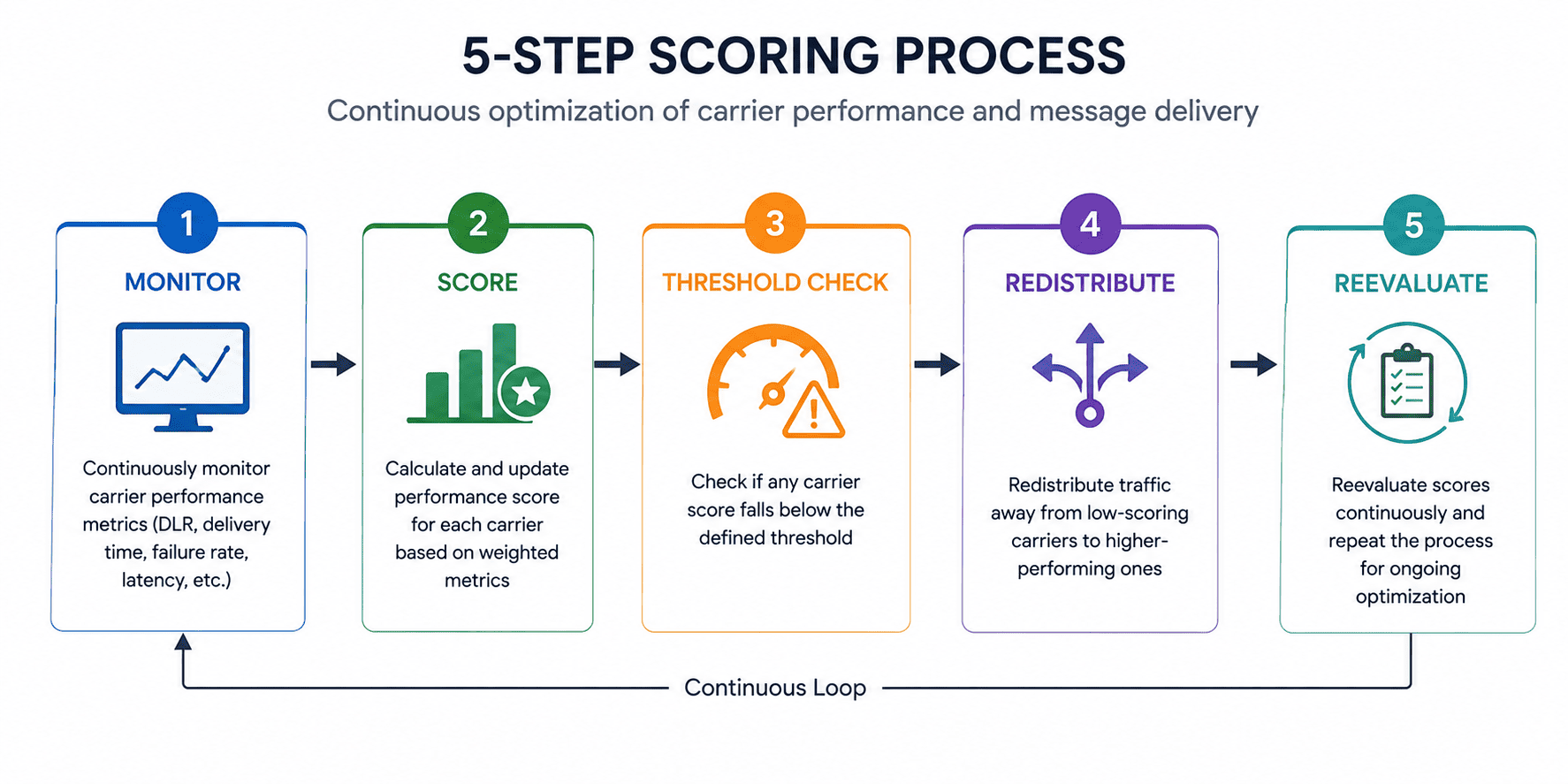
Here’s how that process typically breaks down:
Step 1: Continuous monitoring
The gateway tracks delivery reports (DLRs) coming back from each route for every destination network. This includes success rate, average time to delivery, and any error codes returned by the operator or intermediate carrier.
Step 2: Score calculation
Each route gets a score that updates continuously, not just once a day. A route that delivered 98% of messages in the last hour with low latency scores higher than one that delivered 80% with delayed DLRs, even if the second route is cheaper.
Step 3: Threshold checks
If a route’s score drops below a defined threshold, either from a spike in failures or a sudden latency increase, the system flags it as degraded.
Step 4: Traffic redistribution
New messages get sent through the next best scoring route for that destination. Some systems also apply weighted distribution, sending a percentage of traffic to a backup route even when the primary is healthy, to keep the alternate path warm and validated.
Step 5: Continuous reevaluation
As soon as DLRs from the previously degraded route start improving, the engine can shift traffic back, depending on how the vendor’s algorithm is configured.
This is meaningfully different from a simple ping check. A route can be technically “up” while still delivering messages slowly or failing silently past certain handset types, which is why DLR based scoring tends to catch problems that basic uptime monitoring misses.
Failover and Redundancy in Dynamic Routing
Failover is the part of dynamic routing people notice first, because it’s the difference between an outage that affects your customers and one that gets absorbed quietly in the background.
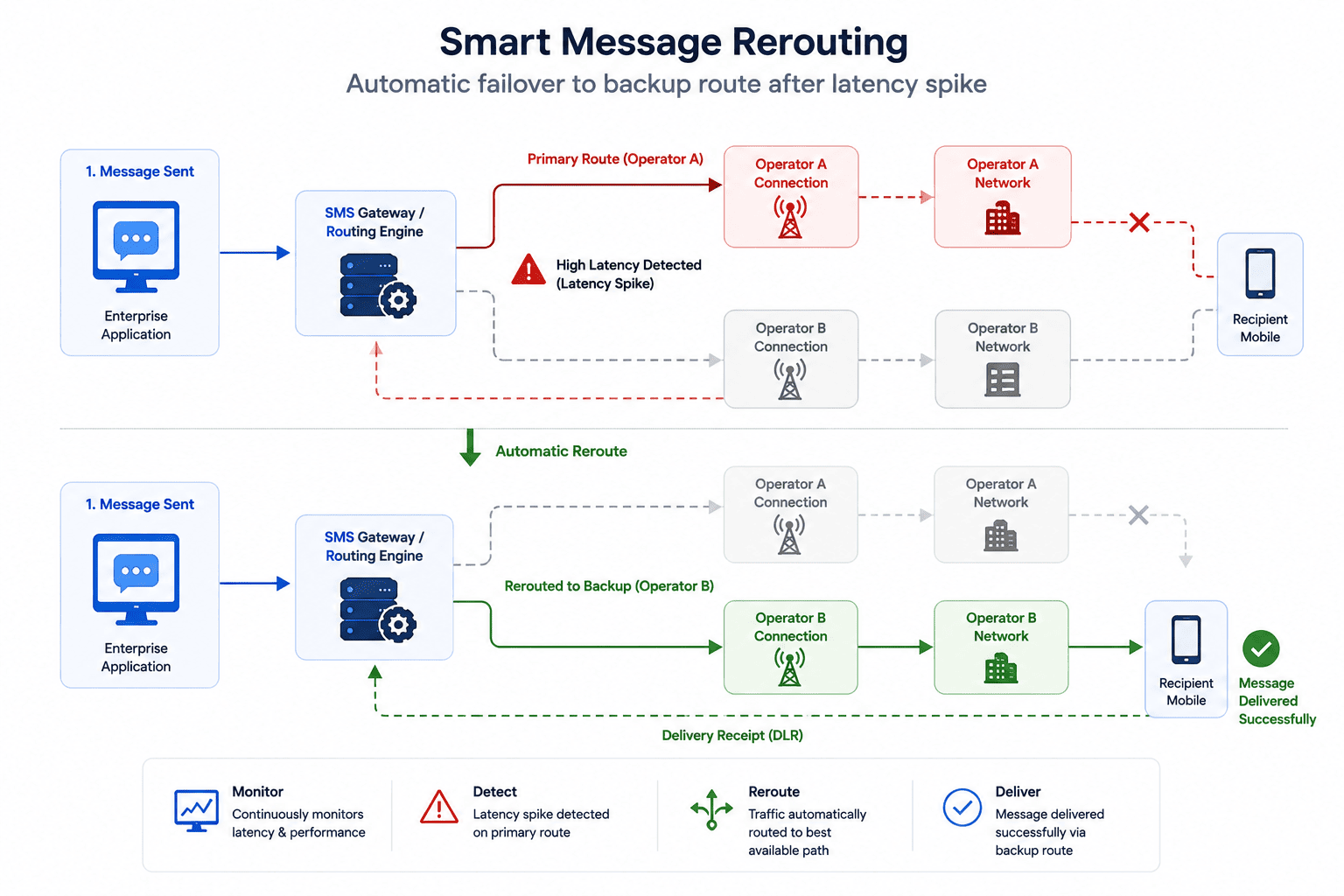
For failover to actually work, three things need to be in place:
- Multiple live routes per destination: Failover is meaningless if there’s only one path available. Redundancy requires at least one, ideally two, alternate connections per major destination network.
- Fast detection: The gap between a route degrading and the system recognizing it determines how many messages get affected before traffic reroutes. Systems that check performance every few seconds catch problems faster than ones that batch-check every few minutes.
- Clean handoff: Rerouted messages shouldn’t duplicate, get dropped, or lose their original submission timestamp when they move to a new path.
Here’s a scenario worth walking through: a bulk SMS reseller sends one-time passcodes for a fintech client through a Middle East operator connection. Mid-afternoon, that operator’s interconnect starts throttling traffic due to unrelated network maintenance on their end. Delivery latency jumps from under 5 seconds to over 40 seconds, which is unacceptable for OTP use cases where codes expire quickly. A gateway with proper dynamic routing detects the latency spike through DLR timing, reroutes new OTP traffic to a backup connection within the same session, and the client’s end users never experience the slowdown. Without that capability, the reseller would only find out about the problem after receiving complaint tickets.
It’s worth being clear about a limitation here too: dynamic routing reduces the impact of route level failures, but it can’t fix a problem on the handset side, a blocked sender ID, or a destination network that’s down entirely with no working alternate path. Redundancy only helps if a working alternative actually exists.
Dynamic Routing and Least Cost Routing (LCR)
Dynamic routing and least cost routing (LCR) often get mentioned together, but they’re not the same thing, and the difference matters.
LCR is a cost optimization strategy that selects the cheapest available route for a destination, assuming that route meets a minimum quality standard. Dynamic routing is the broader mechanism that can incorporate cost as one of several scoring factors, alongside delivery rate and latency, rather than optimizing for price alone.
A gateway that runs pure LCR without dynamic quality checks can end up chasing the cheapest route even when that route is a grey route, meaning traffic that bypasses proper commercial agreements with the destination operator. Grey routes often look cheap and fast in testing, then get blocked or filtered inconsistently, which shows up as unexplained delivery failures over time. This is a known problem in the A2P messaging ecosystem, and it’s part of why regulators and operators have pushed harder on traffic filtering and sender verification in recent years.
Well designed dynamic routing treats cost as one input among several, so the system won’t route OTP traffic through the cheapest available path if that path has a poor recent delivery record. This balance between cost and reliability is usually what separates a genuinely useful routing engine from one that’s optimized to look good on a price comparison sheet.
What to Check Before Choosing a Gateway With Dynamic Routing
Since “dynamic routing” isn’t a standardized term, vendors implement it with very different levels of sophistication. Before choosing a provider, it helps to ask specific questions rather than accepting the feature name at face value.
How many alternate routes exist per major destination?
One backup route is minimal redundancy. Ask how many live alternates are maintained for your priority markets.
What data feeds the routing decision?
Confirm whether scoring uses DLR based delivery rate and latency, or just basic route availability.
How fast does failover trigger?
Ask for the typical detection window between a route degrading and traffic shifting away from it.
Can you set routing rules per use case?
OTP traffic, marketing campaigns, and transactional alerts often need different priorities between speed, cost, and compliance.
Is grey route traffic excluded by policy?
This affects long-term reliability and compliance exposure, particularly for regulated destinations like the US, where 10DLC and TCR (The Campaign Registry) requirements apply to application-to-person traffic.
Can you see route performance data yourself?
Transparency into which routes your traffic is using, and how they’re performing, is a reasonable thing to ask for, not an unusual request.
Best Practices
- Segment traffic by use case before applying routing rules. OTPs need speed and reliability prioritized over cost, while promotional campaigns can tolerate more cost sensitivity.
- Review route performance reports regularly instead of assuming the system is optimizing correctly with no oversight.
- Ask your provider directly whether they use direct operator connections or intermediate aggregators for your priority destinations, since that affects both cost and route stability.
- Set alerts for sudden delivery rate drops even when failover is automatic, so your team knows when something changed upstream.
Common Mistakes to Avoid
- Assuming “dynamic routing” means the same thing across every vendor: Ask how it’s implemented instead of taking the label at face value.
- Treating cost as the only routing priority: The cheapest route isn’t useful if it fails silently or triggers filtering on regulated traffic.
- Ignoring route transparency: If a provider can’t show you which routes are handling your traffic, you can’t properly evaluate their performance claims.
- Skipping use case segmentation: Sending OTPs and marketing messages through identical routing rules often creates avoidable delivery problems for time sensitive traffic.
Conclusion
Dynamic routing is what allows an SMS gateway to keep messages moving reliably when a route degrades, rather than leaving traffic stuck on a failing path until someone notices. The core idea is straightforward: monitor route performance continuously, score each option using delivery rate, latency, and cost, and shift traffic automatically when conditions change. The details matter more than the label, though, since not every provider implements this with the same depth of monitoring or the same number of alternate routes.
If you’re evaluating gateway providers for high volume A2P traffic across multiple regions, ask specifically how their routing engine scores and reroutes traffic rather than relying on the feature name alone. TeleOSS’s SMS gateway software and wholesale SMS solution are built around real-time route scoring and multi-path redundancy for exactly this reason, and our team can walk you through how routing decisions are made for your specific traffic mix and destination markets.
FAQs
What are the advantages of dynamic routing over static routing?
Dynamic routing responds to network conditions automatically, which reduces message failures during outages or congestion. Static routing requires someone to notice a problem and manually update the configuration, which almost always means delays and lost messages happen first.
How does dynamic routing handle network failures automatically?
It continuously monitors delivery performance for each route and shifts traffic to an alternate path when a route’s score drops below an acceptable threshold. The switch typically happens within seconds, without requiring manual intervention from the sender or the gateway operator.
What protocols are used in dynamic routing for telecom?
Dynamic routing itself is a routing strategy rather than a protocol, but it’s commonly implemented on top of SMPP (Short Message Peer-to-Peer) connections and HTTP APIs, using delivery report data returned through those same interfaces to score route performance.
Does dynamic routing help with least cost routing in SMS?
Yes, when implemented well. Dynamic routing can factor cost into its scoring model alongside delivery rate and latency, which allows a gateway to pursue lower cost routes without sacrificing reliability, as long as the routing logic is designed to weigh quality and price together.
Which SMS platforms support intelligent dynamic route management?
Most enterprise grade SMS gateway platforms include some form of dynamic routing, but the sophistication varies widely. Rather than looking for a specific platform name, ask any prospective provider how many live routes they maintain per destination, what data drives their scoring, and how quickly failover triggers.
Is dynamic routing more expensive than static routing?
Not inherently. The routing logic itself doesn’t usually carry a separate cost, though gateways with more mature dynamic routing infrastructure may price their overall service differently. The bigger financial impact usually comes from what dynamic routing prevents, meaning failed messages, retransmission costs, and support overhead from delivery complaints.