
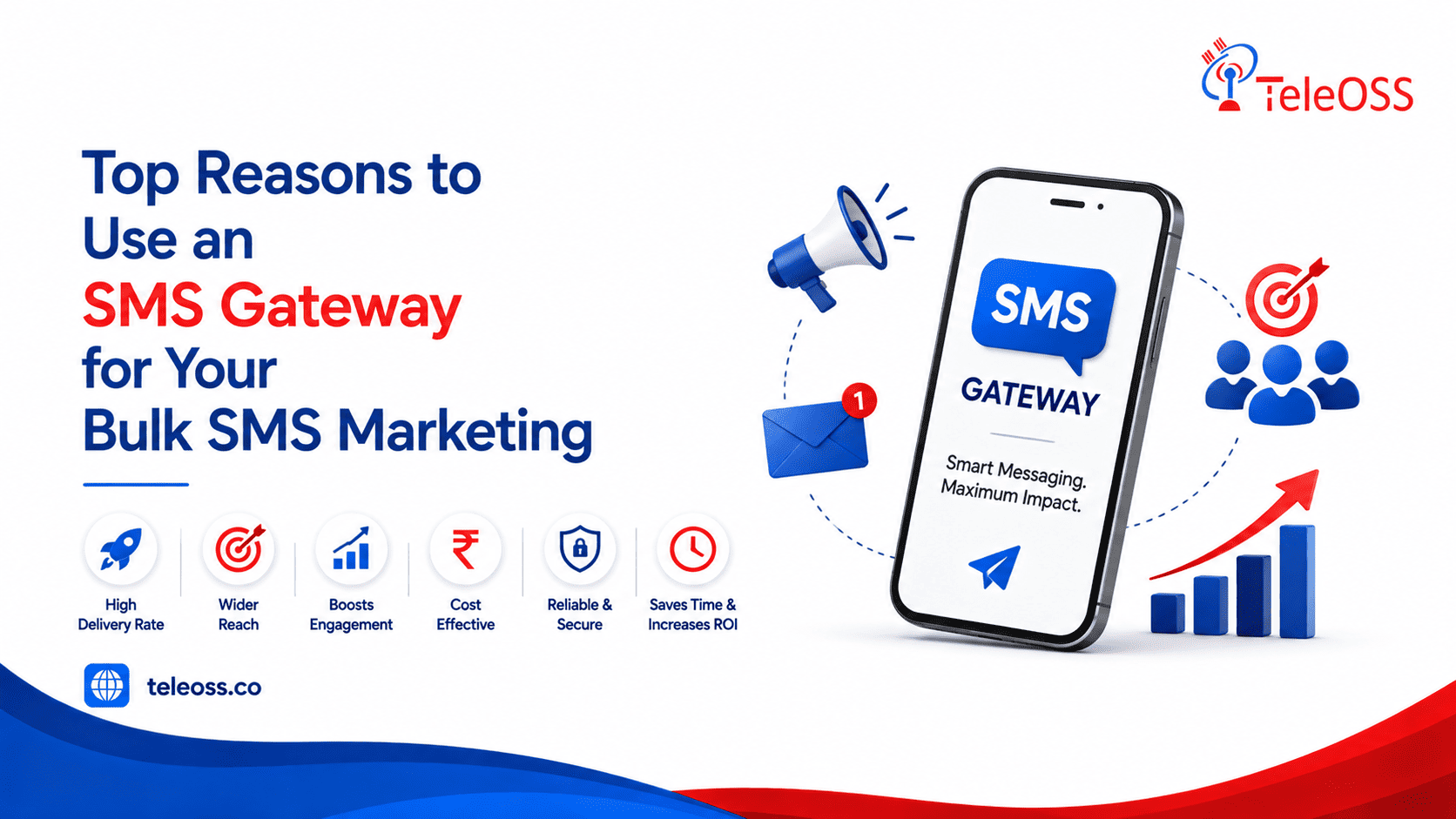
If you have ever tried to send a few hundred promotional texts from a regular phone or a consumer messaging app, you already know why it fails. Messages queue up, some never arrive, and carriers eventually flag the number. An SMS gateway solves this by giving your business a programmatic, carrier connected path to send and receive SMS at volume, with tracking and compliance built in.
This article breaks down what an SMS gateway does, how it changes the outcome of a bulk SMS campaign, and what to check before you commit to a provider.
Quick Answer
An SMS gateway is software that connects your application, CRM, or marketing platform to mobile carrier networks so you can send SMS programmatically instead of manually. For bulk SMS marketing, it matters because it gives you higher throughput, real time delivery reports, list management, opt out handling, and API access, none of which a personal phone or basic messaging app can provide at scale.
Key Takeaways
- An SMS gateway connects your systems to telecom networks through SMPP or HTTP APIs, removing the manual bottleneck of sending texts one by one.
- Gateways report delivery status per message (DLR), so you can measure open proxies like delivery rate instead of guessing.
- Regulatory handling, including opt out (STOP) processing and sender ID registration, is built into most gateway platforms, which reduces legal exposure.
- Throughput is measured in messages per second (MPS) or transactions per second (TPS), and this number is what actually determines how fast a large campaign goes out.
- Wholesale SMS routing and least cost routing (LCR) affect both delivery quality and cost per message, so the routing model matters as much as the interface.
What Is an SMS Gateway?
An SMS gateway is a software layer that sits between a business application and the mobile telecom network, translating outbound requests into SMS traffic and routing inbound replies back to the application. It works by accepting a message request, usually through an API or a connection protocol such as Short Message Peer to Peer (SMPP), then forwarding that request to a mobile network operator (MNO) or an intermediary aggregator for delivery to the handset.
Businesses use gateways to automate one to many and many to many messaging, commonly called application to person (A2P) messaging, which covers marketing texts, appointment reminders, one time passwords, and alerts.
Example: A retail chain running a weekend sale connects its e-commerce platform to an SMS gateway through a REST API. When a customer opts into promotions at checkout, the platform triggers a message request. The gateway queues the message, submits it to a carrier connection, and returns a delivery report a few seconds later confirming whether the handset received it.
How Bulk SMS Marketing Works Through a Gateway
The process is sequential, even though it happens in seconds per message.
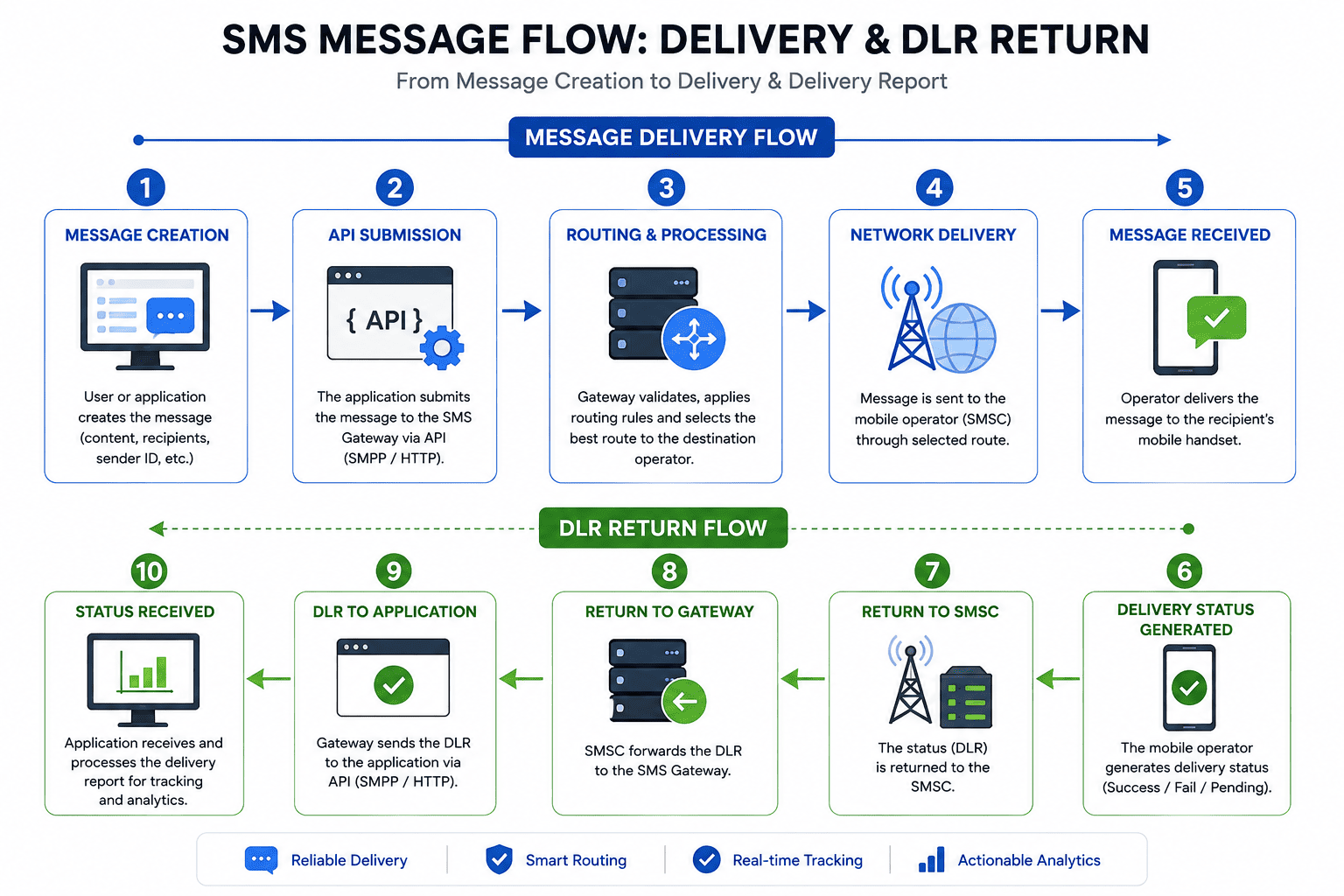
- Message creation: The marketing platform or CRM builds the message content and pulls the recipient list, usually filtered by opt in status.
- API submission: The platform sends the batch to the gateway through an HTTP API or SMPP bind, including sender ID, message body, and recipient numbers.
- Routing: The gateway checks its routing table and selects a carrier or aggregator path based on destination country, cost, and quality rules.
- Delivery to the network: The message enters the mobile network operator’s system, which delivers it to the handset over the signaling network.
- Delivery report (DLR): The handset or network confirms receipt, and this status flows back through the gateway to the sender’s dashboard or webhook.
Each step can be monitored separately, which is what makes gateway based sending measurable in a way manual sending is not.
Why Marketers Move Off Manual Sending
Manual sending through a phone, a basic bulk SMS app, or copy paste tools works for a handful of messages. It breaks down for three reasons: carriers apply spam filters to unusual sending patterns from personal numbers, there is no reliable way to see which messages failed, and there is no systematic way to honor opt outs across a growing list. Once a campaign moves past a few hundred recipients, these three limits become operational risks rather than inconveniences.
Reason 1: Message Throughput and Speed
Throughput is the number of messages a system can send per second, usually written as MPS (messages per second) or TPS (transactions per second). A gateway connection can typically push hundreds to thousands of messages per second depending on the provider tier and the carrier agreements behind it, compared to a manual process that tops out at whatever a human or a single device can manage.
For a marketing team, throughput determines whether a flash sale notification reaches ten thousand customers within a minute or trickles out over hours, by which point the promotion may already be less relevant.
Example: An airline sends a flight delay notification to 50,000 passengers on an affected route. Through an SMPP connection rated at 500 MPS, the batch completes in under two minutes. The same volume sent through a consumer app, limited to roughly one message every few seconds, would take most of a day.
Reason 2: Delivery Visibility and Reporting
A delivery report (DLR) tells the sender whether a message reached the handset, failed, or is still pending. This is generated by the carrier network and passed back through the gateway. Without this signal, a business has no way to know if a campaign actually worked or if a portion of the list simply never received anything.
Gateways typically expose DLR data through a dashboard, a webhook, or both, which lets marketing teams calculate real delivery rates instead of relying on send counts, which only confirm the message left the system, not that it arrived.
Example: A subscription service tracks delivery rate weekly across its renewal reminder campaign. When the rate drops from 96 percent to 84 percent for numbers on one carrier, the team can trace it to a routing issue and switch that traffic to an alternate route, something that would be invisible without per message DLR data.
Reason 3: Compliance and List Hygiene
Bulk SMS marketing is regulated in most markets. In the United States, the Telephone Consumer Protection Act (TCPA) governs consent requirements for marketing texts, and the 10DLC registration system, managed through The Campaign Registry (TCR), requires businesses to register sender identities for application to person traffic. In the European Union, the General Data Protection Regulation (GDPR) governs how personal data, including phone numbers, can be collected and used for marketing. In India, the Telecom Regulatory Authority of India (TRAI) enforces its Distributed Ledger Technology (DLT) framework, requiring registered templates and sender IDs for commercial messages.
A properly configured SMS gateway supports these requirements through features such as automated STOP or opt out keyword processing, sender ID registration workflows, and audit logs of consent and message history. This does not remove the business’s legal responsibility to obtain consent, but it gives the technical means to honor and document it.
Example: A subscription box company processes an average of 40 opt out requests a week across its SMS list. The gateway automatically removes those numbers from future sends and logs the timestamp of the request, which the company can produce if a complaint is ever raised with a regulator.
Reason 4: API Integration With Marketing Tools
Most SMS gateways expose a REST HTTP API and, for higher volume senders, an SMPP connection. This lets marketing platforms, CRMs, and e-commerce systems trigger messages automatically based on events like cart abandonment, appointment scheduling, or loyalty milestones, rather than requiring someone to manually export a list and paste it into a sending tool.
HTTP APIs are generally simpler to integrate for web applications and lower volume sending. SMPP is typically chosen when message throughput and persistent, lower level connection control matter more, which is common among aggregators and high volume enterprise senders.
Example: An online furniture retailer connects its cart abandonment workflow to an SMS gateway API. When a customer leaves items in the cart for more than an hour, the platform automatically fires an API call with a personalized reminder and a discount code, without any manual steps from the marketing team.
Reason 5: Cost Control Through Routing
Wholesale SMS pricing depends heavily on routing. A gateway or wholesale SMS platform can apply least cost routing (LCR), which automatically selects the cheapest available carrier path that still meets a minimum quality threshold for a given destination. Without this, a business either overpays by defaulting to a single premium route or risks poor delivery by chasing the cheapest route regardless of quality, sometimes called a grey route, which can violate carrier terms and get sender IDs blocked.
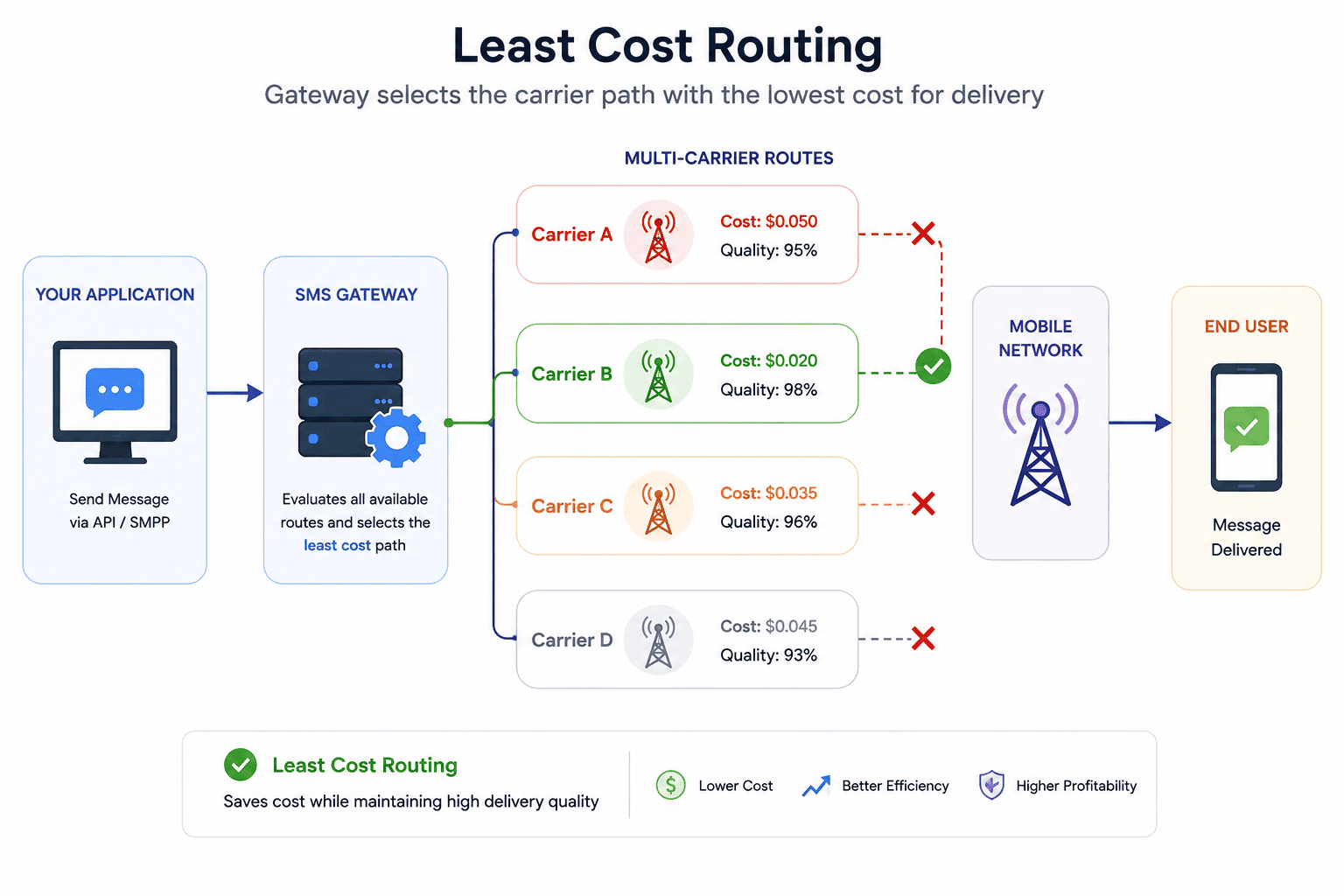
Example: A logistics company sending delivery notifications across 12 countries uses a gateway with LCR enabled. The system routes UK traffic through one aggregator and Nigerian traffic through a different one, based on real time cost and delivery performance data, without the company manually managing dozens of carrier relationships.
Reason 6: Two Way Messaging and Automation
Marketing is not only outbound. Gateways that support two way messaging let customers reply to a promotional text with a keyword to confirm interest, ask a question, or opt out, and route that reply back into the business’s CRM or support system automatically.
Example: A gym chain runs a text to join campaign where prospects reply “JOIN” to a promotional message to book a free trial class. The gateway captures the inbound reply, matches it to the original campaign, and triggers a booking confirmation, all without manual handling.
SMS Gateway vs Sending Through a Carrier App
| Factor | SMS Gateway | Carrier or Consumer App |
| Typical throughput | Hundreds to thousands of MPS depending on tier | Limited to a few messages per minute |
| Delivery reporting | Per message DLR data | Usually none or delayed |
| API access | REST or SMPP integration available | Rarely available |
| Opt out handling | Automated STOP processing | Manual |
| Sender ID registration | Supported for A2P compliance | Not applicable |
| Best suited for | Bulk marketing, transactional alerts, OTPs | Personal or very low volume messaging |
The table above compares typical capabilities. Actual throughput and features vary by specific provider and service tier.
How to Choose an SMS Gateway for Bulk Marketing
Selecting a gateway comes down to matching capabilities to your actual sending pattern rather than picking the provider with the longest feature list.
- Confirm supported connection types: Check whether the provider offers both HTTP API and SMPP, since your development team’s technical requirements will dictate which one fits your stack.
- Ask about throughput tiers: Get a specific MPS or TPS number in writing rather than a vague claim of “fast delivery.”
- Check delivery reporting details: Confirm DLR data is available per message and in near real time, not only as an aggregated daily report.
- Review compliance support: Ask how the platform handles sender ID registration, opt out processing, and regional requirements like 10DLC or TRAI DLT if you send into those markets.
- Understand the routing model: Ask whether routing is based on lowest cost only, or whether it also weighs delivery quality, since cheapest is not always most reliable.
- Test support responsiveness before committing: Delivery issues during a live campaign need a fast response, so evaluate support turnaround during a trial period, not just in the sales conversation.
Common Mistakes to Avoid
- Ignoring throughput limits until a campaign fails: Confirm your provider’s MPS rating supports your largest planned send before launch day, not during it.
- Skipping sender ID registration: Unregistered sender IDs are increasingly filtered or blocked by carriers, particularly for A2P traffic in the US and India.
- Treating delivery rate and open rate as the same thing: A DLR confirms network delivery to the handset. It does not confirm the recipient read the message.
- Choosing the cheapest route without checking quality: Grey routes can look cheap on a rate card and still result in poor delivery or a blocked sender ID down the line.
- Not documenting consent: Even with automated opt out handling, businesses should keep records of how and when consent was originally collected.
Conclusion
An SMS gateway turns bulk SMS marketing from a manual, error prone process into a measurable, compliant, and scalable channel. The real value is not just speed. It is the combination of throughput, per message delivery visibility, built in compliance handling, and API access that lets a marketing team run a campaign with the same rigor they would apply to email or paid ads.
If your team is evaluating infrastructure for bulk SMS marketing, TeleOSS offers SMS gateway software and SMS wholesale solution built around SMPP and HTTP API connectivity, least cost routing, and delivery reporting. You can review the platform’s capabilities on the TeleOSS SMS gateway software page to see how it fits your specific sending volume and compliance requirements.
FAQs
What is an SMS gateway used for in business messaging?
An SMS gateway is used to send and receive SMS programmatically from a business application, rather than manually from a phone. Common uses include marketing campaigns, appointment reminders, one time passwords, delivery notifications, and two way customer support over text.
How does bulk SMS marketing work through a gateway?
A marketing platform sends a batch request to the gateway through an API, the gateway routes each message to the appropriate carrier connection, and delivery reports flow back to confirm which messages reached the handset. This lets a business send thousands of messages in a short window while tracking outcomes per message.
Which SMS gateway has the best delivery rates for enterprise campaigns?
Delivery rate depends more on routing quality, carrier relationships, and sender ID reputation than on any single provider being universally best. Ask a shortlist of providers for documented delivery rate benchmarks by destination country and compare those figures directly rather than relying on marketing claims.
Can I use an SMS gateway API for automated bulk SMS marketing?
Yes. Most gateways expose a REST HTTP API specifically so marketing platforms and CRMs can trigger sends automatically based on events like sign ups, cart abandonment, or scheduled campaigns, without manual list uploads each time.
What compliance rules apply to bulk SMS marketing via SMS gateways?
Rules vary by market. In the US, the TCPA governs consent and 10DLC governs sender registration for A2P traffic. In the EU, GDPR governs how phone numbers can be collected and used. In India, TRAI’s DLT framework requires registered templates and sender IDs. Businesses sending across borders need to check requirements for each destination market, since a gateway supports compliance workflows but does not remove the legal obligation to obtain proper consent.
What is the difference between SMPP and an HTTP API for sending SMS?
SMPP is a protocol that maintains a persistent connection between the sender’s system and the SMS infrastructure, which suits high volume senders who need tighter control over throughput and connection behavior. An HTTP API is typically simpler to integrate for web applications and works well for moderate volume or event triggered sending.