

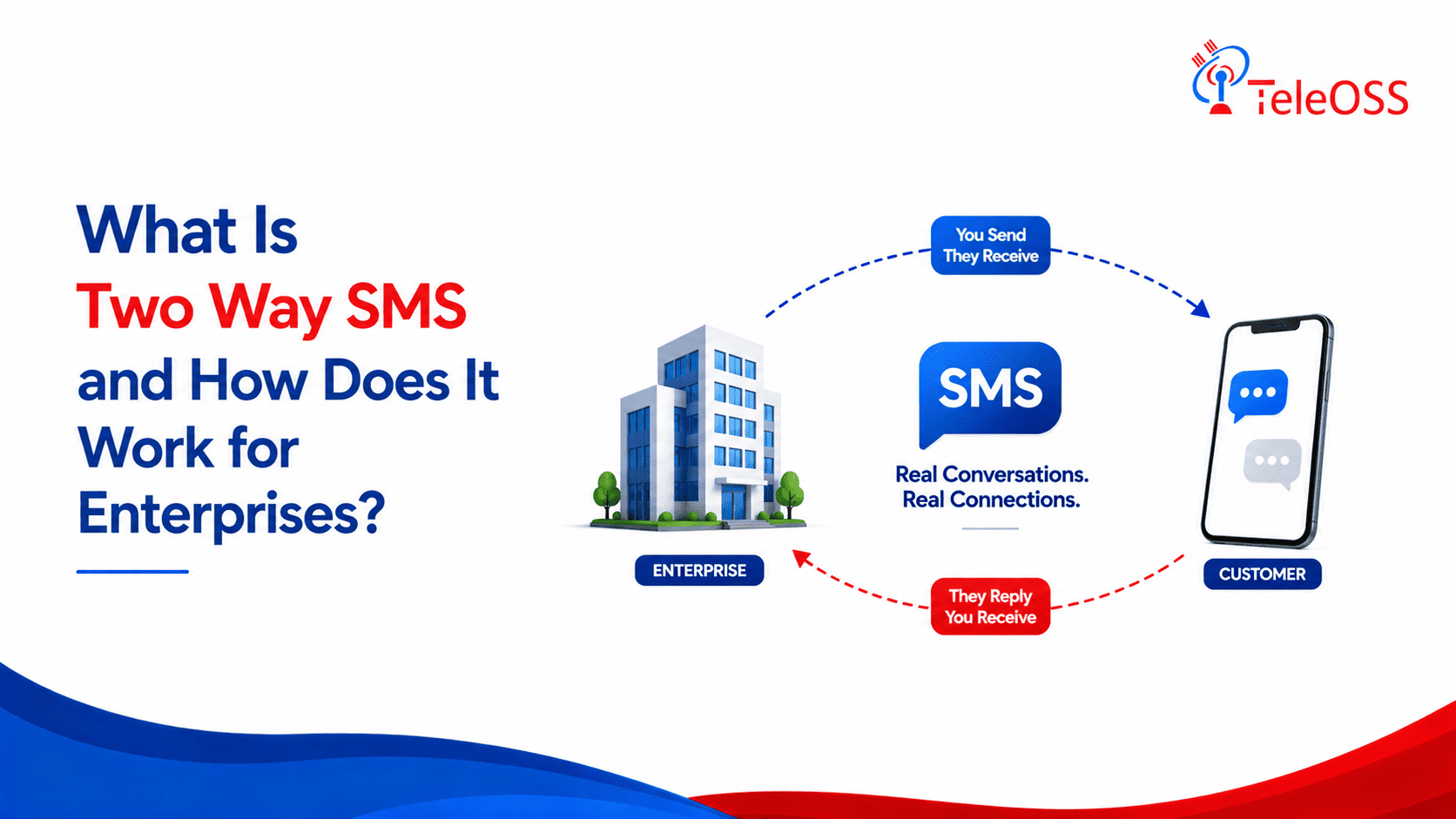
If you have ever texted “STOP” to unsubscribe, replied “YES” to confirm a delivery window, or chatted back and forth with a bank about a suspicious transaction, you have used two way SMS. It is the difference between a business broadcasting at you and a business actually talking with you.
For telecom operators and enterprises, though, two way SMS is not just a feature you switch on. It depends on how inbound messages are routed, how a platform maps replies to the right conversation, and how the underlying gateway handles both directions of traffic without losing context. This guide breaks down what two way SMS actually is, how the message flow works, and what it takes to run it reliably at scale.
Quick Answer
Two way SMS is a messaging setup where a business can both send text messages to a customer and receive replies from them, with each reply routed back into the sender’s system. It works through a phone number (long code, short code, or toll free number) connected to an SMS gateway that handles inbound and outbound routing, keyword detection, and delivery confirmation. Enterprises use it for customer support, appointment confirmations, order updates, and conversational SMS marketing.
Key Takeaways
- Two way SMS requires a dedicated sending number and an SMS gateway or platform that can route inbound replies back to the correct conversation thread.
- One way SMS only pushes messages out. Two way SMS closes the loop by accepting and processing replies.
- Inbound message handling typically relies on either keyword matching (STOP, YES, CONFIRM) or free text routed to a live agent or CRM.
- SMS response rates run well above email. Aggregated 2025 to 2026 industry benchmarks put SMS response rates around 45%, compared to roughly 6% for email.
- In the US, businesses sending application to person (A2P) traffic need to register campaigns through The Campaign Registry (TCR) under the 10DLC framework, or risk carrier filtering.
- Choosing between SMPP and an HTTP API depends on message volume, latency needs, and how much low level connection control your team wants to manage.
What Is Two Way SMS?
Two way SMS is a text messaging model that lets a business and a customer exchange messages in both directions through the same number. The business sends a message, the customer replies, and that reply lands back inside the business’s messaging platform, CRM, or support inbox, tied to the original conversation.
This is different from a basic SMS blast, which only moves in one direction. With two way SMS, the phone number is registered and monitored so inbound traffic does not just disappear. It gets parsed, matched to a workflow, and either handled automatically or handed to a human agent.
A simple example: a logistics company sends “Your delivery arrives between 2 and 4 PM. Reply C to confirm or R to reschedule.” When the customer replies “C,” the system logs the confirmation and updates the delivery record automatically. No phone call, no app download, just a two second reply the customer was already comfortable sending.
One Way SMS vs Two Way SMS
This is one of the most common points of confusion for teams evaluating messaging platforms, so it is worth laying out side by side.
| Aspect | One Way SMS | Two Way SMS |
| Direction | Business to customer only | Business to customer and customer to business |
| Typical use | Alerts, OTPs, broadcast promotions | Support, confirmations, conversational campaigns |
| Number type | Often shared short codes or alphanumeric sender IDs | Dedicated long code, short code, or toll free number |
| Reply handling | None, replies are usually undeliverable or ignored | Routed to CRM, agent, or automated workflow |
| Infrastructure need | Basic SMS gateway | Gateway with inbound routing, keyword logic, and session mapping |
| Reporting | Delivery reports only | Delivery reports plus reply tracking and response analytics |
The practical takeaway: if your use case involves an OTP or a one time alert, one way SMS is simpler and cheaper to run. If you need the customer to act, confirm, or ask a follow up question, you need two way SMS infrastructure from the start. Retrofitting reply handling onto a one way setup later usually means switching numbers, which resets any trust or recognition you had built with that sender ID.
How Does Two Way SMS Work?
At a high level, two way SMS works through four stages: message origination, delivery through the mobile network, the customer’s reply, and inbound routing back to the sender’s platform.
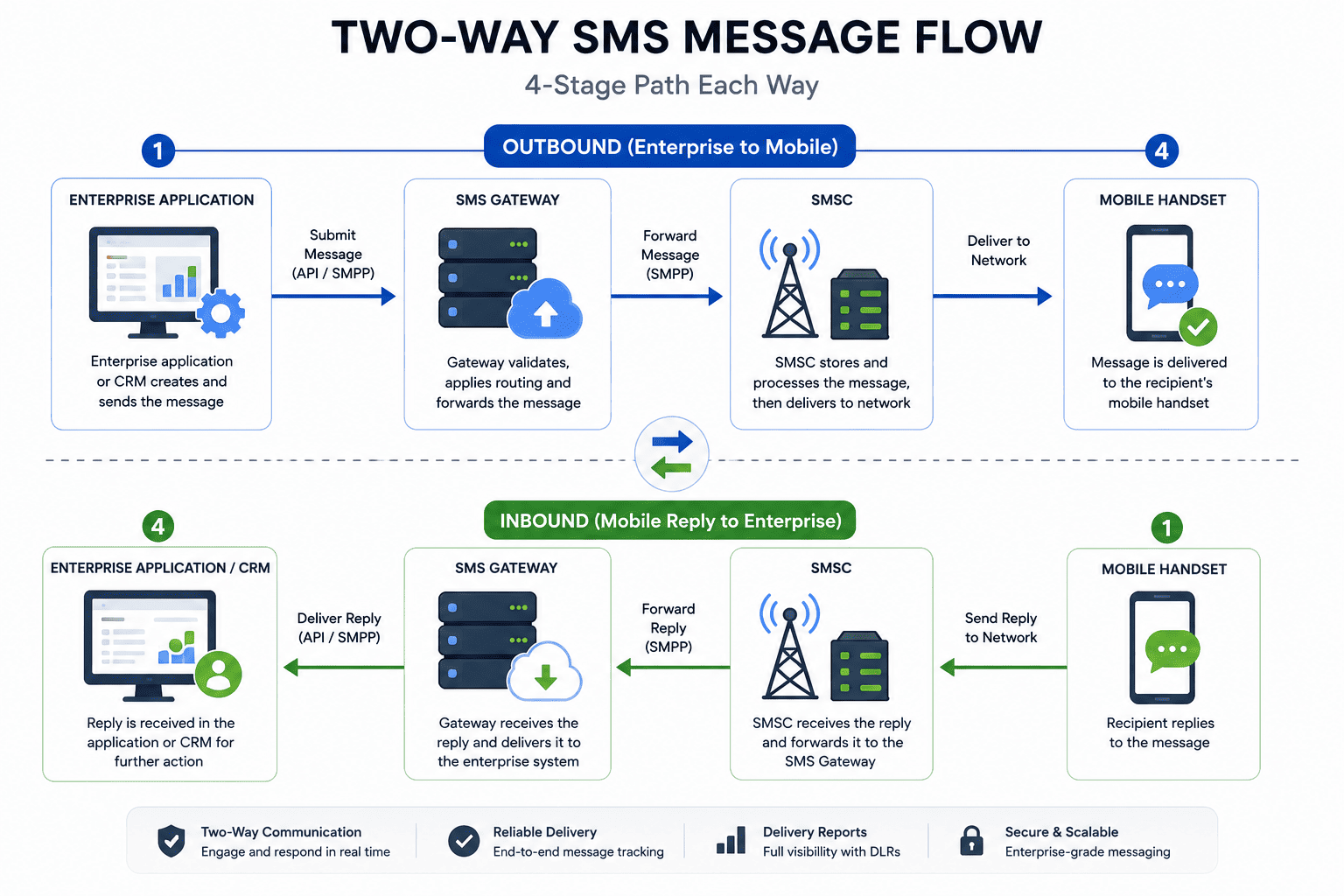
Step 1: The business sends a message
An application or platform submits the message through an SMS gateway, typically using either SMPP (Short Message Peer-to-Peer protocol) or an HTTP API. SMPP is a telecommunications protocol built for high throughput, persistent connections between messaging platforms and SMS infrastructure, and it is common among telecom operators and aggregators moving large volumes. HTTP APIs are simpler to integrate for web and mobile applications that do not need that level of connection control.
Step 2: The message routes through the SMSC
The Short Message Service Center (SMSC) on the operator’s network receives the message, checks routing rules, and forwards it toward the recipient’s handset. This is also where least cost routing (LCR) decisions happen if the traffic is moving through a wholesale or aggregator connection.
Step 3: The customer replies
When the customer types a reply, their carrier routes it back to the SMSC associated with the sending number. This is the step that separates two way from one way SMS. If the sending number is not configured to accept inbound traffic, the reply either bounces or goes nowhere useful.
Step 4: The gateway routes the inbound message back
The gateway matches the inbound message to the original conversation using the sender’s phone number and, in more advanced systems, a session or conversation ID. From there, it can trigger a keyword based automation, forward the message to a live agent, or log it in a CRM.
A bank offers a clean example of this full loop. A customer’s card is flagged for a suspicious transaction. The fraud system generates an alert, sends it through the SMS gateway using an HTTP API call, and the message reaches the customer within seconds. The customer replies “NO” to indicate they did not make the purchase. That reply routes back through the gateway, gets matched to the open fraud case, and triggers an automatic card freeze, all without a phone call.
Key Components of a Two Way SMS System
A working two way SMS setup depends on a few specific pieces working together, not just an SMS gateway on its own.
Dedicated sending number:
This can be a long code (a standard 10 digit number), a short code (5 to 6 digits, higher throughput, used for high volume campaigns), or a toll free number registered for SMS. Shared or unregistered numbers generally cannot support reliable two way messaging because inbound routing is not guaranteed.
Inbound message parsing:
The gateway needs logic to read incoming text and decide what to do with it. This ranges from simple keyword matching (STOP, HELP, YES, NO) to more advanced natural language routing that hands ambiguous replies to a live agent.
Session or conversation mapping:
For any use case beyond a single keyword reply, the platform needs to track which conversation a reply belongs to. Without this, a reply to a delivery confirmation message could get misfiled as a reply to an unrelated marketing campaign.
Delivery reports (DLRs):
These confirm whether an outbound message was delivered, failed, or is pending. For two way flows, DLRs matter because they tell you whether the customer even received the message you are expecting a reply to.
Compliance and opt out handling:
In the US, this means honoring STOP and HELP keywords automatically, a requirement tied to TCPA compliance and carrier rules. In other regions, similar opt out mechanisms apply under local telecom and data protection regulations.
How Telecom Operators Enable Two Way Text Messaging
For operators and aggregators, enabling two way SMS on the network side involves a few additional layers beyond what an enterprise buyer typically sees.
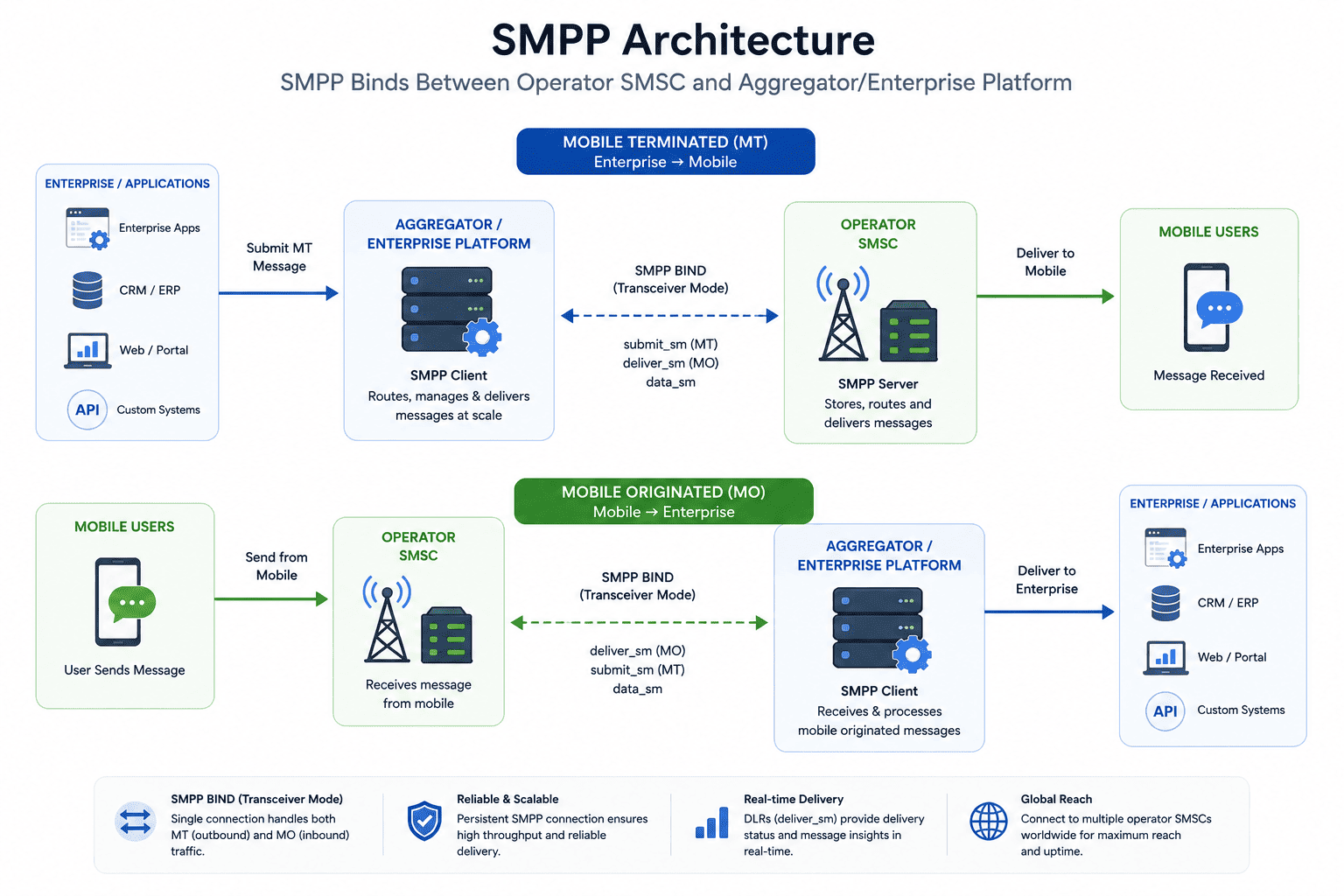
Operators configure SMPP binds between their SMSC and the messaging platforms or aggregators they work with, defining which direction of traffic (mobile originated or mobile terminated) each bind handles. Mobile originated (MO) traffic, meaning messages sent from the customer’s handset, needs to be routed correctly back to the enterprise or aggregator that owns that conversation, rather than getting dropped at the network edge.
This is also where bilateral routing agreements and interconnect settlement come into play. When a reply crosses networks, for example a customer on one carrier replying to a business using a number provisioned through a different carrier, the operators involved need routing agreements that specify how that mobile originated traffic gets handed off and how the interconnect is settled.
Operators also have to manage grey routes and SIM box fraud, both of which threaten the integrity of two way SMS. A grey route bypasses standard interconnect agreements to cut costs, which can break DLR accuracy and inbound routing entirely. This is one of the operational reasons TeleOSS’s SMS Gateway Software includes route validation and monitoring as part of its core routing logic, so operators can confirm that both outbound and inbound legs of a conversation are actually passing through legitimate, agreed routes rather than routes that look cheap on paper but fail silently on delivery or reply handling.
Two Way SMS Use Cases for Enterprises
Customer support:
Retail and telecom customer service teams use two way SMS to let customers text a question and get a human or bot reply without opening an app. This works especially well for support tickets that do not require a phone call, like a billing question or a delivery status check.
Appointment and delivery confirmations:
Healthcare providers, logistics companies, and service businesses send a proposed time and ask for a simple reply to confirm or reschedule. This cuts down on no shows without requiring a phone call from either side.
Two way SMS marketing:
Instead of a one directional promotional blast, a retailer might text “Reply SIZE for your size recommendation” and route replies into a personalized follow up sequence. This turns a broadcast into a conversation, which tends to produce meaningfully higher engagement than a static promotional text.
Fraud and authentication alerts:
As described earlier, banks and fintech platforms use two way SMS to let customers confirm or deny suspicious activity directly by reply, which is faster than routing them to a call center.
Field service coordination:
Utility and telecom field teams use two way SMS to send job assignments and let technicians reply with status updates (EN ROUTE, ARRIVED, COMPLETE) that update a dispatch system in real time.
Benefits of Two Way SMS Marketing
Two way SMS marketing tends to outperform one way campaigns on engagement, mainly because it asks the customer to participate rather than just receive.
Aggregated benchmarks from multiple 2025 to 2026 industry reports place SMS response rates around 45%, compared to roughly 6% for email, and click through rates in the high teens to mid thirties percent depending on industry and message type. It is worth noting that the widely cited 95 to 98% “open rate” for SMS is really a delivery rate, since SMS has no read tracking pixel the way email does. Response rate and reply behavior are the more honest engagement signals for two way campaigns specifically.
Beyond raw engagement numbers, two way SMS marketing produces something one way campaigns cannot: a data trail of what the customer actually wants. A “Reply A for menu, B for sizing help” style campaign tells you something about customer intent that a passive click never will, and that data can feed segmentation for future campaigns.
Limitations and Challenges
Two way SMS is not free of trade offs, and enterprises evaluating it should know these upfront.
Message length and formatting constraints:
Standard SMS is limited to 160 characters using GSM 7 bit encoding, or 70 characters if the message includes characters that require UCS 2 encoding, such as emoji or non Latin scripts. Longer messages get sent as concatenated SMS, which splits the message into segments and can affect both cost and how naturally a reply threads back.
Throughput limits:
Every number and connection has a TPS (transactions per second) or MPS (messages per second) cap. High volume two way campaigns need to plan around this, especially during peak periods like flash sales, or messages queue and delivery timing suffers.
Regulatory compliance overhead:
In the US, A2P traffic on 10DLC numbers generally requires campaign registration through The Campaign Registry (TCR). Unregistered or improperly categorized campaigns risk being filtered or blocked by carriers. Requirements and enforcement details vary and should be verified against current TCR and carrier guidance before launch, since this is an area that changes.
Inbound spam and abuse:
Any number that accepts replies is also a target for spam and abuse attempts. Platforms need basic filtering and rate limiting on inbound traffic, not just outbound.
Cost per message:
Two way SMS, particularly on short codes with high throughput, generally costs more per message than one way bulk SMS on long codes. This needs to be weighed against the higher engagement it typically produces.
How to Choose a Two Way SMS Platform
The right platform depends heavily on your traffic volume, technical resources, and whether you are an enterprise buyer, an aggregator, or an operator.
| Criteria | What to Check | Why It Matters |
| Integration method | SMPP support for high volume, HTTP API for simpler apps | Determines integration effort and throughput ceiling |
| Number types supported | Long code, short code, toll free | Affects cost, throughput, and how fast you can launch |
| Inbound routing logic | Keyword matching, session mapping, CRM integration | Determines whether replies land where they should |
| Compliance tooling | Automatic STOP/HELP handling, TCR registration support | Reduces risk of carrier filtering or regulatory issues |
| Delivery reporting | Real time DLRs, reply tracking | Needed to measure actual two way engagement, not just sends |
| Route quality | Direct carrier connections vs grey routes | Impacts both delivery and inbound reply reliability |
| Scalability | Documented TPS/MPS limits, failover routing | Matters once you move past pilot volume |
For enterprises that need a full conversational layer rather than just raw message routing, a purpose built two way SMS chat platform adds structured conversation views, agent handoff, and reply automation on top of the underlying gateway. For telecom operators and SMS aggregators managing multiple enterprise clients, wholesale grade infrastructure with least cost routing and failover becomes the more relevant evaluation criteria, since reliability across many simultaneous two way conversations depends on route quality as much as the application layer.
Best Practices for Running Two Way SMS
Register your number and campaign before launch:
Whether that means short code approval, toll free verification, or 10DLC campaign registration, do this before sending live traffic. Retroactive registration after carriers flag traffic causes delays that are hard to recover from during a live campaign.
Set clear expectations in your first message:
Tell the customer what to reply and what happens next. “Reply YES to confirm” performs better than an open ended message expecting free text, especially for automated workflows.
Build a fallback for unmatched replies:
Not every reply will match a keyword. Route anything unrecognized to a human agent or a default response rather than letting it disappear silently.
Monitor DLRs actively, not just send confirmations:
A message that fails to deliver is a reply you will never get. Treat delivery failure as an operational metric, not just a technical log entry.
Test throughput under real conditions:
A platform that handles 50 messages per second in testing may behave differently at 500 during a live campaign. Load test with realistic volume before a major launch.
Common Mistakes to Avoid
Using a shared or unregistered number for two way campaigns:
This is the single most common setup mistake. Shared numbers are typically not configured for reliable inbound routing, which means replies get lost even if the outbound message worked fine.
Ignoring opt out compliance:
Failing to honor STOP requests automatically is both a compliance risk and a fast way to damage customer trust. This should be built into the platform, not handled manually.
Treating two way SMS like email:
Long, multi paragraph messages do not translate well to SMS. Messages that require a concatenated SMS chain to explain a simple task usually perform worse than a short, direct message with a clear reply option.
Skipping route quality checks:
Cheaper routing through unofficial or grey routes might look attractive on a rate card, but it frequently breaks DLR accuracy and inbound reply delivery, which defeats the purpose of a two way setup entirely.
Not planning for scale from the start:
Starting on infrastructure that cannot handle projected TPS growth means a forced migration later, often during a period when message volume is already increasing and the team has the least bandwidth to manage a switch.
Conclusion
Two way SMS turns a one directional alert channel into an actual conversation, and for most enterprise use cases, from delivery confirmations to fraud alerts to customer support, that conversation is the entire point. Getting it right depends less on picking a flashy platform and more on the fundamentals: a properly registered number, reliable inbound routing, clean DLR tracking, and route quality that does not quietly break replies in the background.
If you are evaluating infrastructure to support two way SMS at scale, whether as an enterprise building a support workflow, an aggregator managing multiple clients, or an operator handling interconnect traffic, the reliability of the underlying gateway matters as much as the features on top of it. TeleOSS’s SMS Gateway Software and wholesale SMS solution are built around that reliability layer, with support for SMPP and HTTP API integration, least cost and failover routing, and a two way SMS chat platform for teams that need conversation management on top of raw message delivery. You can review the technical documentation or reach out to talk through your specific volume and compliance requirements before committing to a setup.
FAQs
What is the difference between one way and two way SMS?
One way SMS only sends messages from a business to a customer, with no mechanism to receive or route a reply. Two way SMS supports both directions, meaning the business can send a message and receive the customer’s reply back into its system, matched to the original conversation.
Can businesses receive replies to SMS messages they send?
Yes, but only if the sending number and platform are configured for inbound message handling. A dedicated long code, short code, or toll free number connected to a gateway with inbound routing is required. Shared or unregistered sender IDs generally cannot receive replies reliably.
How do telecom operators enable two way text messaging on their networks?
Operators configure SMPP binds to handle both mobile originated and mobile terminated traffic, set up routing agreements for inbound replies that cross carrier networks, and monitor for grey routes that can disrupt delivery reports and reply routing. This typically involves coordination with aggregators or enterprise clients on interconnect settlement and route quality.
What are the best two way SMS platforms for large enterprises?
The right platform depends on volume and integration needs rather than a single universal answer. Enterprises with high throughput requirements typically look for SMPP support, documented TPS limits, real time DLRs, and built in compliance tooling for campaign registration. Smaller deployments may prioritize a simpler HTTP API and a managed conversation interface instead.
How does two way SMS marketing improve customer engagement rates?
By asking the customer to reply rather than just receive, two way SMS marketing creates an active interaction instead of a passive broadcast. Aggregated industry benchmarks from 2025 to 2026 put SMS response rates around 45%, notably higher than typical email response rates, though actual results vary by industry, message type, and list quality.
Does two way SMS work internationally?
Yes, but rules around number types, registration, and messaging content vary by country. Some markets require local number registration or sender ID pre approval, similar in spirit to 10DLC in the US but governed by different regulatory bodies. Enterprises operating across multiple regions should verify local requirements for each market rather than assuming one setup works everywhere.
How much does two way SMS cost compared to one way SMS?
Two way SMS, especially on short codes with higher throughput, generally carries a higher per message cost than bulk one way SMS on long codes. Exact pricing depends on the provider, number type, message volume, and destination country, so specific rates should be confirmed directly with a provider rather than assumed from general benchmarks.