

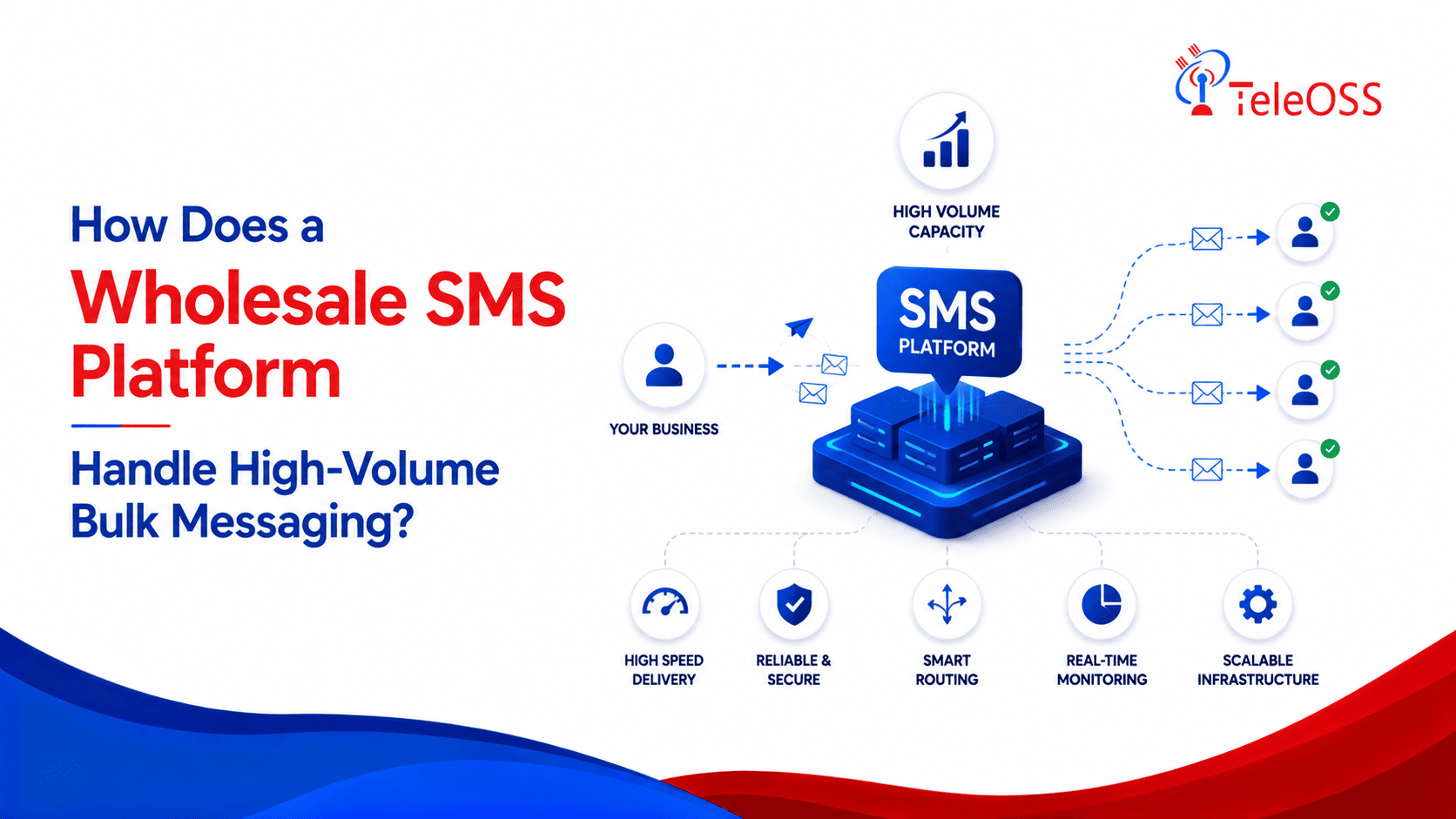
If you send SMS at volume, at some point you outgrow a standard SMS gateway account. That’s usually when the term “SMS wholesale platform” starts showing up in your research. It’s not a rebranded gateway. It’s infrastructure built specifically for buying and selling SMS capacity in bulk, with routing logic, sms billing, and interconnect management layered on top.
This guide explains what a wholesale SMS platform actually does, how it’s different from the gateway most enterprises already use, and what to check before you commit a budget to one. Whether you’re a telecom operator managing outbound traffic, an aggregator reselling capacity, or an enterprise with volume high enough to negotiate directly, the fundamentals below apply.
Quick Answer
A wholesale SMS platform is software that lets telecom operators, aggregators, and large enterprises buy, route, and resell bulk SMS capacity across multiple carrier connections instead of a single gateway account. It manages least cost routing, SMPP connectivity, billing reconciliation, and delivery reporting for high volume A2P traffic. It’s typically used when monthly SMS volume runs into the millions and single-route pricing no longer makes sense.
Key Takeaways
- A wholesale SMS platform manages multiple carrier and aggregator routes at once, choosing the best one per message based on cost, quality, and delivery rules.
- It’s built for volume. Most providers set a practical entry point somewhere in the hundreds of thousands to low millions of messages per month, since the routing and billing overhead only pays off at scale.
- SMPP is the dominant protocol for wholesale connectivity because it supports persistent, high-throughput binds, while HTTP APIs remain more common for lower-volume enterprise integrations.
- Least cost routing (LCR) reduces per-message cost but can affect delivery quality if not paired with route monitoring and grey route filtering.
- Enterprises can access wholesale-grade pricing and routing, usually through an aggregator, though some larger enterprises negotiate direct connections when volume justifies it.
- Route diversity and DLR (delivery report) accuracy matter more than headline pricing when comparing providers, since a cheap route with poor delivery costs more in the long run.
What Is an SMS Wholesale Platform?
An SMS wholesale platform is a software system that lets telecom operators, aggregators, and large enterprises buy and route SMS traffic in bulk across multiple carrier and interconnect partners rather than relying on one fixed gateway connection. It sits between the buyer of SMS capacity and the mobile network operators that actually deliver the message, handling routing decisions, rate management, and settlement.
The word “wholesale” is the operative part. In telecom, wholesale traffic means capacity bought in large blocks, at negotiated rates, for resale or internal high-volume use, rather than retail-style per-message pricing through a single provider. A wholesale platform is the technical layer that makes buying and reselling that capacity manageable instead of a manual spreadsheet exercise.
Example: An SMS aggregator in the UAE might hold SMPP connections to a dozen carriers and sub-aggregators across the Gulf, Africa, and South Asia. Instead of manually deciding which connection to use for a batch of messages headed to Kenya, the wholesale platform evaluates active routes to that destination, checks pricing and recent delivery performance, and assigns the traffic automatically.
How Does an SMS Wholesale Platform Work?
At a basic level, a wholesale SMS platform receives message submissions, applies routing rules, sends the message out through the selected carrier connection, and returns a delivery report. The routing and rules engine is what separates it from a simple gateway.
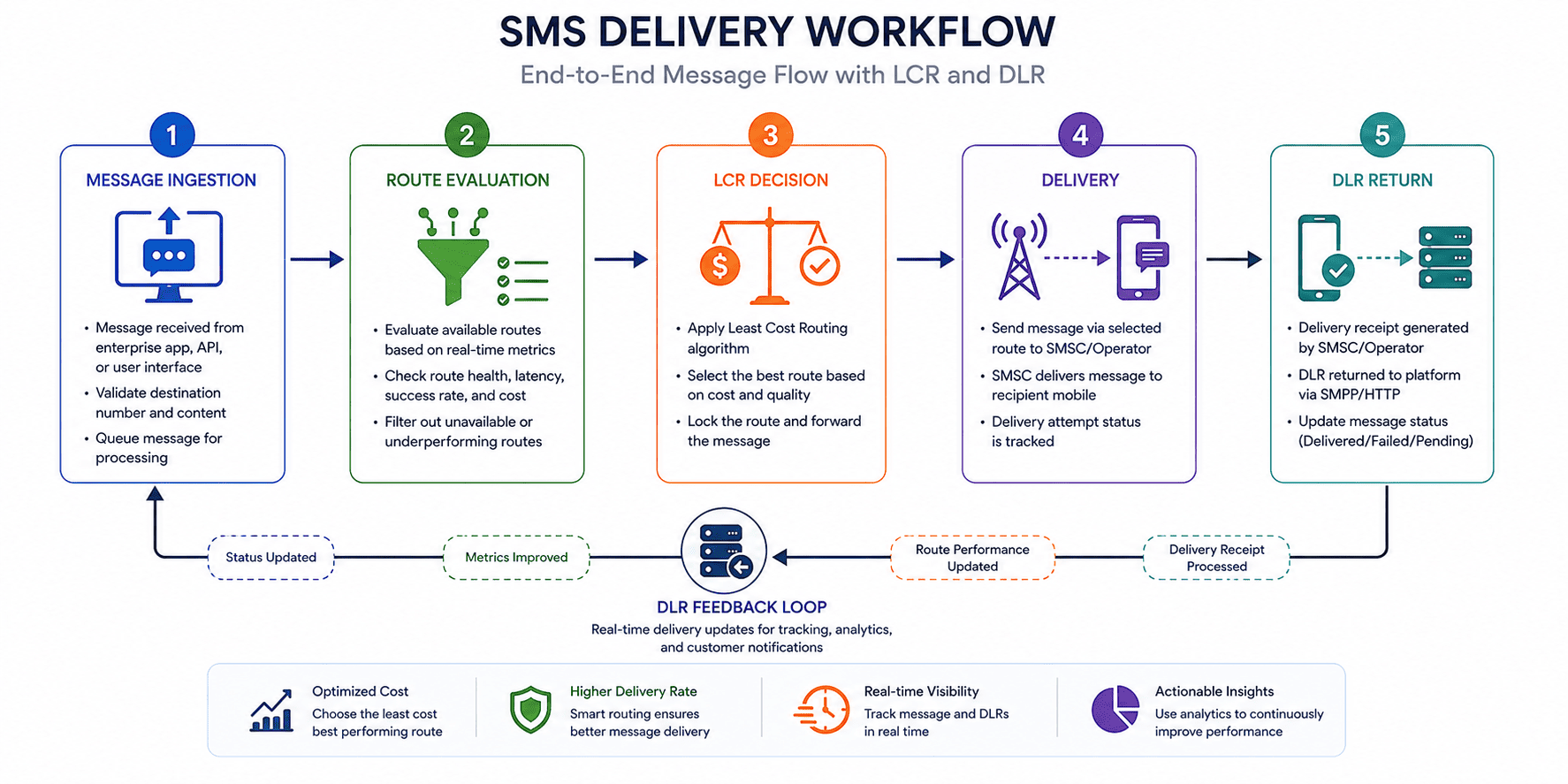
Step 1: Message ingestion
Messages arrive through SMPP binds, HTTP APIs, or file-based batch uploads, depending on how the sender integrates.
Step 2: Route evaluation
The platform checks available routes to the destination country and network, factoring in cost per message, contracted volume commitments, current route quality, and any client-specific routing rules such as preferring direct operator connections for OTP traffic.
Step 3: Routing decision (least cost routing)
Least cost routing (LCR) selects the cheapest viable route that still meets the required delivery and quality threshold for that message type. Some platforms let clients override LCR for sensitive traffic like one-time passwords, where delivery speed and reliability matter more than shaving fractions of a cent per message.
Step 4: Delivery and reporting
The message is submitted to the selected carrier or aggregator. A delivery report (DLR) comes back confirming whether the handset network accepted the message, and this is logged for billing and quality monitoring.
Step 5: Billing and reconciliation
Because wholesale traffic often involves multiple buying and selling relationships, the platform tracks cost per route, revenue per client, and margin, then reconciles this against carrier invoices at the end of the billing cycle.
SMS Wholesale Platform vs SMS Gateway: What’s the Difference?
An SMS gateway connects one sender to one or a small number of carrier or aggregator connections so an application can send and receive SMS. A wholesale platform manages many inbound and outbound relationships at once, with dynamic routing intelligence, rate cards, and settlement built in for resale or high-volume internal use.
| Attribute | SMS Gateway | SMS Wholesale Platform |
| Typical user | Single business sending its own messages | Operators, aggregators, resellers |
| Number of carrier connections | Usually one to a few | Often dozens across regions |
| Routing logic | Minimal, mostly fixed | Least cost routing, quality-based failover |
| Billing model | Flat retail pricing | Tiered wholesale rates, margin management |
| Volume expectation | Thousands to low millions per month | Millions to billions per month |
| Reselling capability | Not typically supported | Core function |
The practical takeaway: if you’re sending your own transactional or marketing SMS and volume is moderate, a gateway is usually the right tool. If you’re buying capacity to resell, or your volume is high enough that route diversity and cost optimization materially affect your margins, a wholesale platform becomes relevant.
Key Features to Look For
Multi-protocol connectivity:
SMPP wholesale connectivity is the backbone for carrier-grade throughput, but HTTP API support matters too, since not every downstream client or aggregator integrates over SMPP.
Intelligent routing engine:
Least cost routing is standard, but look for the ability to set quality thresholds, blacklist unreliable routes automatically, and apply different logic for A2P versus P2P traffic.
Grey route detection:
Grey routes are SMS paths that bypass the intended commercial agreement between operators, often used to undercut pricing illegally. A wholesale platform should support grey route and SIM box fraud detection, since routing traffic through a grey route can violate operator terms and get numbers or accounts blocked.
Real-time DLR handling:
Delivery reports need to be fast and accurate for billing disputes and for clients who depend on confirmed delivery, particularly for OTP and financial alerts.
Multi-currency, multi-tenant billing:
Operators and aggregators serving multiple regions need billing that handles different currencies, tax rules, and client-specific rate cards without manual spreadsheet work.
MCC/MNC based routing rules:
Because pricing and quality vary by mobile country code and mobile network code, not just by country, granular routing at the network level avoids overpaying or under-delivering on specific operators.
Benefits of Using an SMS Wholesale Platform for Bulk Messaging
Lower effective cost per message at scale:
By routing traffic dynamically across multiple carrier agreements, a wholesale platform can bring down blended cost per message compared to a single fixed-rate gateway contract, particularly for cross-border traffic where rates vary widely by destination network.
Route resilience:
If one carrier connection degrades or goes down, traffic can fail over to an alternate route automatically, which matters for time-sensitive messages like OTPs and fraud alerts where a delivery delay has real consequences.
Business model flexibility for aggregators:
A wholesale platform is what makes reselling SMS capacity commercially viable in the first place. Without automated rate management and margin tracking, manually managing dozens of client relationships against dozens of carrier relationships becomes unworkable past a certain size.
Better visibility into delivery performance:
Centralized DLR tracking across all routes gives operators a clearer picture of which carrier relationships are actually performing, information that’s hard to get when traffic is split across disconnected single-route gateway accounts.
Compliance and fraud control at scale:
Centralizing routing also centralizes enforcement. Grey route filtering, SIM box fraud detection, and content filtering can be applied consistently across all outbound traffic rather than per connection.
Example: A regional aggregator handling banking OTPs across three African countries used single carrier connections per country before consolidating onto a wholesale platform. After consolidation, they could apply the same fraud filtering and route failover logic across all three markets from one dashboard, instead of maintaining separate rules and separate monitoring for each country team.
Limitations and Trade-Offs
A wholesale platform is not automatically the right choice, and it comes with real trade-offs worth naming honestly.
It requires volume to justify:
The routing engine, multi-carrier contracts, and billing complexity only pay for themselves once you’re moving enough traffic that cost differences between routes add up to meaningful savings. For a business sending a few hundred thousand messages a month, a good gateway with a solid single provider may be simpler and cheaper to operate.
Aggressive least cost routing can hurt delivery quality:
Chasing the cheapest route on every message, without quality thresholds, can route traffic through less reliable paths. This is a known trade-off in the industry and part of why route monitoring, not just route selection, matters.
Grey routes are a real operational risk:
Some cheaper wholesale routes exist specifically because they bypass proper interconnect agreements. Using them, even unknowingly through an aggregator, can result in messages being blocked, numbers being blacklisted, or contractual disputes with mobile network operators.
Integration and operational overhead:
SMPP binds, rate card management, and multi-carrier reconciliation require technical staff who understand telecom protocols, which is a different skill set than integrating a simple REST API.
Who Actually Uses a Wholesale SMS Platform?
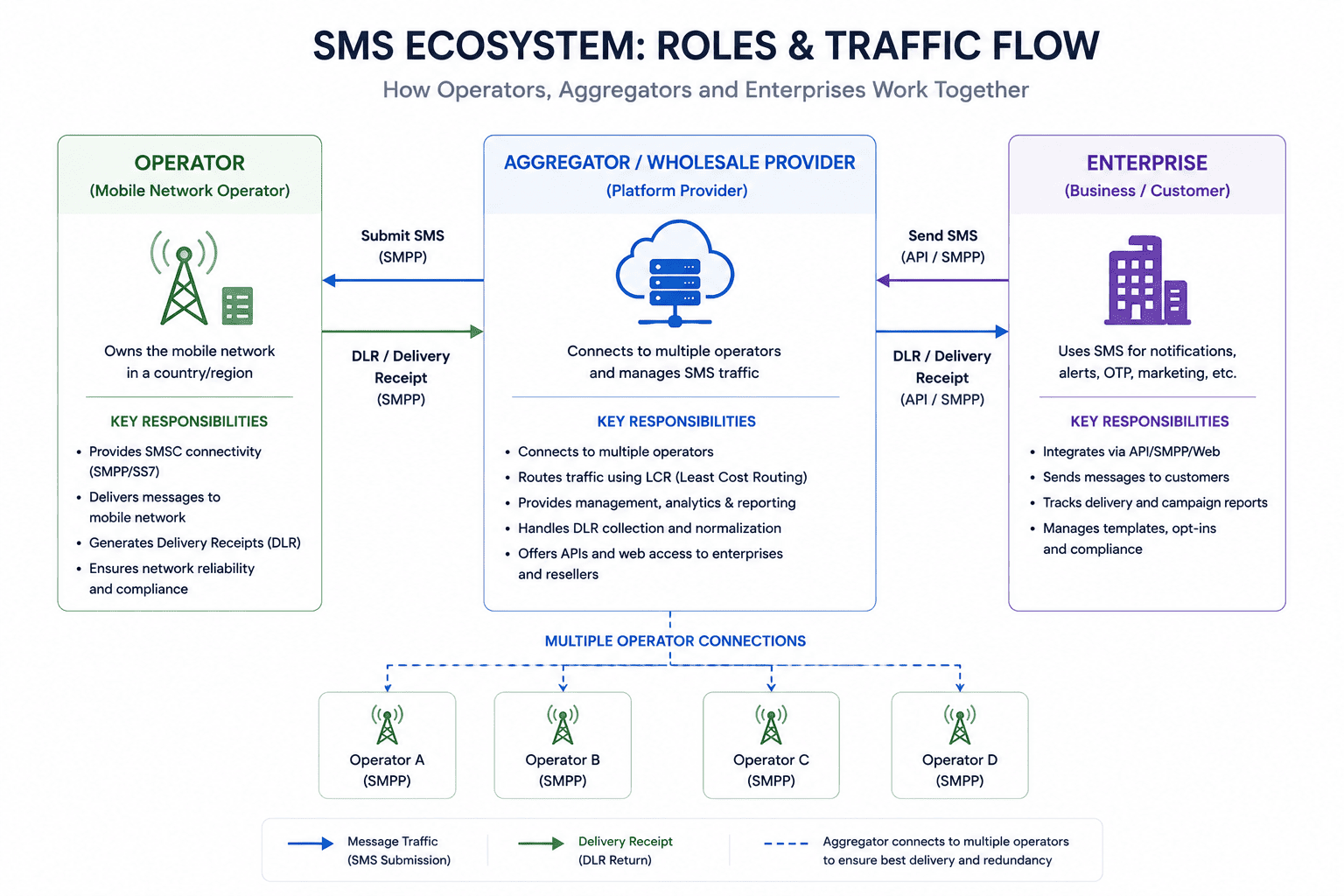
Telecom operators use wholesale platforms to manage outbound A2P traffic from their own network and to monetize excess capacity by selling termination to aggregators.
SMS aggregators are the most natural users, since their entire business model depends on buying capacity wholesale and reselling it to enterprises, often with value-added services like sender ID management or two-way SMS layered on top.
Large enterprises with very high SMS volume, such as banks, telcos’ own enterprise divisions, or e-commerce platforms sending millions of OTPs and notifications monthly, sometimes negotiate access to wholesale-grade routing and pricing, typically still through an aggregator relationship rather than direct operator contracts, since direct interconnects usually require operator licensing that most enterprises don’t hold.
This is a common point of confusion. Enterprises can benefit from wholesale pricing and routing, but they generally access it through a platform provider or aggregator rather than becoming an interconnect party themselves.
SMS Wholesale Platform Pricing: What Affects Cost
Wholesale SMS pricing is not a single number, and any provider quoting one flat global rate is oversimplifying. The following factors are illustrative of what typically drives cost, not actual TeleOSS rates:
- Destination country and network. Rates vary significantly by mobile network, not just by country, since interconnect agreements differ operator to operator.
- Traffic type. OTP and transactional traffic is usually priced differently from marketing traffic, partly because quality and speed requirements differ.
- Volume commitment. Higher committed monthly volume typically unlocks lower per-message rates, similar to any wholesale commodity pricing structure.
- Route quality tier. Direct operator connections generally cost more than routes through intermediary aggregators, but usually offer better delivery guarantees.
- Regulatory fees. Markets with strict A2P registration requirements, such as 10DLC enforcement in the US managed through The Campaign Registry (TCR), can add compliance-related costs that aren’t part of the base per-message rate. [VERIFY current TCR fee structure before publishing, as registration and per-message fees are subject to change.]
If you’re comparing providers, ask for a rate card broken down by destination network rather than a single blended average. Blended rates can hide poor performance on specific corridors that matter to your traffic mix.
How to Choose a Wholesale SMS Platform
Match the decision to your actual role and volume rather than a generic checklist:
If you’re a telecom operator, prioritize interconnect flexibility, SS7 and SMPP protocol support, and the ability to monetize both inbound and outbound capacity.
If you’re an aggregator, prioritize multi-tenant billing, white-label capability, and route management tools that let you manage margin across many client and carrier relationships at once.
If you’re an enterprise, prioritize delivery reliability and reporting transparency over the lowest headline rate. A slightly higher cost per message with 98% first-attempt delivery is usually cheaper in total cost than a lower rate with retries and failed deliveries.
Across all three groups, verify: SMPP bind capacity, route count and diversity to your key destinations, DLR accuracy, grey route and fraud filtering, and whether pricing is transparent by network or only offered as a blended average.
Common Mistakes to Avoid
- Choosing purely on lowest advertised rate: The cheapest quoted rate often reflects the cheapest available route at quote time, not the route your actual traffic will use once volume and destinations are factored in.
- Ignoring route quality monitoring: Setting up least cost routing once and never revisiting it lets route quality degrade silently, since carrier performance changes over time as interconnect agreements shift.
- Underestimating compliance requirements: Markets like the US with TCR and 10DLC registration, or India with TRAI’s DLT framework, have specific compliance steps that affect both deliverability and legal exposure if skipped.
- Treating all traffic the same: OTP, marketing, and transactional alerts have different tolerance for delay and cost trade-offs. Routing them identically usually means either overpaying for marketing traffic or under-serving time-sensitive OTP traffic.
Best Practices for Bulk Messaging at Scale
- Segment routing rules by traffic type, not just by destination.
- Review route performance monthly, not just at contract renewal.
- Maintain at least two viable routes per key destination network to avoid single points of failure.
- Keep delivery report data long enough to support billing disputes and quality audits.
- Confirm registration and compliance status (10DLC, TRAI DLT, or regional equivalents) before scaling volume into a new market.
Conclusion
A wholesale SMS platform earns its place once volume, route diversity, and margin management stop being something you can track manually. It’s the layer that turns bulk SMS from a single vendor relationship into a managed, multi-carrier operation with routing logic, compliance controls, and billing built for scale. The right choice depends less on finding the platform with the lowest advertised rate and more on matching route quality, protocol support, and compliance handling to how you actually operate, whether that’s as an operator monetizing capacity, an aggregator reselling it, or an enterprise sending at a volume where reliability matters as much as cost.
If you’re evaluating infrastructure for bulk messaging or wholesale SMS routing, TeleOSS builds SMS gateway software and wholesale connectivity tools for operators and aggregators managing this kind of traffic. You can review the technical capabilities on the TeleOSS site and compare them against the criteria in this guide before making a decision.
FAQs
What is the difference between an SMS wholesale platform and an SMS gateway?
An SMS gateway connects a single sender to one or a few carrier connections for sending and receiving messages. A wholesale platform manages many carrier and aggregator relationships at once, with routing logic, rate cards, and billing built for resale or very high internal volume.
How much does a wholesale SMS platform cost for operators?
Cost depends on destination networks, traffic type, volume commitment, and route quality tier, so there’s no single standard rate. Providers typically quote per-network rate cards rather than one flat global price, and any pricing figures without that breakdown should be treated as illustrative rather than final.
Can enterprises use a wholesale SMS platform directly or only through aggregators?
Most enterprises access wholesale-grade pricing and routing through an aggregator or platform provider rather than a direct operator interconnect, since direct interconnects typically require telecom licensing. Very high-volume enterprises sometimes negotiate closer to wholesale terms, but the technical connection still usually runs through an aggregator’s infrastructure.
What routing protocols do SMS wholesale platforms typically use?
SMPP is the dominant protocol for high-volume wholesale connectivity because it supports persistent binds and high throughput. HTTP APIs are also supported for clients or partners that don’t need SMPP-level connection control.
Is TeleOSS a wholesale SMS platform for telecom operators and aggregators?
TeleOSS provides SMS gateway software and wholesale SMS infrastructure designed for telecom operators and aggregators managing bulk A2P messaging, including routing and connectivity components relevant to wholesale traffic. Specific feature availability should be confirmed directly with TeleOSS for your use case.